The first thing you have to understand about Kerry James Marshall's paintings is that the darkness of the figures is not a metaphor. It is a pigment decision. The people in his paintings — the women in beauty salons, the couples in parks, the children in housing project courtyards, the figures attending to the ordinary pleasures and difficulties of everyday Black life in America — are painted an extremely deep, rich, saturated black. Not the kind of black that suggests darkness or shadow. Not the kind of black that is actually a very dark brown with ambient light playing across it. A black that is absolute, that asserts itself, that refuses to resolve into something more comfortable. He has said that if you are going to paint a Black person, you have to be willing to really make them BLACK. The word in capitals is his. The argument behind it has been the central formal and political act of his career.
Marshall was born in 1955 in Birmingham, Alabama, and grew up in the Watts neighborhood of Los Angeles — a biography that contains, in its geography alone, two of the most charged sites in twentieth-century American history: the civil rights front lines of the Deep South, and the neighborhood that burned in 1965 in an uprising that the country spent years trying to understand and has never fully reckoned with. He is seventy now, and he has been making paintings since the early 1980s, and in that time he has built one of the most coherent and formally ambitious bodies of work in American art. The coherence is not the coherence of an artist who found something and stayed with it out of habit. It is the coherence of an artist who knows exactly what the project is, who has thought about it from every angle, who has been saying the same thing for forty years because the thing that needs to be said has not yet been heard with sufficient clarity.
What the black means
The decision about pigment is the beginning of everything in Marshall's practice, and it is worth staying with it longer than the explanations usually allow. The conventional account — that he paints his figures very dark as a political statement about representation, as a refusal to soften Black identity for white comfort — is accurate as far as it goes, but it makes the decision sound more programmatic than it is, more like a manifesto than a formal choice. The paintings are not illustrations of a position. They are the position itself, arrived at through the paint.
What the deep black does, formally, is several things at once. It makes the figures assert themselves against any background with unusual force. They are not receding. They are not blending. They are present in the way that a very dark shape against a lighter field is present: insistently, without apology, taking up the visual space they occupy without asking permission to occupy it. This is one meaning. Another is that the deep pigment makes the figures visually unified in a way that lighter, more modulated skin tones are not — the face and the hands and the body read as a single, coherent form rather than as a collection of subtle variations. This gives the figures a quality of self-containment, of completeness, that is the opposite of the fragmentation and reduction that characterizes so much of the tradition's treatment of Black figures when they appeared in it at all.
A third meaning is the one Marshall has articulated most directly: if you are going to paint Black people into a tradition that has consistently painted them out, you do not do it by making them look like what the tradition was comfortable with. You do not do it by softening the blackness into something more palatable to eyes trained on centuries of work that rarely included it. You do it by making the blackness so complete and so beautiful and so formally confident that the tradition has no choice but to make room for it. The paintings do not ask for inclusion. They assume it. And then they make it undeniable.
Growing up in Watts
Marshall moved from Birmingham to Los Angeles when he was eight, arriving in Watts in 1963, two years before the neighborhood would enter history in a way that the country has been arguing about ever since. Growing up there in the years after the uprising — in a neighborhood that had been simultaneously the site of one of the most significant events in postwar American history and consistently underrepresented in the culture that claimed to be processing that history — gave him something that is visible in everything he has made since: the absolute conviction that ordinary Black life is worth the full gravity and attention that the Western painting tradition reserves for kings and myths and allegories of power.
The parks in Watts, the beauty salons, the community gardens, the housing project courtyards where children played — these were not picturesque subjects waiting to be discovered. They were the substance of a life being lived at the intersection of history and the everyday, and the fact that the tradition had not painted them was not evidence that they were not worth painting. It was evidence about the tradition. Marshall understood this early, and it organized everything that came after.
He studied at Otis College of Art and Design in Los Angeles, where he encountered the Western painting tradition in its full pedagogical weight — the Old Masters, the genres, the hierarchy of subjects, the technical conventions that had been developed over centuries to represent certain kinds of scenes and certain kinds of people with the full resources of the medium. He absorbed all of it. And then he began the lifelong project of redirecting it.
The tradition he entered and the one he built
Marshall is one of the most deeply literate painters working in America today in the sense that matters most: he knows the history of painting, knows it in his hands and not just in his head, and every significant decision in his work is made in full awareness of what the tradition has done and what it has refused to do. The references are everywhere, and they are not allusions for the benefit of the art historically educated. They are structural. They are the argument.
When Marshall paints a couple reclining in a park, he is working within the tradition of pastoral painting — the picnic, the leisure scene, the figures in landscape that runs from Giorgione through Manet through the entire history of the genre. When he paints beauty salon interiors, he is working within the tradition of genre painting: the scenes of everyday life elevated by craft and attention into something that the culture agrees to call art. When he makes paintings that reference the conventions of history painting — the monumental scale, the formal composition, the gravity of address — he is placing the subject matter of his paintings into the mode that the tradition reserved for its most serious statements about human experience. He is not parodying these traditions. He is using them, with complete technical command, for subjects they were designed to exclude.
The result is a body of work that is simultaneously inside the Western painting tradition and a reckoning with it. The paintings belong to the lineage — formally, technically, historically — in a way that cannot be disputed. And their belonging makes visible, with unusual clarity, the cost of the exclusion. If these paintings look like they were always supposed to be there — in the museums, in the canonical histories, alongside the Vermeers and the Holbeins and the Copleys — that is because they were. The tradition's failure to include them was not aesthetic. It was a choice. Marshall is undoing the choice one painting at a time.
"If you're going to make a painting of a Black person, you have to be willing to really make them BLACK."
Kerry James MarshallMastry
The retrospective Mastry, organized by the Museum of Contemporary Art Chicago and opened there in 2016, then traveled to the Met Breuer and MOCA Los Angeles, was the moment when the broader art world caught up with forty years of work. The title is a word game — mastery, masterly, the practice of the master, the historical status of the Old Masters — and it announced the terms of the survey precisely. This was not a retrospective of an artist who had been operating at the margins of the conversation. It was a retrospective of an artist who had been at the center of the only conversation that mattered, and who had had the patience, over four decades, to wait for the conversation to get large enough to include him.
The critical response was extraordinary. Reviews in every major publication registered not just appreciation for the work but something closer to reckoning — the sense that the art world had been living with a gap it had not fully acknowledged, and that Mastry was making that gap visible. This is what comprehensive retrospectives of major bodies of work can do, when the work is actually there: they do not create a reputation. They reveal one that already existed and that the institutional structures of the art world had been, for various reasons, slow to fully ratify.
What Marshall said about the retrospective, in various interviews at the time, was characteristically measured. The survey mattered, he acknowledged, because scale matters — because seeing forty years of work together in a coherent arc makes an argument that individual exhibitions cannot. But the practice had not changed because of the retrospective. The studio was the same before and after. The question was still the same question. The answer was still accumulating, one painting at a time.
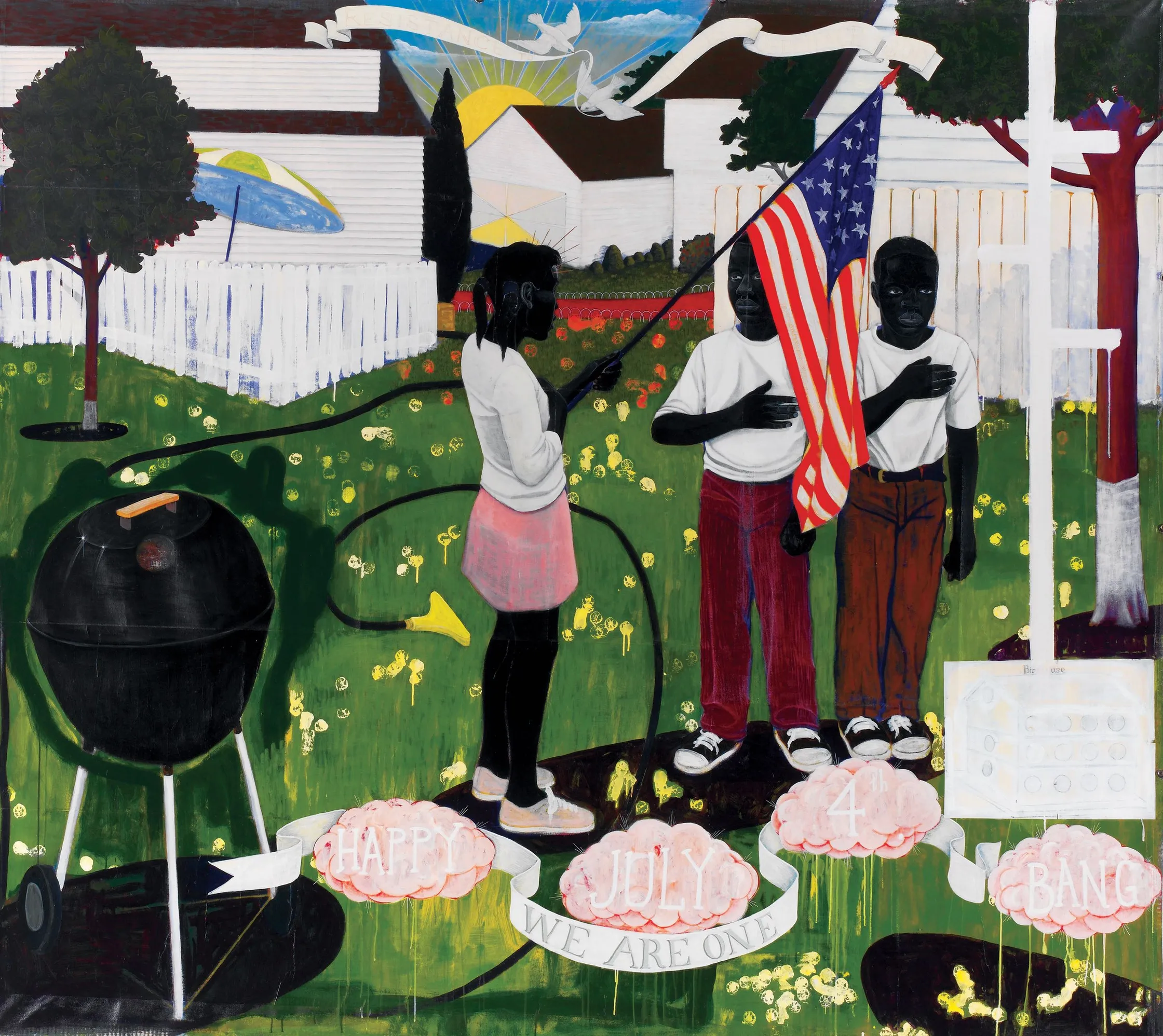
Marshall's “Bang” (1994): an embrace of painting’s age-old narrative function.
Everyday life as history
The subject matter of Marshall's paintings is deliberately ordinary. Parks, beauty salons, housing projects, school scenes, domestic interiors — the settings of everyday Black life in America, rendered with the compositional gravity and technical seriousness of history painting. This is the central formal argument of his career: that there is no meaningful distinction, in terms of what painting should attend to with its full resources, between a scene from the life of Henry VIII and a scene from a Saturday afternoon in a Watts park. The distinction is not aesthetic. It is historical. The tradition made it, and the tradition was wrong, and the paintings correct it without asking for permission to do so.
The housing project paintings are among the most sustained and fully realized expressions of this argument. Marshall has made work set in the Stateway Gardens and Robert Taylor Homes in Chicago — the massive public housing developments that were among the largest in the world during his years in Chicago, and that have since been demolished. He painted them with the attention that the tradition gave to Italian palaces and English country houses. The scale is monumental. The composition is deliberate. The figures are attended to with the care that Dutch genre painters gave to the inhabitants of prosperous Delft interiors. The fact that the subjects are Black residents of a housing project that the city was, even as he painted them, in the process of abandoning and demolishing — this is not ironic. It is the point. These lives are worth the full gravity of the tradition. The tradition's failure to have recognized this earlier is the failure the paintings are correcting.
The beauty salon paintings work differently but make a related argument. Beauty salons have been sites of community, information exchange, and social life in Black American communities for as long as they have existed — spaces with their own particular social texture, their own hierarchies and intimacies and rhythms. Marshall paints them the way Vermeer painted domestic interiors: with loving attention to the quality of light, the particular configurations of figures in space, the sense of a moment of ordinary life that has been granted the dignity of full artistic attention. The argument is not that beauty salons are secretly important in a way that the uninitiated would not suspect. The argument is that their importance was always obvious to everyone who was in them, and that the only question was whether the tradition was paying attention.
The record and what it means
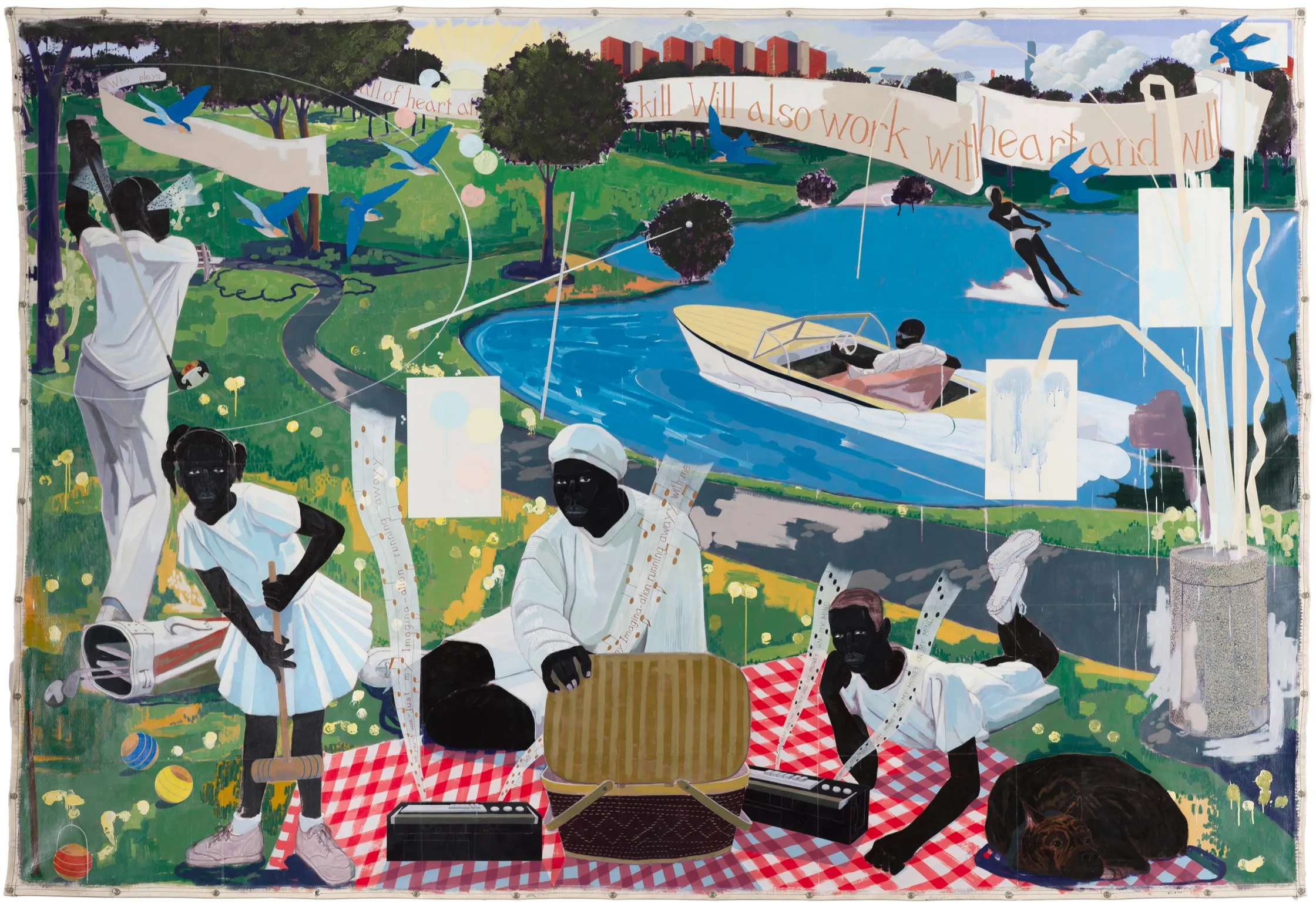
In May 2018, Marshall's 2006 painting Past Times — a large canvas depicting a scene of Black leisure, figures picnicking and water-skiing against a landscape that echoes the conventions of American pastoral painting — sold at Sotheby's New York for $21.1 million, setting a record for a living Black artist at auction. The buyer was Sean Combs. The art world, which has a complicated relationship with auction records, responded with a mixture of celebration, analysis, and the inevitable questions about what the money means and what it doesn't mean.
The record mattered in some ways and did not matter in others, and Marshall has been precise about which is which. The market validation of his work at that scale changes something about how the work circulates and who sees it and what institutional attention it commands. It does not change what the work is. It does not change the studio practice, the formal questions, the ongoing project. The painting that sold for $21 million is the same painting it was before the gavel came down. The argument it makes did not become more correct because of the price.
What the record did do — and this is perhaps the most complicated part of its meaning — is make visible the distance between the work's market value and its historical standing. Marshall had been making major paintings for forty years before the record sale. The work had been in major museum collections, shown in significant institutions, written about by serious critics, for decades. The auction record was not the discovery of something new. It was the market catching up with what was already known, and the catching up happened with the particular violence and clarity that the market brings to everything it touches — all at once, publicly, with a number attached.
The number is not the point. But it is not nothing, either. It is, among other things, evidence. Evidence that the work the tradition spent so long refusing to make — paintings of Black life, made with full command of the tradition's technical resources, insisting on the full humanity and complexity and historical weight of its subjects — is not marginal to the canon. It is not supplementary. It is not a corrective footnote to a story that was already complete. It is the story. It was always the story. Marshall has been painting that story for forty years, in housing projects and beauty salons and parks and on enormous canvases that hold the full gravity of what the tradition was built to carry. The auction room finally said what the paintings had been saying all along: these were always supposed to be here.
"You can't claim the tradition and then leave out the people who were part of making the world it came out of. That's not tradition. That's editing."
Kerry James Marshall