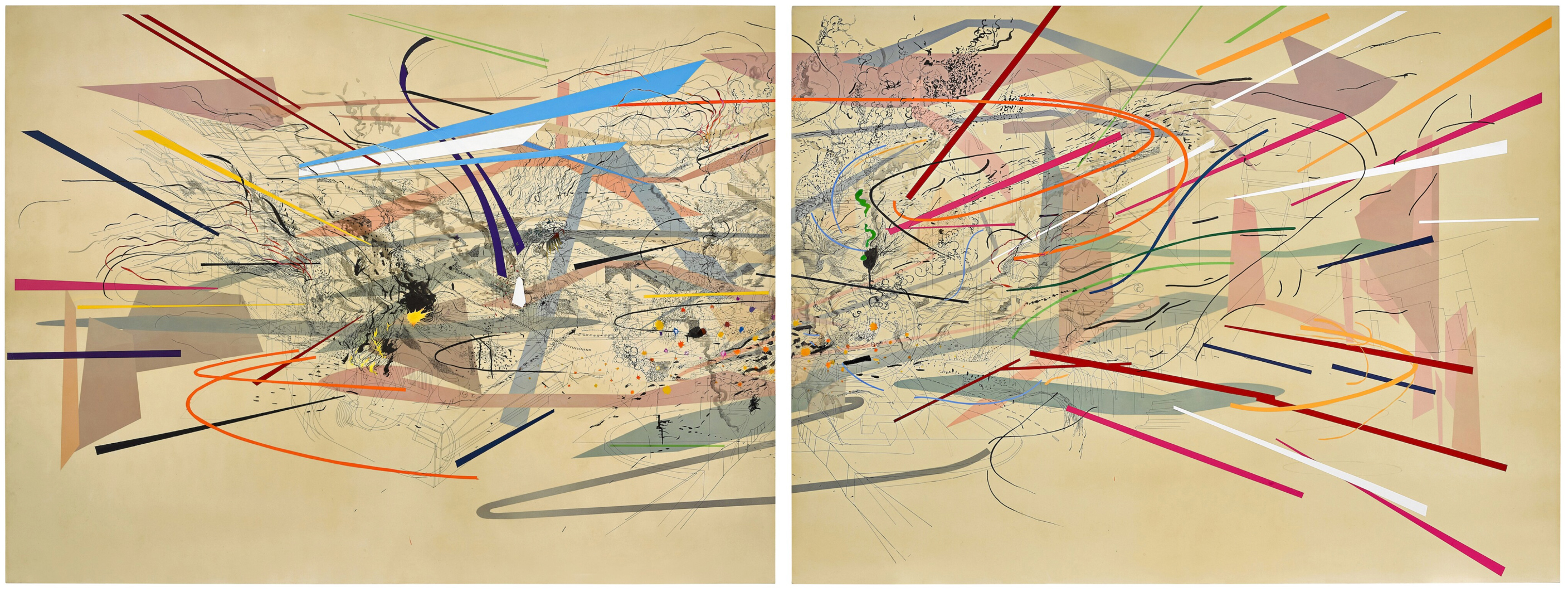
Standing in front of a large Julie Mehretu painting, the first thing you feel is something between joy and vertigo. The marks come at you from every direction — ribbons of white and graphite, explosions of color, thin architectural lines that suggest grids and towers and geometries of control, all of it in motion, all of it simultaneously present. It looks like freedom. It looks like a city seen from altitude, or a universe mid-expansion, or the inside of a mind that processes faster than language allows. It is, by any reasonable measure, beautiful.
The beauty is intentional. And the beauty is a problem.
Mehretu, who was born in Addis Ababa in 1970 and raised in East Lansing, Michigan — daughter of an Ethiopian academic father and an art-teacher mother who moved the family to the United States when she was seven — has spent thirty years building a practice organized around a central formal tension: the paintings look like pure abstraction, unanchored and free, but they are dense archives. Under and inside the swirling marks are layers of projected imagery: architectural blueprints of demolished buildings, displacement maps, census data, cartographic documents of power. She paints over these layers and around them and through them until what remains is not quite the source material and not quite not the source material. It is both, simultaneously — the beauty and what the beauty is made from.
The question the work asks, again and again, across thirty years of enormous canvases, is whether you are paying attention to both.
I. What it's made from
Mehretu's process begins not with paint but with research. For each major body of work, she builds an archive of source images — specific, chosen, historically dense. For Mogamma (2012), her response to the Arab Spring, the source material included architectural drawings of Tahrir Square in Cairo, crowd-density diagrams, protest documentation, and the geometric logic of public spaces designed for control and repurposed for revolt. For HOWL, eon (I, II) (2017), made in direct response to the refugee crisis, the source imagery included displacement maps, migration routes, and the cartographic record of mass movement across sealed borders.
She projects this imagery onto the canvas. She traces some of it. She paints over it. She builds in layers — sometimes four or five deep — until the original source material is visible only in the ghost of a line, a faint architectural edge beneath an explosion of color, a grid that persists beneath the gestural marks like a skeleton under skin. The finished painting looks like pure abstraction. It is not pure abstraction. It is abstraction built from evidence.
"The paintings look like joy. They are built from the sediment of catastrophe, and the fact that they look like joy is part of what they're saying."
This matters because of what it asks of the viewer. You can stand in front of a Mehretu and feel only the rush of the marks, the beauty of the color, the kinetic energy that turns the whole surface into weather. Many people do. The paintings reward that experience. They are, on purely formal terms, among the most exhilarating large-scale abstract works being made by any painter alive.
But Mehretu is not making formal exercises. She is making documents. The source material is still there, compressed, legible to anyone who looks closely enough and knows what to look for. The archives are inside the paintings. The paintings are about what we do with the record of catastrophe — whether we let it remain legible or whether we paint over it with something so beautiful that we stop asking what's underneath.
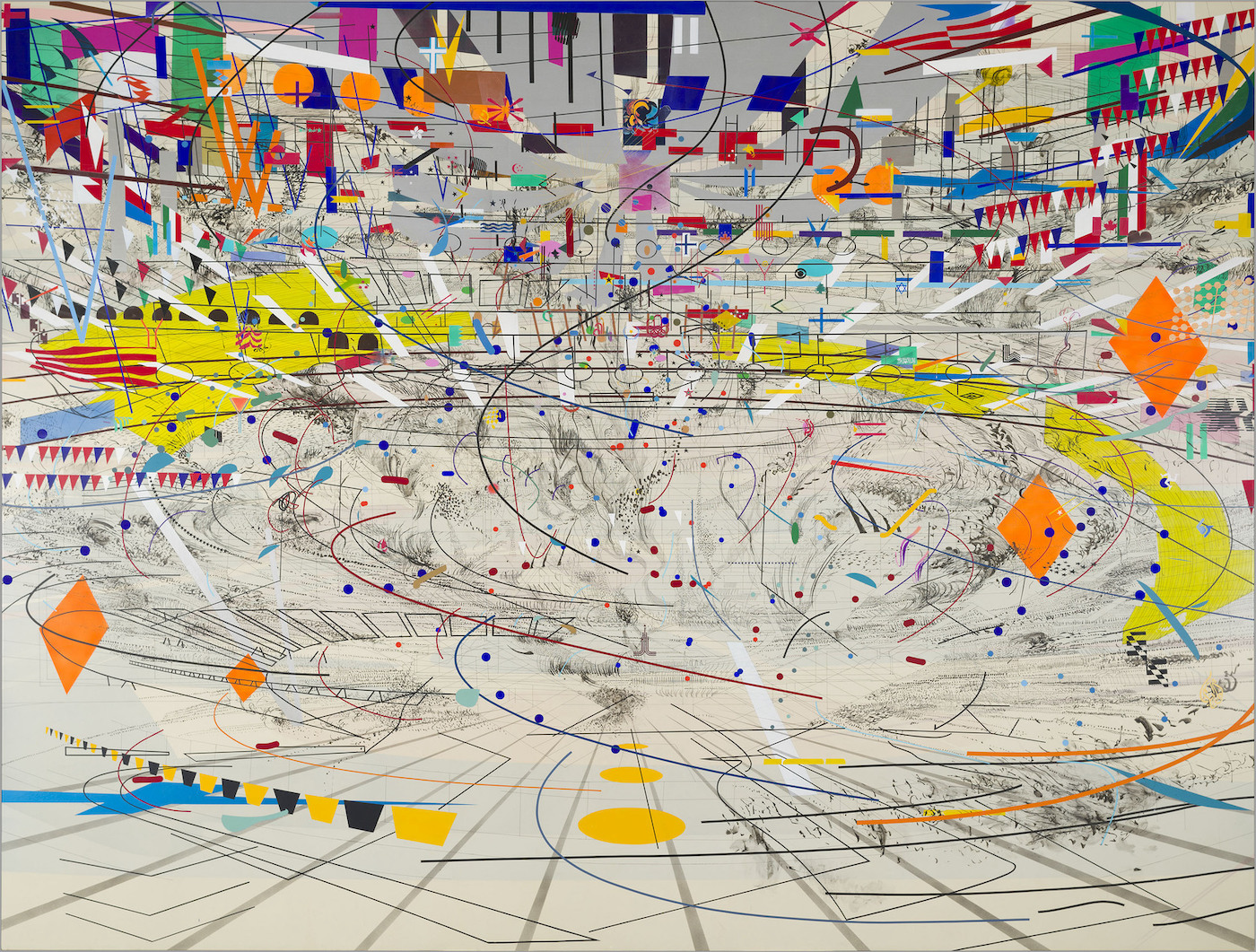
Julie Mehretu, Stadia II, 2004. Ink and acrylic on canvas. 108 × 144 inches. Collection Carnegie Museum of Art, Pittsburgh. © Julie Mehretu.
II. The Stadia series and what it knew early
The work that first established Mehretu's critical reputation — the Stadia series, made between 2002 and 2004 — operates on a slightly different register than the later work, but it announces all the major themes with unusual clarity, as if she were making explicit what she would later learn to bury deeper.
The source material for the Stadia series is sports arenas: their architectural plans, their geometric logic of mass gathering, their particular arrangement of bodies in space. The paintings are enormous, and they carry the blueprints of these structures as visible armatures — not quite hidden, not quite foregrounded, present as a kind of skeleton under the gestural explosion of the surface. You can read the stadium plans in the works. You can see the concentric arcs of seating tiers, the radial logic of crowd management, the geometry of a space designed to move thousands of people efficiently and direct their collective attention toward a predetermined center.
Sports arenas are interesting architectural objects precisely because they are designed, with complete transparency, to aggregate human energy and channel it. The geometry is totalizing, and it is totalizing in a way that feels like freedom — the freedom of collective experience, of being part of something larger than yourself, of the roar of a crowd that your individual voice joins and can no longer distinguish from. You sit where you're told to sit. You look where you're directed to look. The architecture of belonging is also the architecture of compliance. Mehretu was looking at this in 2002 with the specific clarity of someone who had grown up between two cultures — between Addis Ababa and East Lansing, between the Global South and the American Midwest — and who therefore carried a particular sensitivity to the architectures of belonging and exclusion, the systems that decide who is inside and who isn't.
Stadia II (2004), now in the Carnegie Museum of Art's permanent collection, is among the most fully realized works of her early career. Standing in front of it, you feel the familiar Mehretu rush — the marks, the depth, the sense of a world in controlled detonation. Then you begin to see the stadium plans behind it, and the painting reorganizes itself around a different center of gravity. The beauty does not disappear. The discomfort arrives alongside it, and stays.
Berliner Plätze (1998) — Early career paintings built on architectural plans of Berlin public squares, beginning the formal methodology she would develop for the next thirty years.
Stadia II (2004) — Carnegie Museum of Art. Stadium blueprints as the armature for a meditation on mass gathering, collective energy, and the geometries of social control.
Mural (2009) — Goldman Sachs headquarters, New York. Permanent commission, eighty feet wide. The largest single public statement of her career, and the one that raises the most questions.
Mogamma: A Painting in Four Parts (2012) — MoMA collection. Response to the Arab Spring; source material includes architectural drawings of Tahrir Square and crowd-density maps.
HOWL, eon (I, II) (2017) — Made directly from the refugee crisis, migration maps, and the political ruptures of 2016–17. Among her most urgent and least buried works.
Beloved (Siege) series (2020–22) — Made during and in response to the pandemic and the global uprisings of 2020. The archive here includes protest footage and news imagery.
III. Scale as argument
Mehretu's paintings are large. This is understating it: some of her major works are twenty-five to thirty feet wide. The Goldman Sachs headquarters commission is an eighty-foot permanent mural installation. You cannot see these works comfortably. They exceed your visual field at any reasonable viewing distance. To see the full composition, you have to stand back so far that the individual marks lose definition. To see the marks, you have to stand close enough that you lose the composition. There is no position from which the work is fully available to you at once.
This is not a problem to be solved. It is a formal argument.
Mehretu is making paintings that behave the way the systems they document behave: too large to be comprehended from any single position, requiring constant repositioning, never fully available to a viewer who stands still. The experience of standing in front of a major Mehretu is the experience of being unable to take it all in — of knowing that there is more happening in the work than you can hold in your visual field simultaneously. You are made small by the scale in precisely the way that individuals are made small by the systems the work is built from.
There is something almost confrontational in this that the paintings' beauty tends to obscure. A thirty-foot painting that is made from displacement maps does not let you stand comfortably outside the displacement. The scale insists. It says: this is not a document you can hold at arm's length. You are inside it. You have always been inside it.
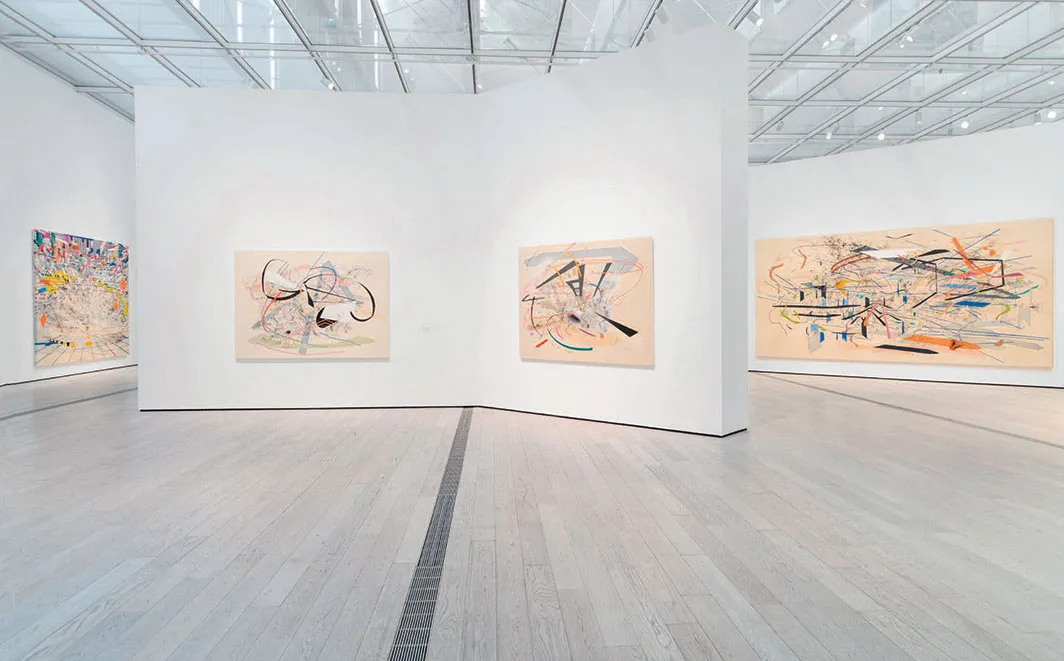
View of Julie Mehretu, 2019–20, Los Angeles County Museum of Art. From left: Stadia II, 2004; Babel Unleashed, 2001; Untitled 2, 2001; Retopistics: A Renegade Excavation, 2001. The traveling retrospective marked thirty years of her practice.
IV. The Goldman Sachs question
The commission that gets the most attention — and produces the most discomfort, for those willing to sit with it — is "Mural" (2009), the permanent work Mehretu made for the lobby of Goldman Sachs's new downtown Manhattan headquarters. It is eighty feet wide. It is among the most formally ambitious paintings she has ever made. It is also, by any reasonable analysis, inside one of the major architectures of global financial power.
Mehretu was commissioned by Goldman Sachs to make permanent work for their headquarters — work that would be seen daily by the employees and visitors of an institution that is, at minimum, adjacent to the forces her paintings are built from. She took the commission. The question is what she did with it.
"She painted for Goldman Sachs the same thing she paints for museums: a document of power so beautiful that power itself has trouble recognizing the portrait."
One reading: Mehretu made beauty for an institution that produces the conditions her paintings document, and in doing so implicated herself in those conditions. Another reading: she painted for Goldman Sachs exactly what she paints for the Whitney and SFMOMA — a document of power so beautiful that power itself has trouble recognizing the portrait. Both readings are available. The work does not resolve them. That is, arguably, the point: a painting that holds this kind of contradiction without resolving it is doing something more honest than one that resolves it cleanly in either direction.
There is a third reading that is harder to dismiss: the paintings are genuinely antagonistic to the institutions and systems that have embraced them, and the embrace does not neutralize the antagonism. The displacement maps do not become neutral because they hang in a financial lobby. The refugee routes do not become aesthetic objects because a major museum buys them. The archive is still active. The sources are still accumulating. What Mehretu is doing — burying the evidence inside the beauty, forcing the institutions that celebrate the beauty to also house the evidence — may be the most subversive institutional relationship in contemporary painting. Or it may be the oldest story in the art world: the radical absorbed by the system it critiques. The work refuses to tell you which.
V. The retrospective and its limits
The retrospective organized by SFMOMA in 2019, which traveled to the Whitney in 2021, gave Mehretu's work the institutional weight it had long deserved. The scale of the survey — spanning thirty years of production, from the early Berliner Plätze works through Mogamma and into her most recent large-scale abstractions — made the argument for her place in the lineage of American painting more fully than any previous treatment of her work.
The catalog essays were excellent. The hanging was thoughtful. The presentation gave viewers everything they needed to understand the formal logic of the work and its historical and political dimensions. By the art world's own metrics, this was the retrospective done right.
What the retrospective also did — without necessarily intending to — was reveal the ways in which institutional celebration can be its own kind of softening. The SFMOMA and Whitney contexts are not Goldman Sachs; they are not the architectures of financial power. But they are architectures of institutional power, and they are architectures that have historically had specific relationships to who gets shown and whose work gets historicized and which bodies of evidence get preserved and which get painted over. Mehretu's work is about exactly this. The tension between the work and its institutional context is not an embarrassment. It is a continuation of the formal argument the paintings are making — which means the institution is, whatever its intentions, part of the piece.
VI. HOWL and the permanent present
HOWL, eon (I, II) was completed in 2017 and shown at Marian Goodman Gallery in New York. The diptych — each panel enormous, together forming a work that asks to be experienced as an environment rather than an object — was made directly from the political moment: the refugee crisis, the rise of authoritarian nationalism, the feeling in 2016 and 2017 that the present was becoming something that had not yet been named.
The source material is relatively close to the surface here, less buried than in earlier work. The cartographic imagery is more legible — the displacement maps more recognizable, the migration routes more visible through the gestural surface. Looking at it, you feel the archive closer to the skin. The paintings have the quality of news: urgent, raw, not yet resolved into the permanence that art is supposed to provide.
This quality has not aged in the way you might expect. Seven years after its completion, the maps of displacement embedded in the work are not historical. The migration routes are still active. The borders are tighter. The forces that made the work urgent have not resolved into history; they have continued, and in some cases accelerated. HOWL, which was made as a response to a particular moment, has become a document of a permanent condition.
This may be the most uncomfortable thing the work does over time: it refuses to let us put the archive in the past tense. The paintings look like abstraction, which means they look like something that has been processed into art, which means they look like something that has been safely moved into the realm of aesthetic experience and historical distance. They have not. The source material is still active. The archive is still accumulating. Mehretu keeps painting. The storm is not a metaphor for something that happened. It is a description of what is happening now, made in a language beautiful enough that you might stop noticing the weather.
That, finally, is what thirty years of this practice adds up to: a body of evidence that looks like a body of work. The distinction is real. Most painting is one or the other. Mehretu has spent her career insisting that it can be both simultaneously — that the archive and the painting are not in tension but are the same thing, that the history and the beauty are made of each other, that you cannot have the joy without also holding what the joy is built from.
She has made the argument at scale, literally and figuratively, in work that hangs in the lobbies of financial institutions and the galleries of major museums and the permanent collections of the most important art museums in the world. The question is not whether the argument has been made. It has. The question is whether you are looking at it carefully enough to hear it.