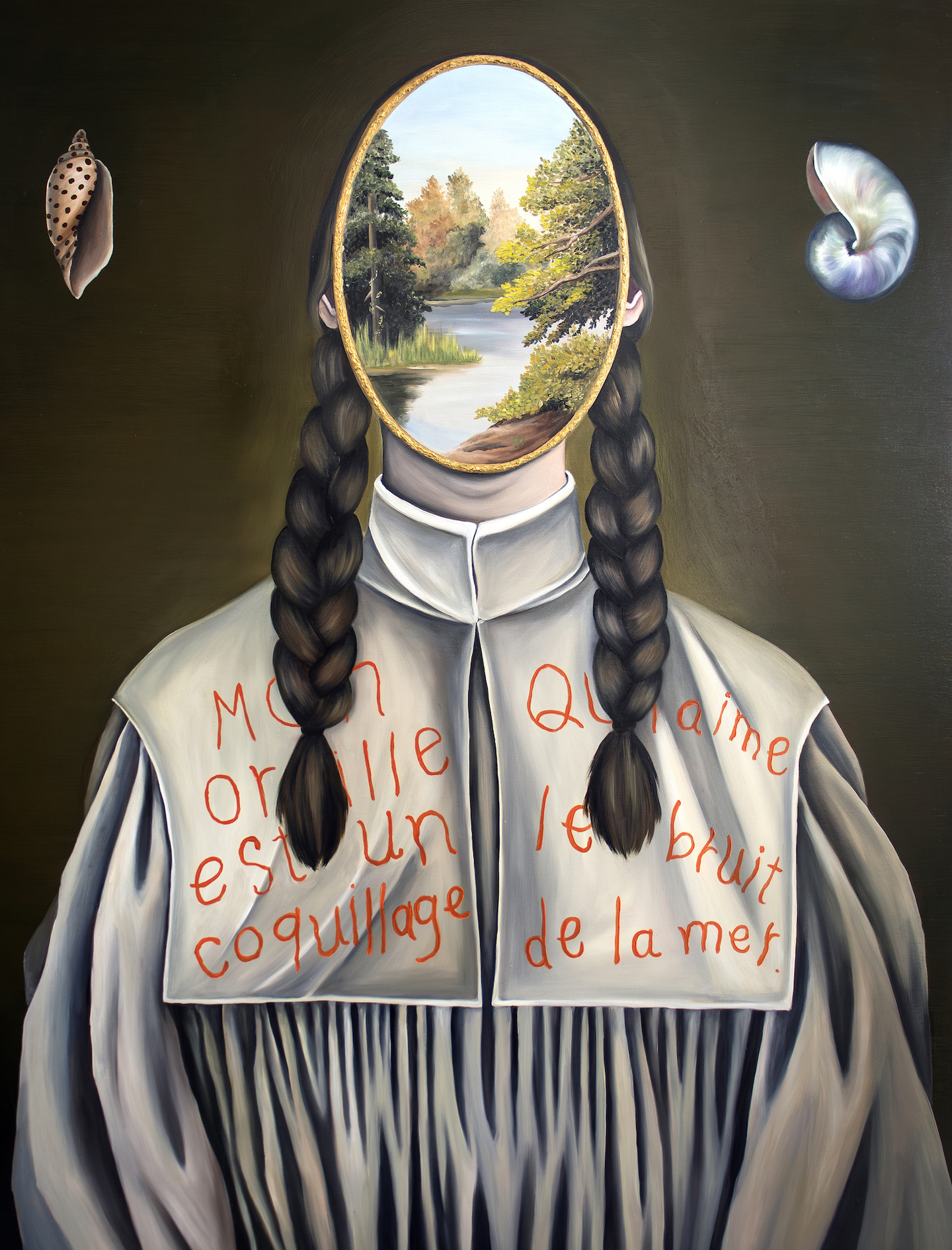
There is a face in every painting Mariko Enomoto has ever made — a head, a neck, shoulders, the suggestion of a person — and in every one of them, the face itself is gone. In its place: a bouquet crowding up from behind a collar, a tangle of vines threading through where cheekbones should be, the dense froth of a peony sitting where a mouth might have been. The person is clearly there. Their face is clearly not. And somehow, inexplicably, you feel like you know them better than if you could see them at all.
Enomoto was born in 1982 in Japan and grew up in an environment that was, by her own account, full of pictures. Her great-grandfather was a nihonga painter — a practitioner of the traditional Japanese painting style that uses mineral pigments, animal glue, and a centuries-old relationship with the natural world as subject. She has said the influence was ambient rather than direct: she didn't study under him, didn't receive formal instruction from anyone for a long time. What she absorbed was something harder to name — a sense that painting was a normal thing to do, that the home could be a place where images were made and lived with.
She went to vocational school to study fashion. This matters more than it might seem. Fashion is a discipline about surfaces and concealment, about the relationship between a body and what it wears, about how what you put on can construct or obscure a self. Enomoto eventually left that field behind and taught herself to paint — acrylic on canvas, starting around 2004 — but the questions she was asking were not so different from the ones fashion asks. What does clothing do to the person inside it? What does a covering reveal? What does it protect?
"The face is the place we search for truth about a person. When it's gone, you have to find that truth somewhere else."
— Mariko EnomotoWhat the flowers are doing
The first thing to understand about Enomoto's work is that the plant material in her paintings is not decorative. It is not background. It is not filler. The flowers and vines and organic forms that replace her subjects' faces are painted with the same attentiveness, the same degree of finish, as everything else in the picture — the collar, the hands, the fabric of a jacket. There is no hierarchy between figure and flora. They have equal claim on the picture's surface.
This creates an immediate disorientation. We come to portraits expecting a face, and we use the face to anchor everything else — to date the picture, to locate its emotional center, to decide whether we trust what we are seeing. Remove the face and the painting has to reorganize itself around whatever replaces it. In Enomoto's work, that is almost always something that grows, something that cannot be controlled, something that has its own logic entirely separate from the logic of portraiture.
The effect is strange and it is not strange. It is strange because the cognitive gap — person, no face — triggers something close to unease, the same mild wrongness that makes dreamscapes feel off even when nothing overtly terrible is happening. It is not strange because Enomoto paints the substitution as if it is entirely natural, as if flowers have always lived there, as if this is simply what a face looks like. The painting offers no explanation. It does not consider the situation unusual. And gradually, neither do you.
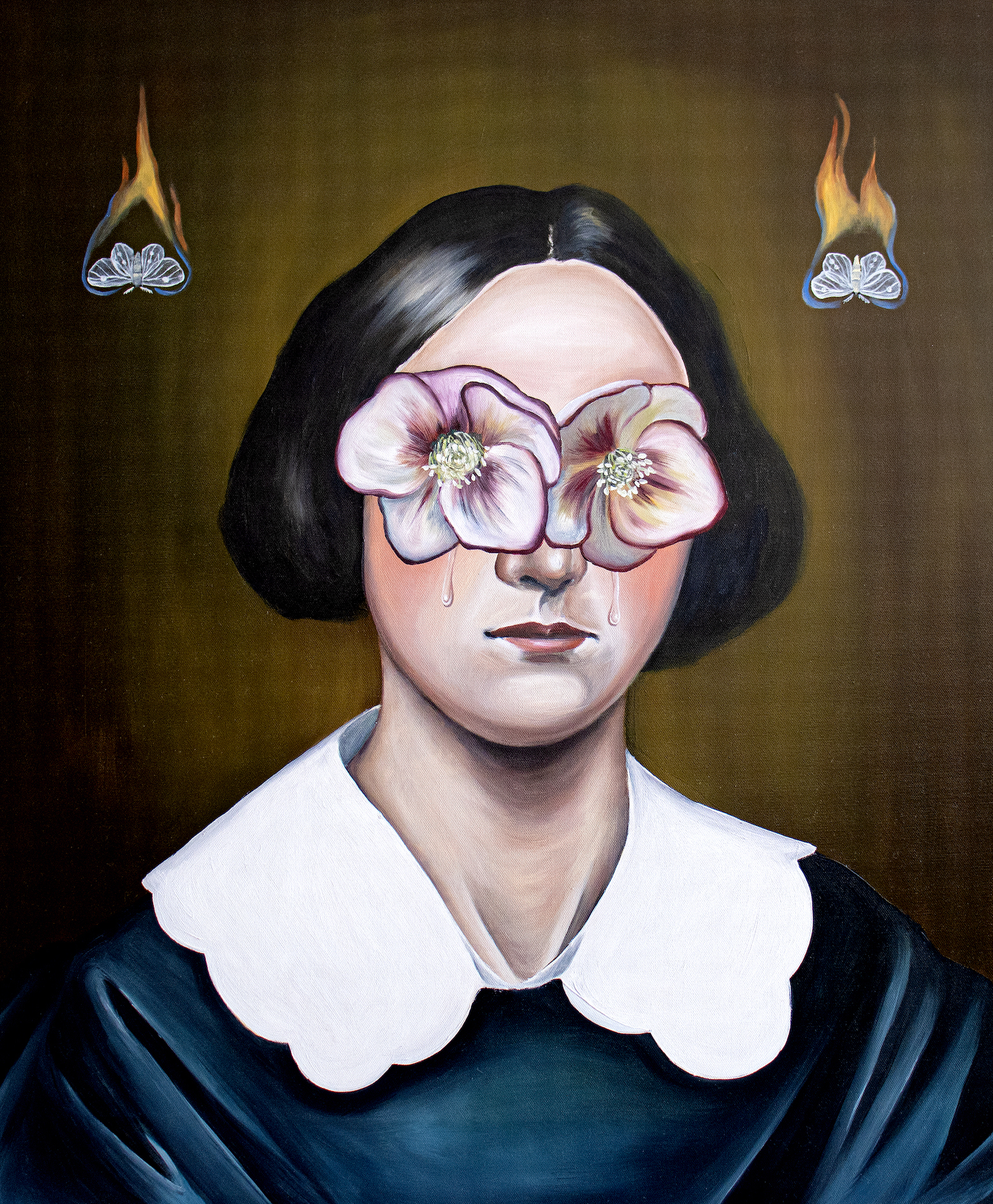
Mariko Enomoto, acrylic on canvas. From Sky, Flowers, Melancholy (Geijutsu Shimbunsha, 2021). Courtesy the artist.
The self-taught thing, and why it's not the story
There is a version of Enomoto's biography that makes a lot of the self-taught part. She learned without teachers, without an MFA, without an institutional structure to channel her toward a particular set of references or concerns. This is true and probably relevant, but it can become a story that replaces the more interesting one, which is about what she actually built.
Self-taught artists sometimes carry the influence of their autodidacticism visibly — a rawness, a certain indifference to craft convention, a technique that has been worked out in private rather than refined in dialogue with others. Enomoto's painting looks nothing like that. Her surfaces are polished to a degree of control that feels considered rather than accidental. The color relationships in her work — warm skin tones against cool floral blues, the specific greens she uses for stems and leaves — suggest someone who has spent years working out exactly what she wants paint to do and has gotten it to do it.
What the self-taught background may have given her, instead, is freedom from the question that haunts a lot of trained painters: am I doing the right thing? The surrealist tradition she is often placed adjacent to — the melting clocks, the impossible anatomies, the dream-logic of bodies reorganized by the unconscious — was made by people who had explicit philosophical programs, who were arguing about what painting was for. Enomoto seems uninterested in being part of an argument. She paints the thing she sees, which happens to be faces replaced by flowers, and leaves the theorizing to whoever's looking.
"There is something that does not make you feel uncomfortable somehow — even when it should."
— Tokyo Art Beat, on the "Moment" exhibition, 2021The book cover that changed everything
In 2017, Cho Nam-joo published a novel in South Korea called Kim Jiyoung, Born 1982. It is a book about an ordinary Korean woman — born the same year as Enomoto, as it happens — whose life is methodically, quietly shaped by the structures of gender in her society. The novel was a phenomenon in Korea and then in Japan, where it sold hundreds of thousands of copies after its translation, and where reading it in public became a small act with large implications. It is the kind of book whose cover is noticed, and whose cover's artist becomes, by association, part of the conversation the book is having.
The Japanese edition was published by Chikuma Shobo with a cover illustration by Mariko Enomoto. A figure, a woman's form. No face — or rather, where the face should be, a flowering arrangement, a kind of bloom-mask, a veil made of petals. It was exactly the right image for exactly the right book. A woman whose individual identity has been obscured by the role she is required to play, whose face has been replaced by something beautiful and impersonal and not chosen by her at all.
Whether Enomoto intended this particular reading is almost beside the point. The image had a reading and that reading was persuasive and the cover reached an audience of millions. After that, her name traveled in a different way. Not just within Tokyo's gallery circuit or the world of Japanese illustration, but outward, into bookshops and apartments and the kind of conversations people have about books that turn out to be about something larger than books.
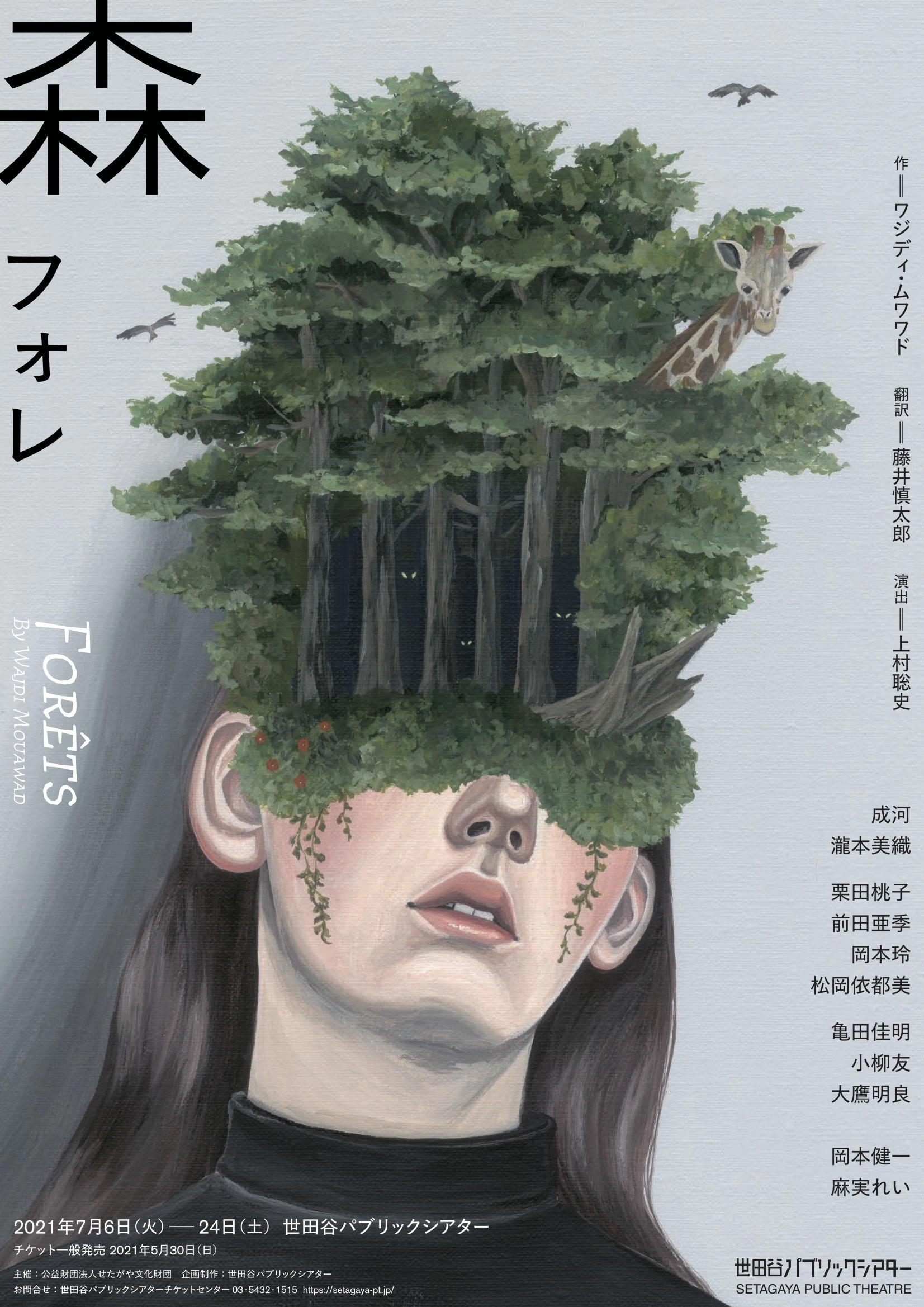
Mariko Enomoto, cover illustration for the Japanese edition of Cho Nam-joo's Kim Jiyoung, Born 1982 (Chikuma Shobo, 2018). Courtesy the artist.
Sky, Flowers, Melancholy
The art book came out in 2021, published by Geijutsu Shimbunsha and titled Sky, Flowers, Melancholy. It is 144 pages and it collects a decade of work — the full range of Enomoto's acrylic paintings, her illustrations, her commissions and her personal work laid out in sequence. The title is her own, and it is a good title. It names the three things that are actually in her paintings, if you're paying attention: the sky-light quality of her backgrounds, the flowers that do the work of faces, and the particular emotional temperature of looking at someone whose face you cannot see.
Melancholy is the right word and not an obvious one. Enomoto's paintings are not dark. They are not mournful in the way that a lot of art that deals with concealment or loss tends to be mournful. The colors are warm, the flowers are often beautiful, the compositions are resolved with a kind of quiet satisfaction. But there is something underneath that. An absence that is aware of itself. A person who has been covered, whether by choice or circumstance, and the feeling of looking at that covering and wondering what it is protecting, and from what.
The 2021 "Moment" exhibition at OIL by Bijutsutecho in Shibuya — one of Tokyo's better small gallery spaces, attached to the art magazine Bijutsu Techo — showed new work from the period and drew the kind of attention that pushes a practice from known-within-a-circle to known more broadly. The earlier "In the Woods" exhibition at elephant STUDIO, the "Flowery Ghosts" show — each one added to a body of work that was becoming harder to ignore. It is a slow accumulation rather than a sudden break, which is usually what it looks like when a career is actually building rather than just having a moment.
What she is actually painting
There is a useful question to ask about any artist whose signature move involves a formal device: what is the device for? A painter who always uses a particular palette, a sculptor who always uses the same material, a photographer who always frames in a certain way — the question is not whether the device is interesting, but what it unlocks. What becomes possible because of it that would not be possible without it?
For Enomoto, the absent face unlocks a kind of attention that regular portraiture tends to shut down. When we see a face, we read it. We assess age, mood, character, attractiveness, familiarity. We make conclusions. The face resolves the picture. Enomoto refuses that resolution. Her paintings stay open in a way that portraits rarely do, because the thing that would close them — the face, the direct address, the eye contact — is not there. What fills the space instead is something that grows without meaning to, that has no expression, that cannot be read the way faces can be read.
This is not a trick of concealment. It is a method of opening. The paintings ask you to look at everything else — the posture, the clothes, the specific weight of a hand — and to build your understanding of the person from the periphery rather than the center. This is, of course, how we come to know most people: not from a single confrontation with their face but from the accumulated evidence of how they move through the world. Enomoto just makes that process visible.
She has mentioned her great-grandfather's nihonga work as a background presence in her thinking — the tradition of Japanese painting that is constitutionally in relationship with natural forms, with flowers and birds and seasons, with the idea that the natural world and the human world are not separate registers but participants in the same conversation. The flowers in her paintings are not decorations from the Western botanical illustration tradition. They grow the way things grow in Japanese painting: as equals, not as accessories. The face is gone. Something else is present. It is not a loss. It is a different kind of abundance.
Where the work is going
Enomoto continues to make paintings, take commissions, and produce work that sits in the interesting zone between fine art and applied illustration. This is not a zone that Western art institutions have always been comfortable with — the anxiety about whether something is "real art" or "just illustration" is largely a Western anxiety and one that, like most institutional anxieties, says more about the institution than the work. In Japan, where the visual culture is more fluid about these distinctions, Enomoto's practice has room to move in ways that feel natural rather than compromised.
The work has reached audiences that painting rarely reaches: readers of literary fiction, fans of the INITIAL fashion collaboration that came later, people who first encountered her through a book jacket and then went looking for more. This is how artists accumulate a public without being represented by the major galleries, without winning the prizes, without the machinery of institutional art world promotion. Image by image, surface by surface, each face replaced by a flower that grows in its absence.
There is something almost stubbornly hopeful about that. About the idea that hiding a face could be a way of saying something truer about a person than showing one. About the decision to keep making the same essential gesture — the substitution, the bloom, the veil of petals — and trusting that each new iteration will mean something different because the person underneath is different. That is the wager every portrait painter makes, and Enomoto makes it in the most unusual possible way: by refusing to show you the one thing portraits are supposed to show.
You leave her work having seen a lot of flowers and no faces, and somehow feeling that you understand something specific. It's hard to name what. That's the point.