There is a photograph of Gerhard Richter in his Düsseldorf studio, taken in 1977. He is standing in front of a large canvas, brush in hand, looking not at the painting but slightly past it — as if the work itself is secondary to whatever he is thinking about. It is a fitting image for an artist who has spent his entire career treating painting as a form of doubt rather than certainty. The paintings in Landschaften, on view at David Zwirner's West 20th Street space through July 10th, are the record of that doubt applied to the most trustworthy subject in the history of art: the natural world.
The show spans roughly four decades, from the late 1960s to the early 2000s, and is curated by David Zwirner and gallery partner David Leiber in close collaboration with Richter himself. It is an unusual arrangement — a dealer staging a major scholarly retrospective of a living artist's thematic output — but it works, because Zwirner has earned the authority. The result is the most coherent gathering of Richter's landscape paintings shown in New York in a generation. Several works come directly from the artist's personal collection. Others arrived fresh from Richter's acclaimed retrospective at the Fondation Louis Vuitton in Paris, which closed earlier this year.
A Snapshot From Corsica
The story begins, improbably, with a vacation. In the late 1960s, Richter visited the French island of Corsica and came home with a camera roll of snapshots — sea, cliffs, light on water. He began painting from these photographs, and something clicked. The process of translation — from snapshot to canvas, from the frozen chemical moment of photography to the slow material accumulation of oil paint — turned out to be exactly the kind of problem he wanted to spend his life on. What happens to an image when you move it? What does the hand add, or subtract? What does the blur mean?
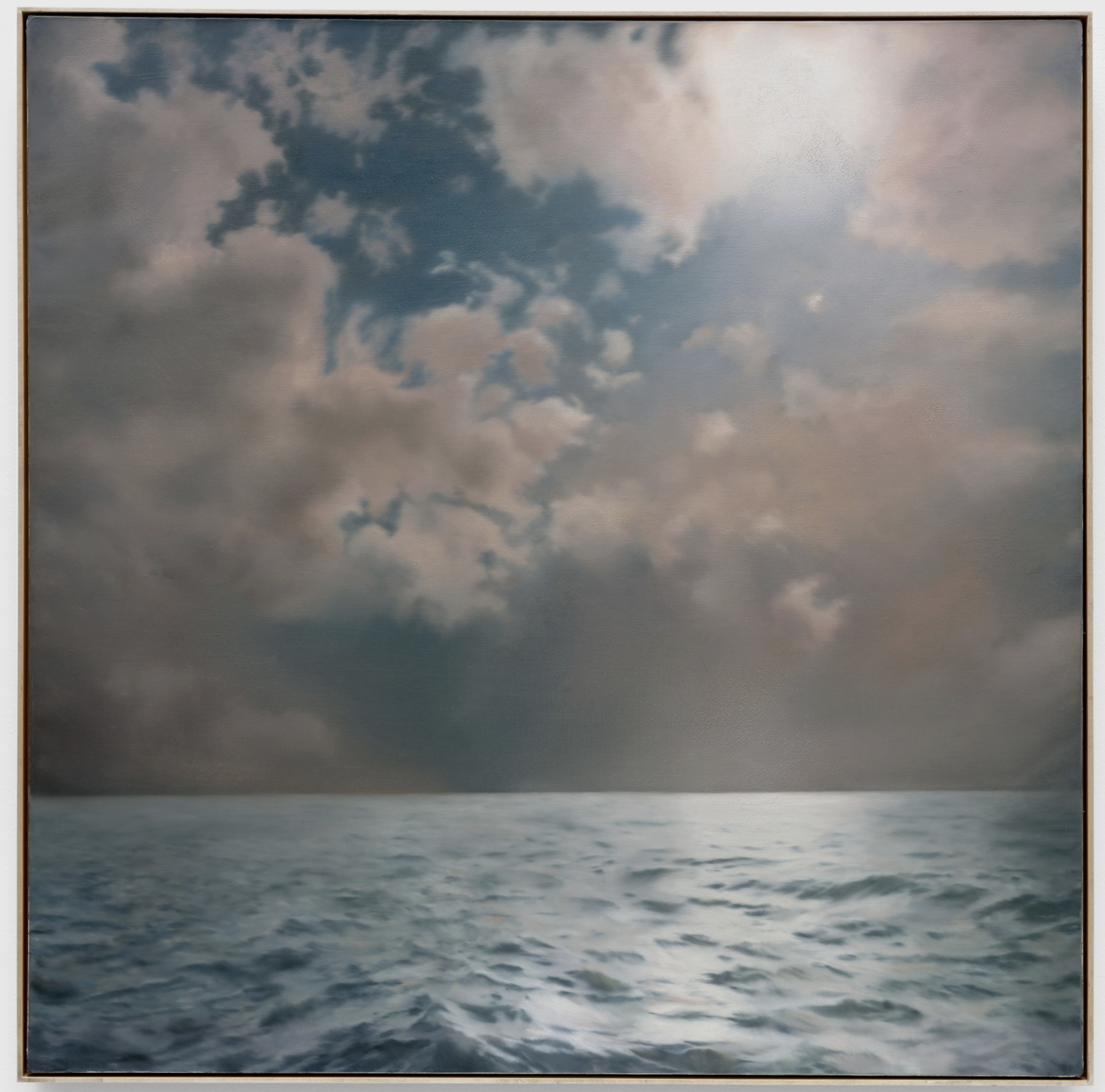
The early seascapes that anchor the first room of the show are atmospheric and quietly strange. Seestück (Gegenlicht) (Seascape [Contre-jour], 1969) is large and squarish, roughly six and a half feet on each side, depicting open water in a blaze of contre-jour light — the sun behind the horizon, everything else in silhouette and shimmer. Richter made it by collaging two separate photographs of sea and sky and using the composite as his reference. The result looks like reality but feels reconstructed, assembled, slightly off. It is the kind of painting that rewards standing still in front of for a while.
"When I look out of the window… truth for me is the way nature shows itself in its various tones, colors and proportions. That's a truth and has its own correctness."
— Gerhard RichterWhat the Blur Is Doing
Richter's signature sfumato — the soft, dragged smear that makes his landscapes look as if you are seeing them through fogged glass, or in the moment just before sleep takes you — is often misread as a stylistic tic, a brand. It is not. The blur is an argument. It is Richter's way of saying that the photograph is not reality, that the painting of the photograph is even further from reality, and that at some point the accumulation of distance becomes interesting in itself. He is not painting landscapes. He is painting our relationship to landscape — mediated, doubted, processed through machines and memory.
This becomes especially clear in the three versions of Apfelbäume (Apple Trees, 1987), each depicting the same bucolic scene — a cluster of trees beside a winding country road — at increasing levels of blur. The first is almost photorealistic. The second is softer, the edges beginning to give. The third is barely legible, the trees dissolving into a green-gray mist. Hung together, the sequence reads like a meditation on forgetting: the image intact, then fading, then almost gone. It is also, somehow, more moving the less you can see.
Installation view, Gerhard Richter: Landschaften, David Zwirner, New York, 2026. Courtesy David Zwirner.
Ice, Fog, and the Ghost of Friedrich
The middle rooms of the show gather the Alpine and Arctic paintings of the early 1980s — Davos S. (1981), Garmisch (1981), and the haunting Eisberg im Nebel (Iceberg in Mist, 1982), a small canvas in which a pale iceberg floats in a sea of bluish fog, barely present, the boundary between ice and air nearly invisible. The art critic Daniel Baird, quoted in the catalogue, calls these works possessed of "a radiant, steely, classical beauty" — and notes, correctly, that while they evoke Caspar David Friedrich's allegorical landscapes, they deliberately refuse Friedrich's humanist consolation. There are no figures in Richter's wilderness. No lone wanderer above the sea of fog. The landscape does not exist for us, or because of us. It simply is.
This is perhaps the most genuinely unsettling thing about Richter's landscapes: their total indifference to the viewer. Conventional landscape painting, from the Dutch Golden Age through the Hudson River School to the Impressionists, implicitly positions the human as the measure of the natural world — the eye that gives the scene meaning. Richter removes that flattery. His mountains and icebergs and beech trees are not sublime because we find them so. They are what they are, regardless.
When Abstraction and Landscape Talk to Each Other
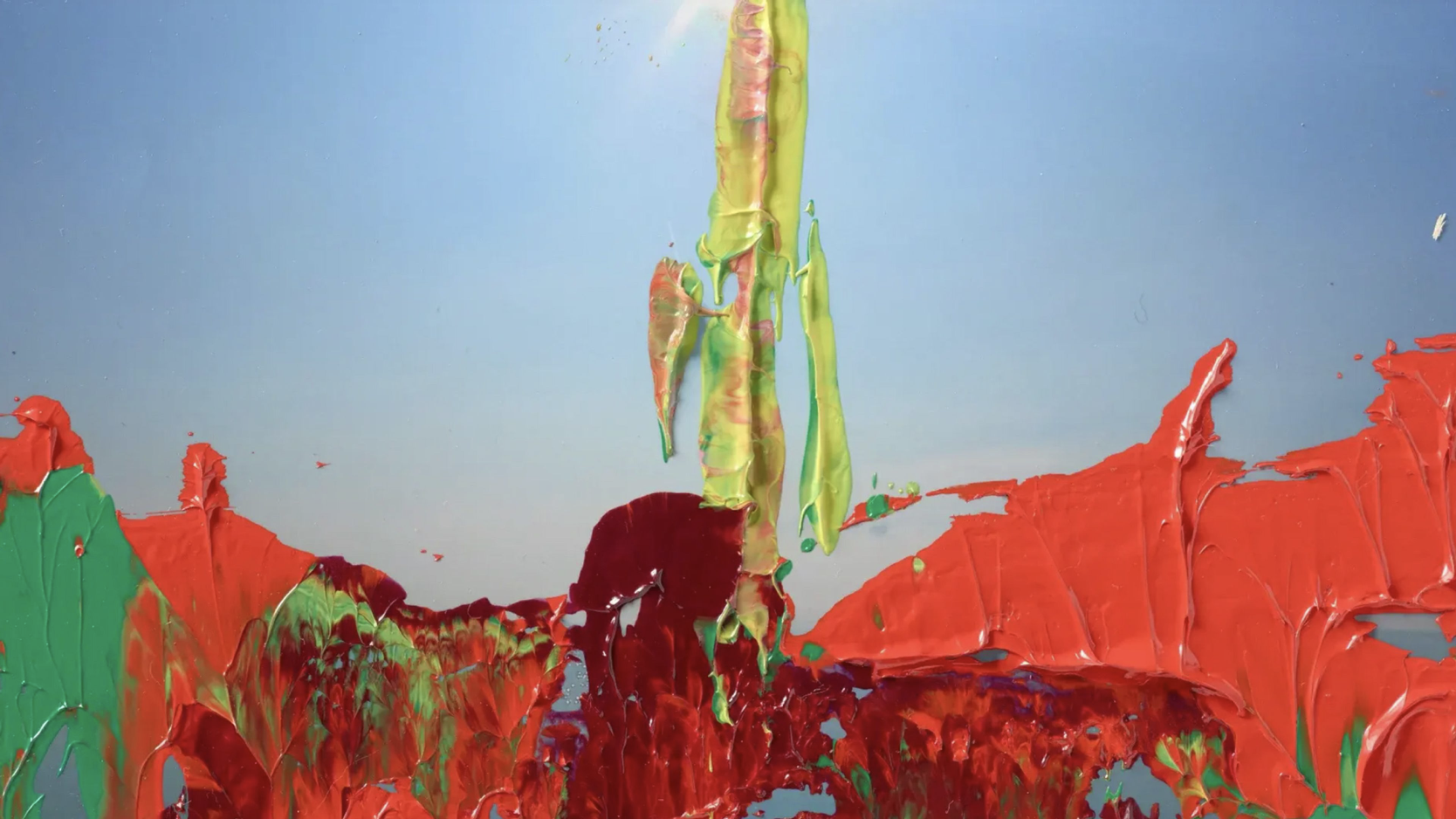
The exhibition's most ambitious curatorial decision is to hang the landscapes in dialogue with a selection of Richter's Abstrakte Bilder (Abstract Paintings), which he began formalizing in 1976. The two bodies of work developed in tandem throughout the late 1970s and 1980s, each informing the other. In some cases, a canvas that began as a landscape was subsequently overpainted with gestural marks until the original image disappeared. In others, an abstract work conjures landscape through nothing more than its title — Wolken (Clouds, 1982, now in MoMA's collection) and Fenster (Window, 1985) are visible in the show, each a riot of squeegeed paint that resolves, if you let it, into something atmospherically plausible.
"If the Abstract Pictures show my reality, then the landscapes… show my yearning. Though these pictures are motivated by the dream of classical order and a pristine world — by nostalgia, in other words — the anachronism in them takes on a subversive and contemporary quality."
— Gerhard RichterThat self-diagnosis — the abstractions as reality, the landscapes as yearning — is one of the most honest things any painter has said about their own work. It also clarifies what is actually on view in these rooms: not a survey of Richter's landscapes, but a map of his interior life, divided between what he knows and what he wishes were true. The show ends with Kapelle (Chapel, 1995), a church interior buried under layers of blue and white paint applied with a spatula, the original image just barely surviving beneath. It is a painting about erasure, about the persistence of what we cannot quite bring ourselves to cover completely. It is, quietly, the most beautiful thing in the show.
Jasper Johns: Copy/Trace
Running concurrently in Zwirner's adjacent gallery space — and worth the extra twenty minutes — is Jasper Johns: Copy/Trace (through June 26th), curated by independent scholar Jeffrey Weiss. The show focuses on Johns's use of copying and tracing as primary modes of making: duplicating his own paintings, leaving bodily imprints, tracing existing images through translucent supports. It is, in its own quieter way, concerned with many of the same questions as the Richter next door — what is an original, what does repetition do to meaning, how does the hand change what the eye sees. The two shows make an excellent double bill. Go on a Tuesday; the West 20th Street block is at its most civilized.
Gerhard Richter: Landschaften
David Zwirner · 537 West 20th Street, Chelsea, New York
May 7 – July 10, 2026 · Tuesday – Saturday, 10am – 6pm
Admission free · davidzwirner.com
Also on view: Jasper Johns: Copy/Trace · through June 26, 2026