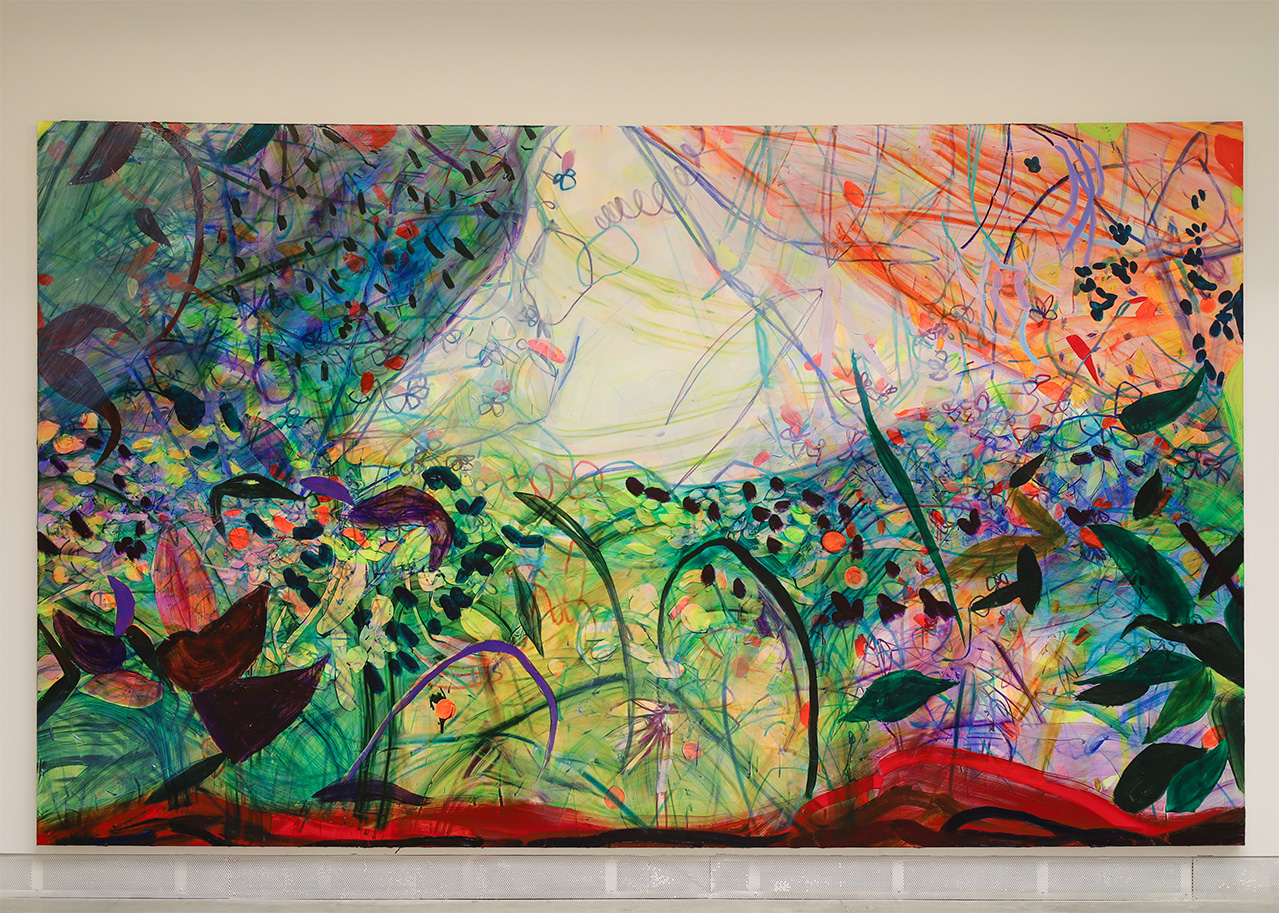
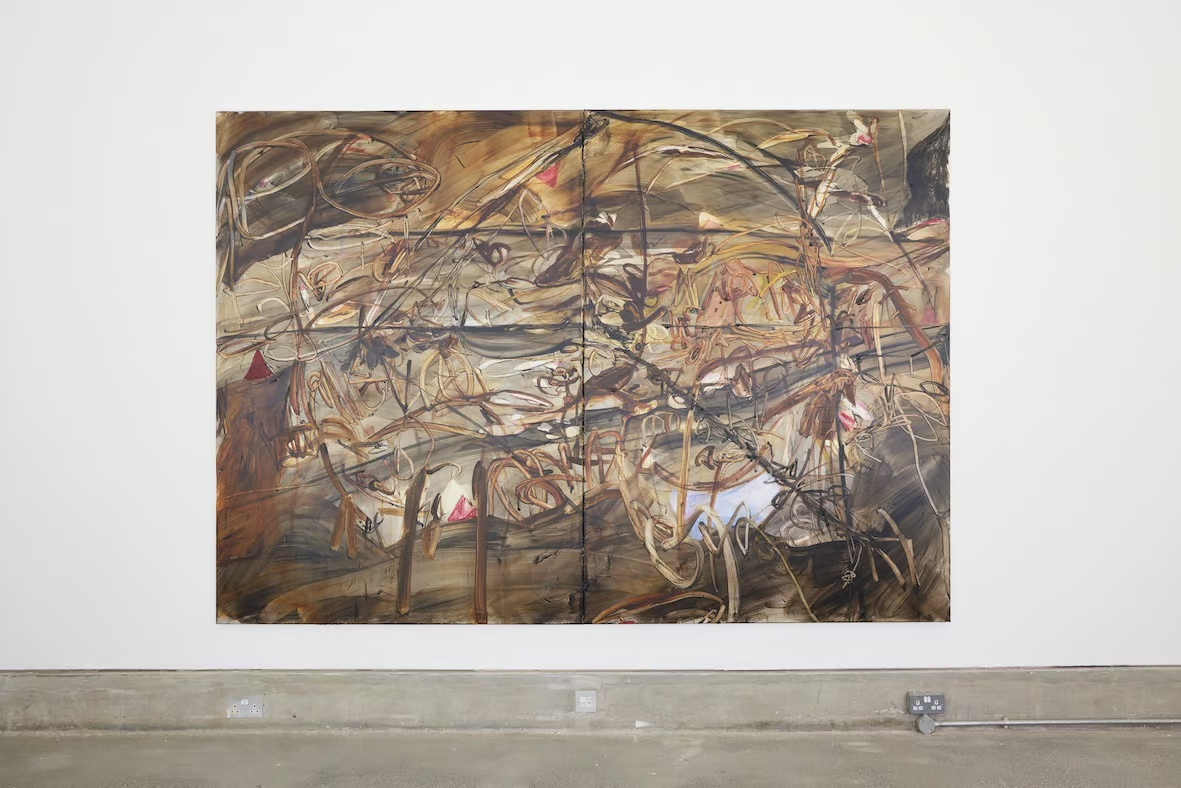
There is a particular experience of standing in front of a Jadé Fadojutimi painting that has no clean equivalent in contemporary abstract work. The canvas does not invite you in so much as it arrives at you. The marks — and there are thousands of them, in every direction, in every register from whisper to scream — do not cohere into a readable space or a single dominant gesture. They layer and cancel and insist and argue with each other across surfaces that feel pressurized, that feel like the inside of something rather than the outside. You are not looking at a record of a thing that happened. You are inside the happening, and it has not finished.
Fadojutimi, born in London in 1993 to Nigerian parents, went to the Slade School of Fine Art and then to the Royal College of Art, and she arrived in the broader art world's consciousness already painting in a register that seemed to have no apprentice period behind it. There is no early figuration, no period of realism she later abandoned. From the beginning, her work has been abstract — not abstract in the sense of distilled or simplified, but abstract in the sense of interior, of belonging to an inner world that has its own logic and its own weather and has no interest in describing the outer one. This is rarer than it sounds. Most painters who work in abstraction carry traces of the figurative tradition even when they are working against it. Fadojutimi's paintings do not feel like they are working against anything. They feel like they are working from somewhere — from inside — that the figurative tradition never reached.
What the painting is actually doing
The density is the first thing. Stand close to a large Fadojutimi and the surface becomes an event. Oil and oil bar, applied in layers that sometimes read as individual gestures and sometimes merge into fields of accumulated mark-making, build up into textures that catch light differently depending on where you stand. The paint has a physical presence that is almost aggressive. It is not thin. It is not considered in the sense of restrained. It is considered in the sense that every decision — and there are an enormous number of them — is intentional, even when the intention is to let the mark go where it wants to go.
The speed is the second thing. The paintings look fast. They have the quality of a mind that moves faster than language allows, that makes connections before it can articulate them, that feels before it understands what it is feeling. This quality — which can look, to the uninitiated, like chaos — is in fact one of the most controlled effects in her practice. Keeping the energy of a mark alive across a canvas that might be eight or ten feet wide, sustaining that quality of immediacy over a process that takes weeks or months, is a technical achievement that the paintings wear so naturally that you almost miss it. The canvases feel like they were made in an afternoon. They were not. They are records of sustained, disciplined intensity that has learned to look effortless.
The third thing — the one that distinguishes her work from the general field of gestural abstraction — is the interiority. The paintings are not about something external. They are not responses to landscape or architecture or politics or history, at least not in any traceable sense. They are responses to the interior: to feeling, to the experience of being a consciousness moving through time, to the gap between what can be known and what can be felt and what can be made. This makes them strange, and it makes them honest in a way that work with a more legible external referent is sometimes not.
The youngest in the room
In 2021, the Tate acquired a Fadojutimi painting, making her the youngest artist ever to enter the Tate Collection. She was twenty-eight. The art world, which has a complicated relationship with youth — romanticizing it in the abstract while being structurally skeptical of it in practice — reacted with a mixture of genuine excitement and the subtle suspicion that attaches to any ascent that happens this fast. Was the recognition commensurate with the work, or was it the work of a market and an institution looking for the next thing?
Spending time with the paintings makes this question feel less interesting than it seemed. The Tate acquisition was not a bet on a promising young painter. It was a recognition of a practice that was already fully formed — that had been fully formed, in its essentials, since she was at the Royal College. The institutional recognition arrived at an unusually early point in a career that would have earned it eventually regardless. What is notable is not that she was twenty-eight when the Tate acquired her. It is that the work at twenty-eight was already doing what it is doing now: painting the inside of everything, refusing to simplify, refusing to resolve.
Fadojutimi has spoken about institutional recognition with a particular clarity about what it does and does not change. The Tate is a validation of a kind that matters, she has said, because it means the work is seen. But it does not change what the painting is, or what it needs to be. The studio practice is the same before and after the acquisition. The canvas does not know about the Tate. The mark does not know about Gagosian. The only place where she can be completely honest, she has said, is inside the painting. Everything else is context. The painting is the fact.
"The only place where I can be completely honest is inside the painting. Everything else is context."
Jadé FadojutimiMusic as structure
Fadojutimi paints while listening to music. This is not unusual — many painters work with sound — but the role that music plays in her practice is more structural than ambient. She has described the canvas as a kind of score, the painting as a kind of notation of what the music does to the body that is listening to it. This is a different relationship than inspiration. Inspiration implies that the music provides content that the painting then represents or translates. What Fadojutimi describes is closer to a formal relationship: the music provides architecture, and the painting inhabits it.
The implications of this are significant for how you read the work. If the painting is not representing the music — not trying to make visible what the music sounds like — but is instead using the music as a structural frame, as a set of durations and dynamics and movements within which the mark-making happens, then the connection between the two is invisible in any direct sense. You cannot hear the music in the painting. But the music's organization is there, underneath, the way a grid persists underneath a gestural surface without asserting itself visually. The structure enables the freedom. The architecture makes the wildness possible.
This also clarifies something about the density. If you are painting within a musical structure — within the duration of a piece, within its dynamics, within the internal logic of its movement from one state to another — then the number of marks per square inch is not random. It corresponds to something. Not in a literal, one-to-one way. But in the way that a long, sustained phrase in music produces a different kind of attention than a short, percussive one. The density of a Fadojutimi is the density of a mind that is listening to something very carefully and letting what it hears move through its hands.
The language problem
Fadojutimi has a complicated relationship with language. Not in the sense of being inarticulate — she speaks about her work with unusual precision and without the false modesty that some painters use to protect themselves from the reduction of what they do — but in the sense of being consistently preoccupied with what language cannot do. What cannot be said. What can only be painted.
The titles of her works are one manifestation of this. They are not the short, neutral titles of much abstract painting — not Untitled, not Study in Red. They are long phrases, fragments of thought, the kind of thing that sounds like it came from the middle of a sentence rather than the beginning of one. Titles like The Rift and the Resplendence, or Prickle of the Familiar, Thrill of the Unknown. These are not descriptions of the paintings. They are something closer to coordinates: they point toward the interior space the painting is trying to reach, the feeling-state it is working within, without claiming to translate that space into words. The title is the limit of what language can do. The painting is what happens past that limit.
This is not a mystical position. It is a precise one. Language operates by fixing meaning — by making a word stand in for a thing in a stable way. Painting, at least painting of this kind, operates by refusing that fixity. The marks mean something — she is not making decorative abstraction, not making beauty for beauty's sake — but what they mean cannot be paraphrased. This is not a failure of the painting. It is the whole point of the painting. If it could be said, she would say it. She paints it because it cannot be said. The canvas is the record of the gap.
"If I could say it, I would say it. I paint it because it can't be said. The canvas is the record of everything language leaves out."
Jadé FadojutimiWhat abstraction means now
Choosing to work in abstraction in 2026 is not a neutral decision. The past decade has seen a significant shift in what the art world asks of painting — a renewed interest in figuration, in representation, in work that carries legible political content, that depicts specific bodies in specific historical contexts. This shift has produced some of the most important painting being made today. It has also produced a climate in which the choice not to figure, not to represent, not to make the political content of the work immediately visible, can read as evasion. As retreat.
Fadojutimi's abstraction is not a retreat. This needs to be said clearly, because the paintings do not say it themselves — they have no interest in defending their formal choices against the demands of the moment. They are too busy being what they are. But the choice to paint the interior — to insist that the inner world is as real as the outer one, that the experience of being a consciousness is a legitimate subject, that feeling is not less political than representation — is its own kind of insistence. It is a refusal to cede the entire territory of painting to the legible and the describable. It is a claim that there are things worth painting that cannot be named in advance, that the canvas is one of the only places in the culture where that kind of unnamed experience can be made visible.
For a young Black British woman working in a tradition that has not always made space for her — not in the abstract expressionist canon, not in the postwar American painting that still organizes so much of how abstraction is historicized and valued — the choice of abstraction carries an additional charge. She is not representing herself in the paintings. She is not depicting her experience in any legible autobiographical sense. What she is doing, which is perhaps more radical, is insisting that her interior life is large enough and complex enough and worth enough to fill enormous canvases, to demand the viewer's full attention, to be taken seriously on its own terms. This is not a small claim. It never has been.
Where the work is going
Fadojutimi now lives and works between Edinburgh and New York, which is itself a particular kind of displacement — between two cities that have very different relationships to the art world, different rhythms, different demands on the attention. Edinburgh is slow in the way that some northern cities are slow, with a quality of interiority that suits a practice organized around the inner life. New York is fast in the way that New York is always fast, demanding engagement with the world, with the market, with the noise of the present. Moving between them is a way of keeping both available — the solitude that the painting needs, and the friction that keeps it from becoming merely solitary.
Her recent work has, if anything, become more insistent. The density has not resolved into legibility. The marks have not learned to be quiet. If there is a direction, it is further in — further into the interior that the paintings are exploring, further past the point where language can follow. This is not comfortable, and it is not meant to be. The paintings ask a lot of the viewer: sustained attention, willingness to sit with work that does not resolve, openness to an experience that cannot be summarized. In a culture that has strong incentives to summarize everything — to convert the experience of art into content, into a caption, into something that travels well on a small screen — this is a form of resistance.
The question for the next phase of her practice is not whether she can sustain the intensity. She has already answered that. The question is where the intensity leads — what the paintings become as they go further in, whether the interior has a geography that can be mapped across a career, whether the record of a mind at full speed accumulates into something that looks, over time, like a self-portrait. Not a picture of a face. Something more honest than that. A portrait of the inside of everything.