The first time you see the Stony Island Arts Bank from outside — driving down Stony Island Avenue on Chicago's South Side, past the vacant lots and the stretch of commercial blocks that have been slowly eating themselves since the sixties — it stops you. Not because it is beautiful, though it is, in the way that things which have been through serious damage and come out the other side are beautiful. It stops you because you were not expecting it to be there. A neoclassical bank building from 1923, six columns, a recessed portico, terracotta ornament intact, fully restored and lit and open in a stretch of street where nothing else is any of those things. You do not need to know anything about Theaster Gates to feel the argument the building is making just by existing. Someone decided this should survive. Someone decided it was worth saving. Someone decided the South Side of Chicago was worth the same attention the rest of the world gives to places it already believes are worth caring about.
That someone is Gates, and the decision he made about Stony Island Arts Bank in 2012 — buying the derelict building for a dollar, raising funds to rehabilitate it, opening it as a cultural institution — is not metaphorical. It is not a gesture toward community investment or a site-specific art installation that packs up when the show closes. The building is still there. The archive it houses is still there. The South Side has a permanent cultural institution where there was a ruin, and that institution was made by an artist, and calling it art does not diminish any of that; it forces us to think harder about what art is actually capable of.
Architecture Instead of Canvas
Gates trained as a ceramicist and as an urban planner — a combination that sounds eccentric until you spend any time with his practice, at which point it sounds almost inevitable. The ceramicist's instinct is toward material, toward the hand, toward objects that hold use and beauty in the same container. The urban planner's instinct is toward systems, toward the city as a designed object, toward the question of who benefits from spatial decisions. Gates has never separated these two educations. He studied at Iowa State, then spent time at the University of Cape Town, then moved back to Chicago to work as a city planner, and was making ceramics through all of it — selling his pots from a wagon on the South Side to supplement his salary, learning Japanese folk-pottery traditions, thinking about what objects are for.
The shift toward architecture as medium was not, by his own account, a formal decision. It was a practical one. In 2006, he bought a house on Dorchester Avenue on Chicago's South Side for $16,500. The neighborhood had been in decline for decades; the house was derelict. He rehabilitated it and opened it as a cultural space called the Archive House, putting a collection of art books and records inside it and opening it to the community. He bought the house next door. Then the one next to that. The Dorchester Projects grew from this accretion of decisions, each one practical and each one, simultaneously, a statement about what space means and who deserves it and what it takes to change the answer to that question in a specific neighborhood in a specific city.
What makes this art rather than urban planning — or rather, what makes the distinction beside the point — is the precision with which Gates understands what buildings mean as cultural objects. A vacant building on the South Side is not a neutral space. It is a document of disinvestment, a physical record of decades of decisions about where money flows and where it doesn't, about which neighborhoods a city decides to let die. When Gates buys that building and restores it and opens it as a cultural institution, he is not covering over that history. He is working with it. The building's previous condition is part of the work. The fact that someone had to do this — that the city did not, that the market would not, that it required an artist's vision and a ceramicist's patience and an urban planner's understanding of how space becomes meaning — is also part of the work.
The Specific Geography
Chicago's South Side is not an abstraction. It is a specific place with a specific history — the history of the Great Migration, of Black Americans moving north from the Mississippi Delta and finding, in Chicago, a city that was willing to employ them in the stockyards and the steel mills while simultaneously enforcing racial covenants that determined where they could live. The South Side was built by Black Chicago, institutionally and culturally and architecturally, and it has been subject for decades to the particular kind of urban disinvestment that follows when a city decides that the people who built a neighborhood are not worth sustaining.
Gates grew up in Chicago, born in 1973, son of a roofer father. He has said that his father's work — the physical labor of it, the knowledge of materials, the way a building holds together and the way it fails — was one of his primary educations. This is not sentimental. It is literal. The Dorchester Projects are the work of someone who understands what buildings actually are: not symbols but physical systems, requiring skilled labor and money and decision-making and maintenance, subject to neglect and decline and restoration. The art that Gates makes from buildings is grounded in this knowledge. When he rehabilitates a structure, he is not staging a metaphor. He is doing the thing.
The Dorchester Projects now comprise several buildings on and around Dorchester Avenue — the Archive House, the Black Cinema House, the Listening House — each organized around a different cultural function. They are not galleries. They are more like community infrastructure organized around specific collections and practices: film, music, printed matter. The neighborhood has benefited materially from their presence. This is verifiable. Gates is aware of the tensions this creates — the artist as gentrifier, the cultural institution as the leading edge of displacement — and he has engaged with those tensions explicitly, in interviews and in the work. He has not resolved them, because they cannot be resolved. The practice lives in the friction.
What the Pots Hold That the Buildings Don't
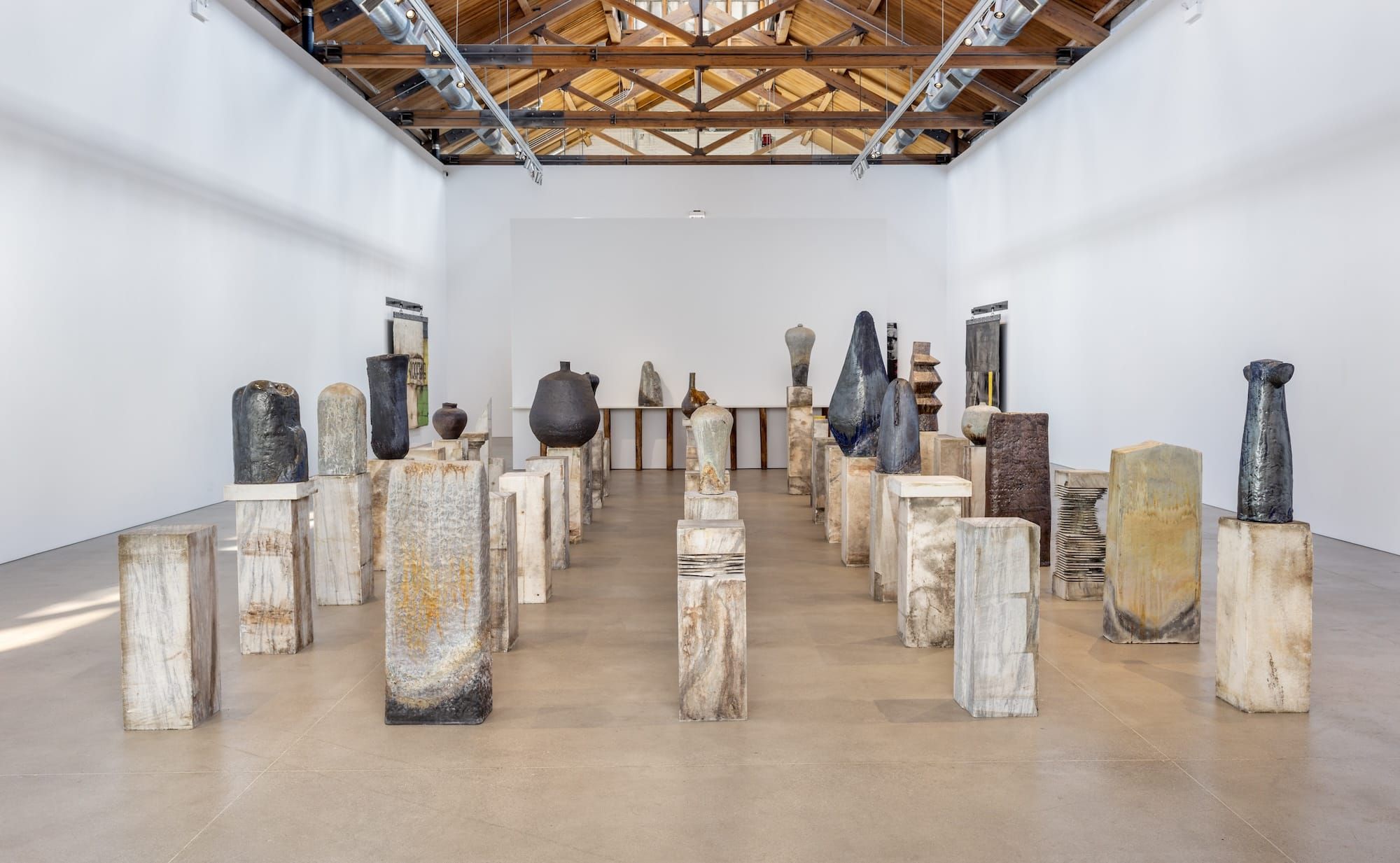
Alongside the architectural projects — which are, necessarily, public, collective, and large — Gates maintains a ceramics practice that is quieter, more intimate, and in some ways more formally adventurous than anything the buildings allow. His pots draw on Japanese folk-pottery traditions, specifically the mingei movement's emphasis on craft as a democratic art form, on the beauty of objects made for use. He spent significant time in Japan studying these traditions, and the influence is visible in the work — the glazes, the forms, the sense of the hand present in the surface. But the ceramics are not Japanese pots. They are something else: objects that hold two traditions in the same form, that carry the history of Japanese folk craft and the history of Black American making in the same vessel.
This is not fusion in the music-festival sense. It is a formal argument about what traditions are worth drawing on and who gets to draw on them and what happens when a Black American artist trained in urban planning and ceramics decides that the mingei movement has something to say to the South Side of Chicago. The pots are small enough to hold in your hands. They are, in this sense, the opposite of the Stony Island Arts Bank — personal where the bank is civic, portable where the bank is fixed, intimate where the bank is institutional. Gates has described the ceramics as a place where the practice can breathe, can be experimental, can fail without consequence. The buildings can't fail. The pots can.
"The city kept deciding this neighborhood wasn't worth saving. So I decided it was. That's not activism. That's just disagreeing with a bad decision."
— Theaster GatesMusic as Practice, Not Side Project
Gates leads a performance ensemble called the Black Monks of Mississippi, and calling it a side project would misread the practice entirely. The Black Monks are not a band that happens to be fronted by an artist. They are a formal component of a practice that treats music, ceramics, architecture, and civic action as different outputs of the same thinking. The ensemble draws on the tradition of Black American sacred music — gospel, the blues, the particular quality of voice and communal call-and-response that connects the Mississippi Delta to Chicago — and folds it into durational performance events that are often staged in the spaces Gates has built or restored.
What music does that objects cannot is obvious when you think about it, and worth saying anyway: it exists only in time. A building is always there. A ceramic pot sits on a shelf, waiting. Music happens and then stops, and the stopping is part of the work. The Black Monks' performances in the Stony Island Arts Bank or the Archive House or the Listening House create a relationship between space and time that neither architecture nor object can produce alone. The building holds the performance. The performance activates the building. Each makes the other legible in a different way.
There is also something specifically political about Gates choosing music as a medium. Black American music — gospel, blues, jazz, house — is one of the great cultural contributions of the South Side of Chicago, and it has been extracted from that neighborhood with approximately the same mechanism by which other forms of value have been extracted: taken elsewhere, commercialized, celebrated in contexts that have nothing to do with where it came from, while the place it came from continued to decline. Gates staging music in the neighborhood where it was made, as part of a practice explicitly about that neighborhood's value and survival, is not a coincidence. It is, again, a formal decision that is also a civic one.
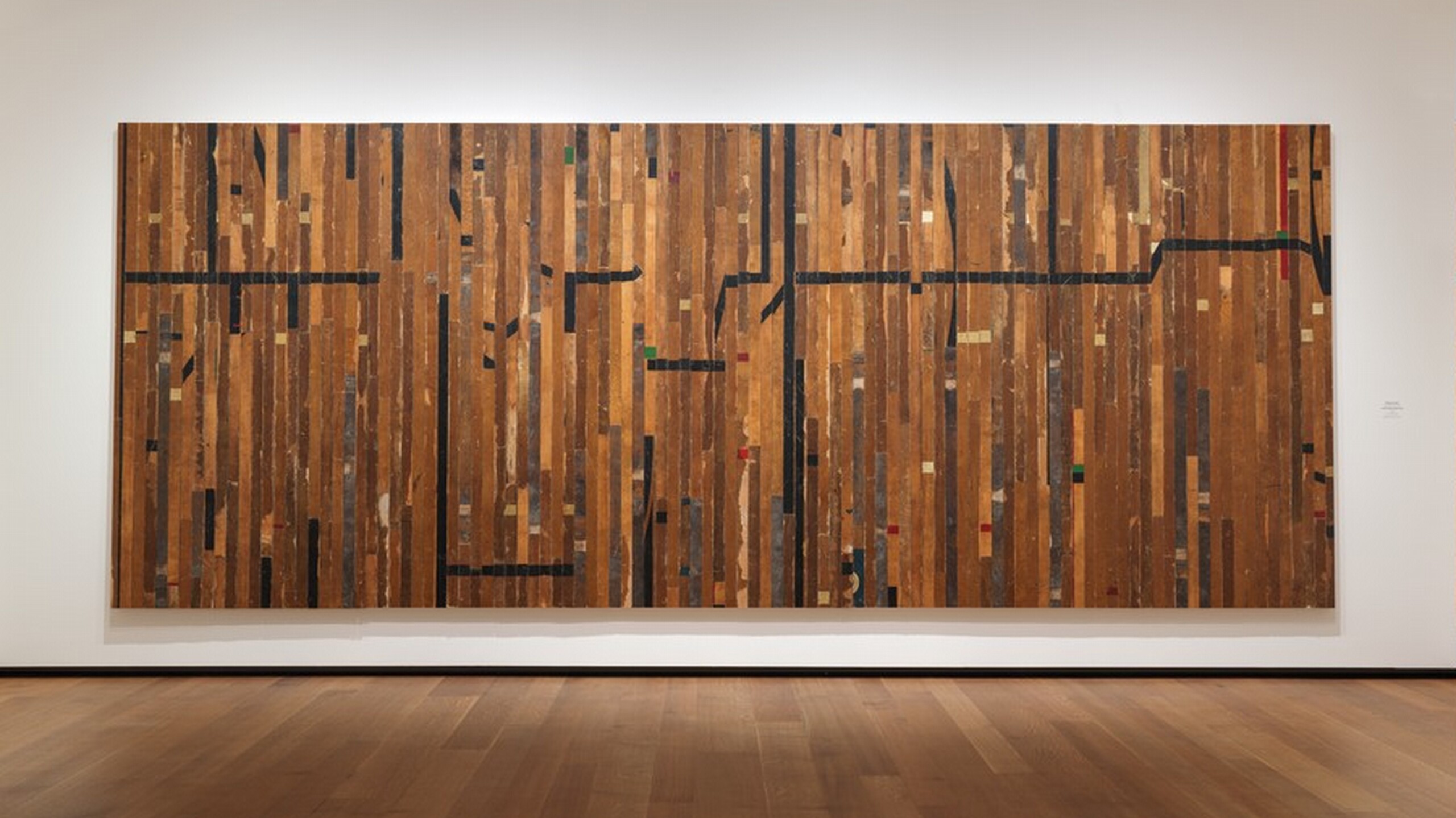
Theaster Gates, Ground Rules (black line), 2015. Wood flooring, 2018.11.1.
Stony Island Arts Bank and the Idea of Preservation
The collections housed in the Stony Island Arts Bank are not Gates's personal possessions in the conventional sense. They are archives: the Johnson Publishing archive, which includes the complete records of Ebony and Jet magazines — the photographic and editorial history of Black American life and culture from the 1940s through the early 2000s — alongside a vinyl record collection, the Frankie Knuckles archive (Knuckles being the DJ widely credited as a founding figure of house music, Chicago-born, South Side-rooted), and the archive of the Prairie Avenue Bookshop, a legendary architectural bookstore that closed in 2009. These are materials that were, in various ways, at risk: underfunded, unhoused, in danger of dispersal or loss.
Gates's argument — and it is an argument, made at the level of institutional design rather than rhetoric — is that preserving these archives is itself an art form. Not in the metaphorical sense in which people sometimes call curating or cooking or teaching an art form. In the literal sense: the decision about what survives, who makes that decision, where the surviving material is housed and who has access to it, what frame is placed around it — all of these are aesthetic decisions, formal decisions, decisions that shape what a culture knows about itself. The Johnson Publishing archive in the Stony Island Arts Bank, accessible to researchers and community members on the South Side of Chicago, is a different object than the Johnson Publishing archive in a climate-controlled warehouse in a suburb. The same material means something different depending on where it is and who can reach it. Gates knows this. The bank is the argument.
There is also something quietly extraordinary about the Frankie Knuckles archive being housed here. Knuckles died in 2014. House music — the genre he helped invent, at the Warehouse club on the South Side in the late 1970s and early 1980s — has become a global phenomenon, a foundational genre in the history of popular music. The city of Chicago declared his birthday a holiday. And his archive, the material record of a practice that changed music, is in a restored bank building on the South Side, a few blocks from where the Warehouse used to stand. That feels right. It feels like a decision someone made deliberately. It is.
"To preserve is to decide. Every archive is an argument about what matters. I just wanted to make that argument explicitly, in the neighborhood where the evidence was made."
— Theaster GatesThe Terms of the Work
Gates has won the Artes Mundi Prize, the Nasher Prize, the Hyundai Commission at Tate Modern. He is represented by White Cube and Gagosian, which are not small galleries. The art market has found his work, and the art market's finding of work tends to change the work, or at least to change the conditions under which the work is made and understood. There is real money moving through this practice now — through the galleries, through the institutional commissions, through the ceramics market, which has been unusually robust for his work — and real money raises real questions about what the practice is and who it is for.
Gates has been direct about this. The revenue from gallery sales and institutional commissions funds the South Side projects. The Stony Island Arts Bank does not sustain itself through admission fees; the Dorchester Projects do not generate rent. They are subsidized, in part, by the art market's appetite for Gates's ceramics and installations. This is an honest arrangement, stated plainly, and it is different from the more common configuration in which artists make work about inequality and the proceeds fund their own practices and the inequality continues. Gates is using the market to fund something outside the market's usual logic. Whether this fully resolves the tension between his institutional success and his civic commitments is a question the work does not pretend to answer. What it offers instead is the fact of the buildings — standing, open, used — as evidence that the arrangement is producing something real.
What the practice costs, in the end, is harder to calculate than what it gives back. It costs patience of an unusual kind — the patience of someone who understands that a neighborhood, like a pot, takes time, and that the results of careful attention are not always visible in the short timeframes that art institutions and art markets prefer to work in. It costs a willingness to operate at the intersection of domains — art, urban planning, music, civic action — that do not share a vocabulary and do not always understand each other. It costs a sustained attention to a specific place, a specific community, a specific set of questions about what Black American culture on the South Side of Chicago deserves and what it has been denied and what it would look like to begin, materially and artistically and institutionally, to close that gap.
What it gives back is harder to overstate. Not just the buildings, though the buildings are real and visible and worth seeing. The practice gives back a model — provisional, contested, imperfect — for what it might mean to make art that takes seriously the claim that beauty and civic action are not opposites. That an artist can work at the scale of a neighborhood and still be making formal decisions. That the question of what survives is an aesthetic question. That culture and community are not different things. Gates has been making this argument in Chicago for twenty years, with ceramics and music and masonry and archival boxes and restored terracotta ornament. The argument is not finished. The buildings are still open.