There is a painting in the Lehmann Maupin stockroom — or there was, the last time anyone checked — that McArthur Binion made in the early 1970s. It has never been exhibited. He made it when he was living in New York, twenty-something years old, walking the same streets as Basquiat and Sol LeWitt and a dozen other people who were about to become the art world. He made work then. He kept making it for the next forty years, in studios in Detroit and Chicago, teaching at Columbia College, showing infrequently, not exactly in hiding but not exactly visible either. And then, around 2013, when he was sixty-six years old, the world caught up with what he had been doing.
This is not a comeback story, because Binion never went anywhere. It is something else — a story about what it means to make work for decades before the conditions exist for people to understand it, and about what happens to a body of work when the world finally comes around. He calls himself a "Rural Modernist," which is one of the better self-descriptions I have heard from a painter, and which means something specific: that his engagement with the history of abstraction — with Malevich, Mondrian, the Minimalists — runs through the cotton fields of Macon, Mississippi, through a father who moved the family to Detroit to work in the auto industry, through a childhood that had nothing to do with art school and everything to do with manual labor and the particular quality of attention it demands.
Macon, Mississippi, to Harlem, to Cranbrook
Binion was born in 1946 on a cotton farm in Macon, Mississippi, one of eleven children. The family moved to Detroit when he was five, following his father to the auto plants. He went to Mumford High School, studied business at Morgan State, transferred to Wayne State to study creative writing, dropped out at nineteen to become an associate editor at a magazine in Harlem. That is the version of the story that sounds like it could go a dozen different directions — and it almost did. The Harlem job took him to MoMA, where he encountered Abstract Expressionism for the first time. He has described it as arriving somewhere he didn't know he was trying to get to.
He traveled in Europe for two years, took his first drawing class somewhere along the way, came back to Wayne State, got his BFA in 1971. Then Cranbrook Academy of Art in Michigan, where he earned his MFA in 1973, becoming the first Black student to graduate with a painting MFA from the school. This fact is quietly extraordinary. It was 1973. He was at one of the most rigorous art programs in the country, surrounded by Minimalism and Conceptualism, and he was bringing something to it that the curriculum had no language for yet — an experience of American life that had no precedent in the canon he was being trained in.
"My work begins at the crossroads — at the intersection of Bebop improvisation and Abstract Expressionism."
— McArthur BinionWhat Is Under the Grid
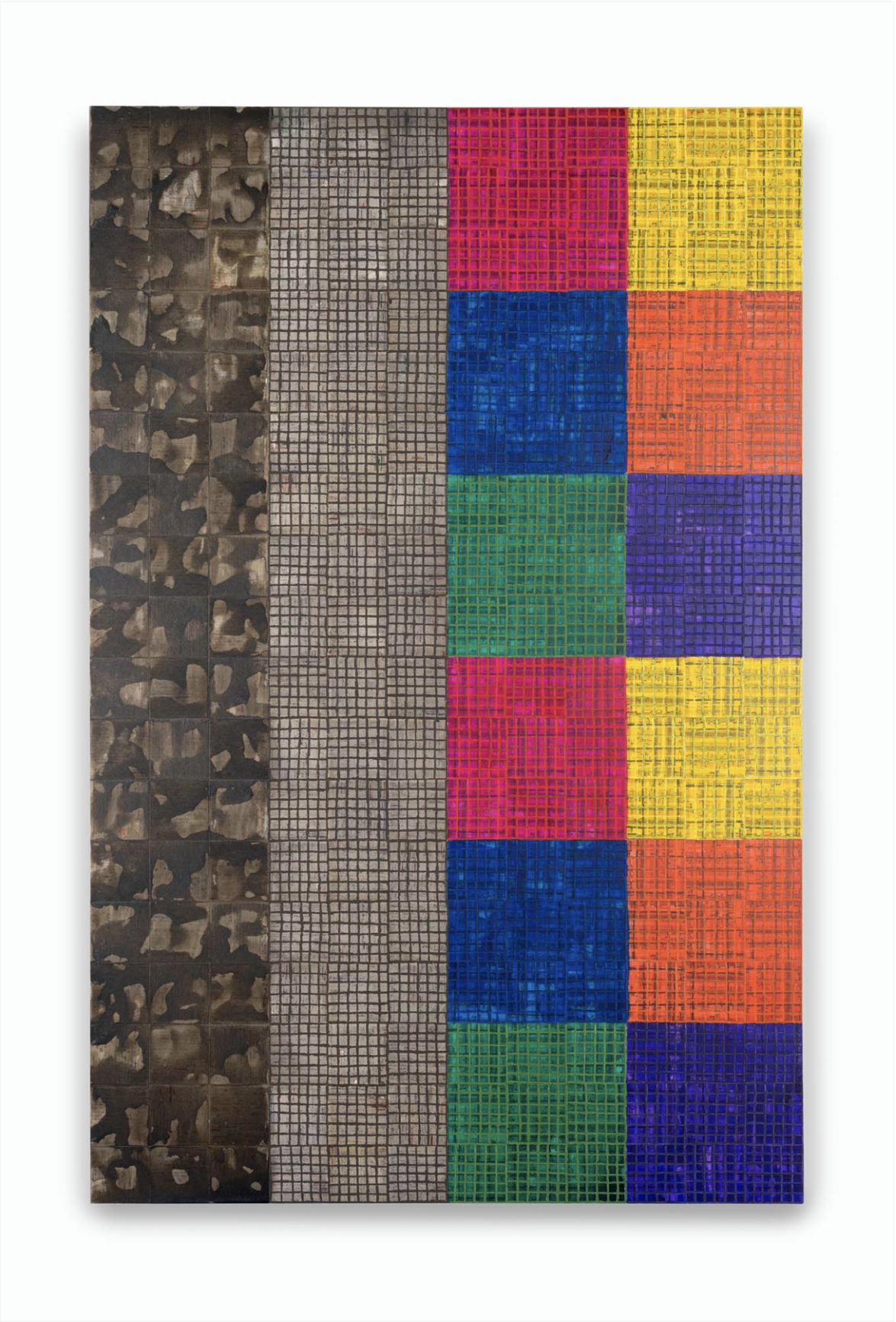
In Binion's DNA paintings — the series that made his reputation, though he had been developing the ideas for years before anyone was paying close attention — the surface of the canvas is not a blank. Before he applies the oil stick, before the grid begins, he lays down a collaged substrate: pages from his personal phone book from the 1970s, handwritten in his own hand. Negatives of his birth certificate. Copies of his passport. Documents that are, in the most literal sense, the material record of a life — who he called, where he was born, where he had traveled.
Over this, he builds the grid. He works in oil stick, which requires physical pressure — so much pressure that he became ambidextrous over years of practice, switching hands when one arm tired. The marks are repetitive, serial, relentless. They cover the documents almost entirely, leaving traces visible only in certain lights, at certain angles. You might walk past a DNA painting and see only the grid, the rigor, the formal beauty of marks in space. Or you might look closer and find a handwritten phone number, an address, a name. The autobiography is always there. It is just underneath.
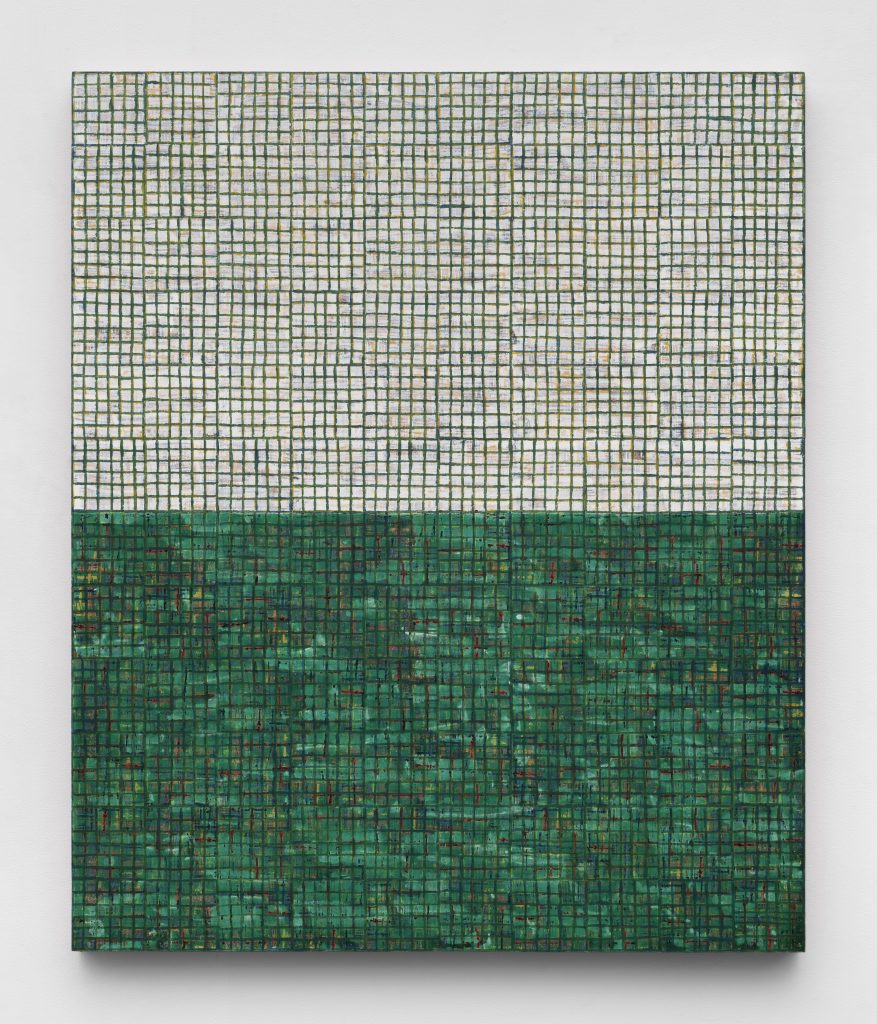
McArthur Binion, Handmadeness:eight, 2023. Ink, oil paint stick and paper on board, 48″ × 40″ × 2⅛″.
The effect, in person, is something that photographs cannot fully capture — and I say this having spent a fair amount of time looking at photographs of this work before I saw it on a wall. There is a physical quality to the surface, a density and warmth, that changes the experience of the grid entirely. Where Minimalism can feel cold — its whole point is to resist the personal — Binion's grids feel inhabited. The formal language is there, rigorous and precise, but it is running over something warmer and more specific. You feel the presence of the life underneath even when you cannot see it clearly.
Sixty-Six and Suddenly Visible
Binion spent the 1990s and 2000s teaching at Columbia College Chicago, making work, showing infrequently. Chicago dealer Kavi Gupta started representing him in 2013, and the work began to move into the wider conversation. By 2017 he was at the Venice Biennale, in Christine Macel's curated exhibition VIVA ARTE VIVA, where the DNA paintings received what critics called notable mention — a phrase that barely covers it. A 2019 front-page piece in the New York Times placed him among a generation of Black artists in their seventies who were "enjoying a market renaissance after decades of indifference." He joined Lehmann Maupin in 2018. The market followed.
What is interesting about Binion's late recognition is not the recognition itself but how he has handled it. He has not changed the work. He has not made it more legible or more obviously autobiographical or more accommodating of the moment's appetite for certain kinds of narrative. The DNA paintings in 2024 look like the DNA paintings in 2003 — more confident, perhaps, in their scale and ambition, but continuous with what he was doing when nobody was watching. This is rarer than it sounds. A lot of artists, when the market catches up with them, unconsciously adjust the work toward what the market caught up to. Binion has not done this. The grid is still the grid. The life is still underneath it.
"I didn't come from art history. I landed there."
— McArthur BinionModern:Ancient:Brown
In 2019, Binion started the Modern:Ancient:Brown Foundation in Detroit — a fellowship and residency program for artists and writers of color. The name comes from a phrase he has used to describe his own practice: where he comes from, what he is making, who he is making it for. It is not a small thing to start an institution in your seventies, after decades of making work in relative quiet, and it suggests something about how Binion sees his own story — not as a personal achievement to be consolidated but as part of a larger project of making space for the people who come next.
He is seventy-nine years old. He is still making work. The grids are still accumulating marks. Somewhere beneath them, in the collaged substrate of every new canvas, there is another document — another trace of a life that has been unusually long, unusually persistent, and unusually uninterested in adjusting itself to circumstances. The world kept changing around him. The work stayed the same. Eventually they met.