In the fall of 2013, Trevor Andrew needed a Halloween costume. He was living in New York, far from the Canadian mountains where he had spent his twenties as a professional snowboarder, and he was making art — paintings, street work, the usual unglamorous grind of someone who has traded one impractical career for another. He looked around his apartment and found a set of Gucci sheets. He cut eyeholes in them, draped himself in the fabric, and walked out into the Lower East Side.
Someone on the street called out: "GucciGhost." The name stuck.
What followed — over the next decade, across the walls of New York and the runways of Milan and the auction records of the secondary market — is one of the stranger stories in recent art history. It is a story about what happens when street art does exactly what street art is supposed to do, which is refuse to ask permission, and then finds itself invited to sit at the table it was never supposed to touch. It is a story about the absorption of subversion by the thing being subverted, and about the question that follows: once the ghost has been given a seat at the table, what does the ghost do next?
Trevor Andrew's answer, characteristically, was to disappear.
I. What the costume was really about
Before GucciGhost, there was a different kind of Andrew: a kid from the Whistler corridor who grew up in the mountains and made it to the professional snowboarding circuit at a time when snowboarding was making its first serious claims on mainstream culture. He competed at the highest levels of the sport through his twenties, which is a demanding, physically costly career, and he was making art on the side the whole time — paintings, drawings, the private work that athletes sometimes make when they need somewhere to put everything the sport doesn't have room for.
When the career wound down and he moved to New York, the art became the main thing. He was painting, doing street work, finding his footing in a city where the distance between making work and being seen making work is extremely short and extremely unforgiving. The Gucci sheets and the Halloween costume were not a calculated move. They were a joke that had a serious idea inside it: the luxury monogram, one of the most defended pieces of intellectual property in the fashion world, made imperfect. Dripped. Crooked. Stripped of its authority by a guy in cut-up bedsheets on a street corner.
"I had taken a perfect logo and stripped it down into a raw, fun, imperfect thing."
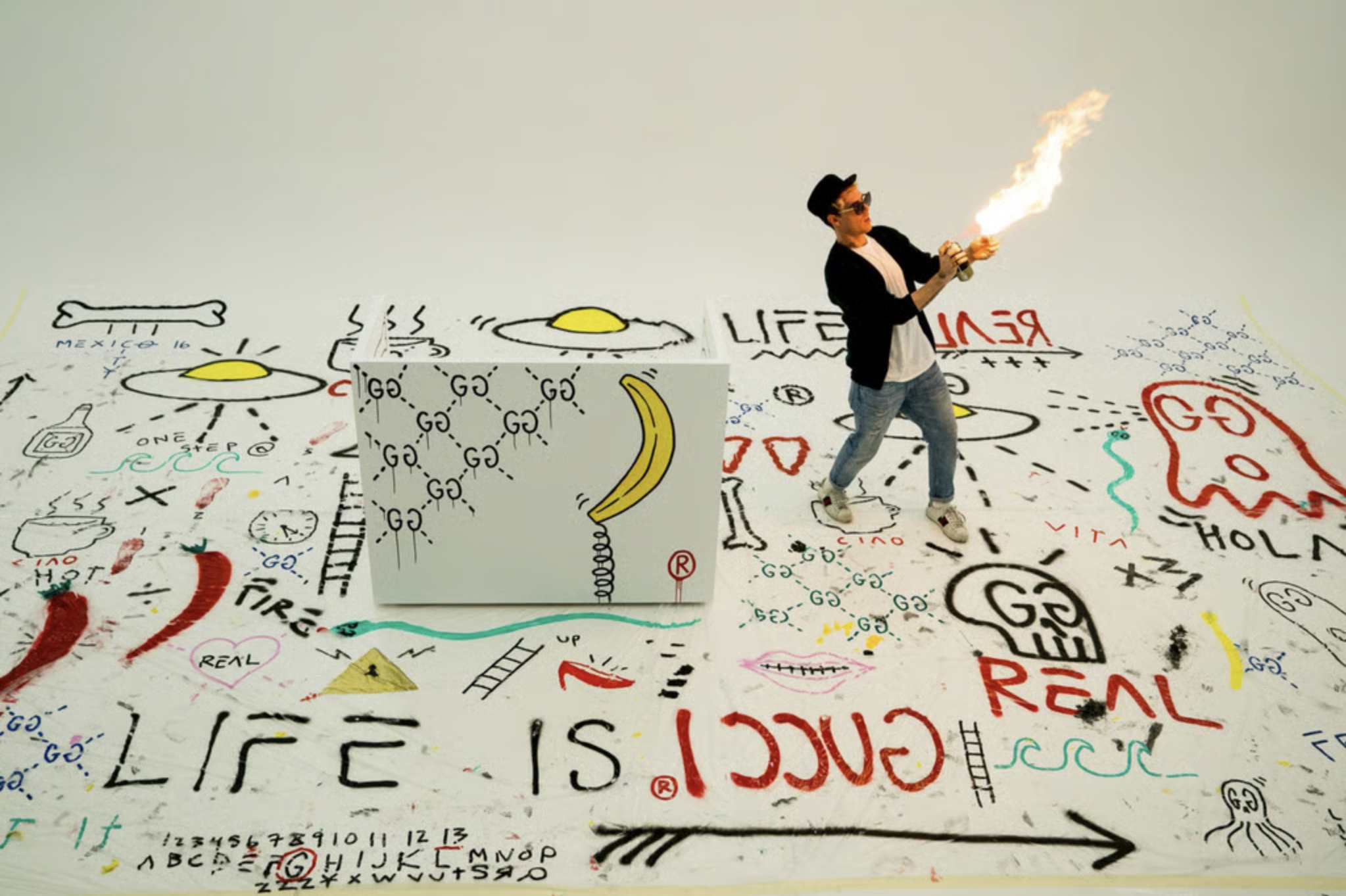
— Trevor AndrewAndrew began taking the GucciGhost imagery to the streets — spray-painting his dripping, hand-distorted version of the GG monogram on walls, on clothing, across the visual field of a city already saturated with luxury brand presence. He posted the work to Instagram under the hashtag #guccighost. The images spread. The account grew. By 2015 and 2016, GucciGhost was one of the more talked-about presences in a street art world that was already deeply entangled with fashion culture, and Gucci — whose legal team had every reason to pursue him — had a decision to make.
II. The invitation
Alessandro Michele, who had just taken over as Gucci's creative director in early 2015 and was in the process of dismantling everything the brand had been doing for the previous decade, saw what Andrew was making and did not see an infringement. He saw an artist who understood something about the Gucci logo that the brand itself had perhaps forgotten — that it was a symbol with enough power to survive being roughed up, that its authority was not diminished by being played with but actually amplified. Michele called. Andrew answered.
The collaboration on Gucci's Fall 2016 collection is now something of a case study in how luxury fashion and street culture can operate together without either party entirely losing themselves in the process — or at least appearing not to. Andrew painted directly on bags. He put his "REAL LOVE" logo above the Gucci wordmark. He contributed his dripping, hand-made GG to clothing and accessories that would sell for prices entirely unrelated to their street art origins. Michele described Andrew's language as "authentic" — which it was, and which was precisely why it was valuable to a brand trying to recapture some version of that quality.
The collaboration worked, commercially and culturally. It also raised questions that neither party had much incentive to answer publicly: What does it mean when the thing you were subverting invites you in? What does the subversion cost when it's printed on a $2,000 bag? And what happens to the artist when the brand, having absorbed the gesture, moves on to the next thing?
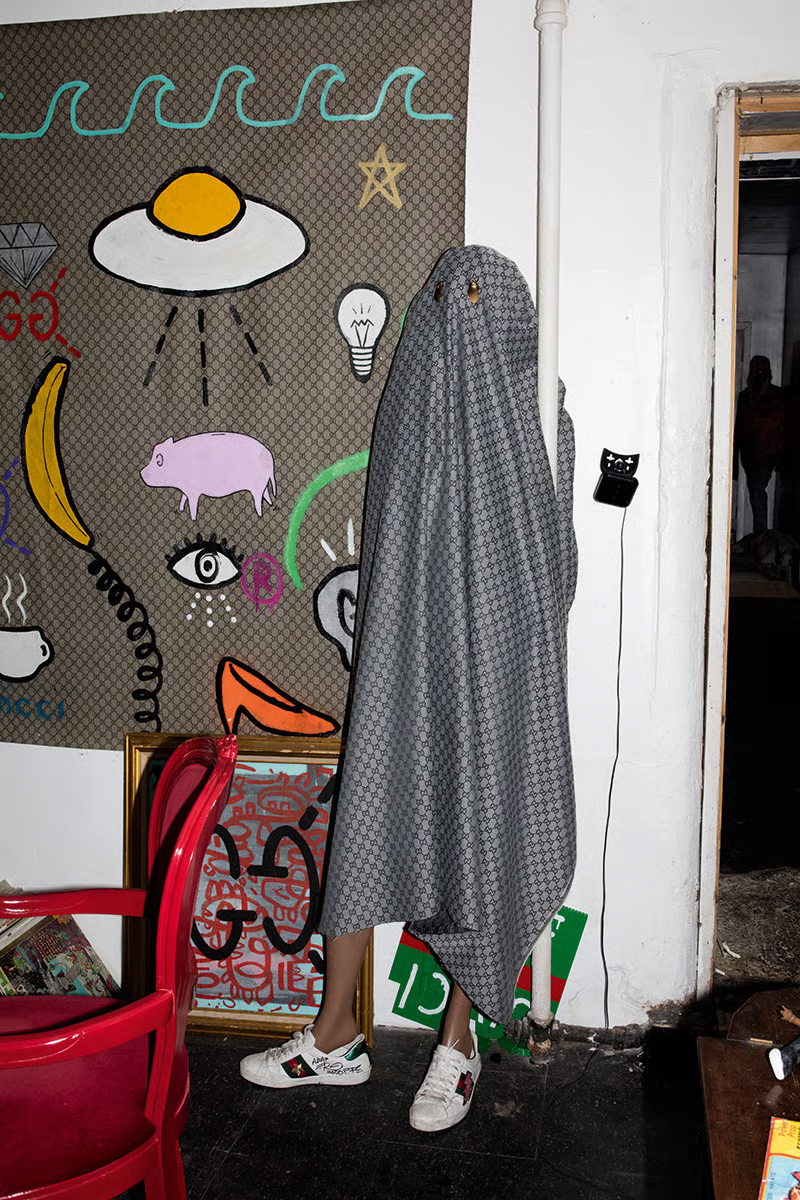
Trevor Andrew, GucciGhost series. Courtesy the artist.
III. Ten years on the wall
What is easy to miss in the GucciGhost story — because the collaboration with Gucci is so loud, so visually dominant, so perfectly suited to the kind of coverage that comes with a major fashion house's PR apparatus — is that Andrew kept making work throughout and after it. The collaborations with Gucci were an episode in a larger career, not the whole career. He showed at Deitch Projects in New York, at Milk Galleries, at the Modern Art Museum in Shanghai. He made work for the Victoria and Albert Museum in London. He released music. He built an audience that existed outside the fashion world.
But GucciGhost had become a brand in its own right — which is both the best and the worst thing that can happen to an artist's persona. The best, because it provided visibility and commercial viability that most artists never achieve. The worst, because it created an expectation: people wanted more GucciGhost, which meant they wanted the same gesture repeated, refined, expanded, but fundamentally the same. The dripping monogram. The "REAL LOVE." The ghost. The image that had started as a costume improvised from bedsheets had become a product, and products are not supposed to stop being themselves.
"It really put me on the map — but now I'm ready for new ideas."
— Trevor AndrewIn 2023, Andrew announced that he was retiring GucciGhost. After ten years and what he described as every major opportunity the persona could provide, he was done. The decision was not forced on him by the market or by a legal dispute or by any external pressure. He simply decided that the ghost had done what it could do, and that continuing to produce work under that name would be, in his own language, dishonest. The most interesting thing an artist can do after a decade of making one recognizable thing is stop making it.
IV. Bang, Bang
The work Andrew has been making since — developed over six years, with the Western-themed series shown in its first major public outing at D'Stassi Art in London in 2023 — is called "Bang, Bang," and it has almost nothing to do with GucciGhost. Almost.
The new work takes the Hollywood cowboy as its subject: the mythologized, sepia-toned, inescapably American figure of the Western, the image that generations of films and television and advertising have made into something that feels like it was always there, always inevitable, always true. Andrew grew up in Canada, which gives him a particular angle on the American West as a construction — a story a culture told itself about itself, using specific visual materials, with specific omissions. The cowboy is a branding exercise of a particular kind, and Andrew, who spent a decade inside the machinery of luxury branding, knows something about how those exercises work and what they cost.
The paintings use spray paint — the medium Andrew has worked with since his street art years — to reimagine these figures: provocative, audacious, the nostalgia intact but destabilized. The Hollywood cowboy rendered in the same gesture that once rendered the Gucci monogram. The technique is continuous even when the subject has completely changed, which turns out to be its own kind of statement: the hand that painted the ghost is the same hand painting the cowboy, and both are paintings about the distance between a symbol and what it actually means.
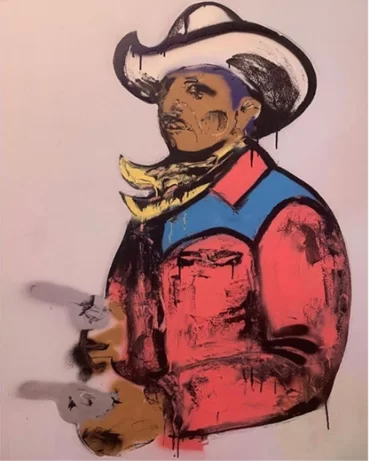
Trevor Andrew, from the Bang Bang series, 2023. Spray paint on canvas. Courtesy D'Stassi Art, London.
V. What the ghost left behind
There is a room in the "Bang, Bang" exhibition that contains GucciGhost work — Andrew included it specifically as context, as a kind of tombstone. Here is where I came from. Here is the thing I made. It was real, and now I'm done with it. The gesture is unusual in a world where artists and their market ecosystems are both incentivized to keep producing the thing that sold. Most artists who find a signature that works stick with it, refine it, let the market build around it. The signature becomes the brand becomes the legacy.
Andrew's decision to retire GucciGhost is interesting precisely because it wasn't a business decision. By most commercial metrics, the ghost was still working — the name still carried recognition, the work still sold, the collaborations were still possible. He retired it because he was done, which is a different thing entirely, and a rarer one.
What the decision reveals about the work — looking back at it now, with the distance of a few years — is that the GucciGhost project was always more coherent as a critique than it appeared when it was happening. The dripping, imperfect monogram was not just a funny joke about luxury branding. It was a sustained argument, repeated across a decade and a thousand walls, about the relationship between a symbol and its authority: about what happens when you take something designed to signify exclusivity and make it messy and public and free. The collaboration with Gucci complicated that argument in interesting ways — by accepting the invitation, Andrew let the brand complete the loop, absorbing the critique into itself, which is what brands do when they're strong enough. But the argument was always there, underneath the ghost costume, and the work Andrew is making now is its continuation in a different register.
The cowboy is another perfect logo. Andrew is taking it apart in the same way, with the same tools, for the same reasons. The ghost has moved on. The work has not.
1979 — Born in Canada. Spends his twenties as a professional snowboarder, competing at the highest levels of the sport.
2013 — Moves to New York. Creates GucciGhost as a Halloween costume; begins painting the distorted GG monogram across the city.
2015–16 — GucciGhost reaches critical mass on Instagram. Alessandro Michele invites collaboration on Gucci's Fall 2016 collection.
2016–22 — Continues making work under GucciGhost while also showing at Deitch Projects, Milk Galleries, the V&A London, and the Modern Art Museum in Shanghai. First NFT collection sells out in 12 seconds.
2023 — Retires GucciGhost after ten years. Debuts "Bang, Bang" — the Western series — at D'Stassi Art in London. States: "It really put me on the map — but now I'm ready for new ideas."