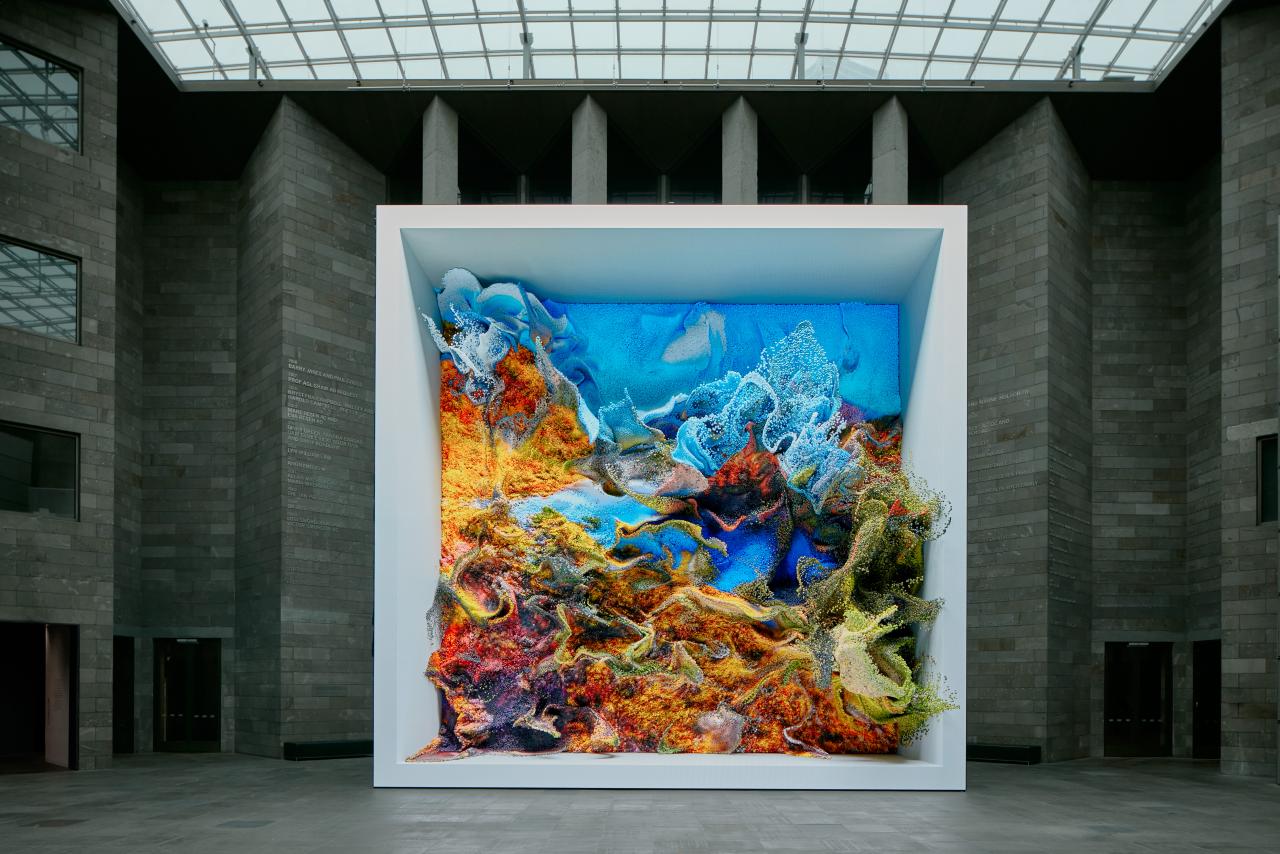
The first thing you notice is that it's alive. Not in the way we reach for the word when a painting feels energetic or a sculpture has presence — actually alive, in the sense that it is changing, continuously, in ways you cannot predict and cannot fully track. The surface moves like a deep ocean photographed from above: slow enough that the motion registers as drift, fast enough that nothing holds. Colors you didn't see arrive at the edge of your vision and dissolve before you can name them. Forms that suggest architecture — vaulted ceilings, coastlines, the branching logic of river deltas — emerge and reabsorb into the luminous field. You find yourself looking for a stable center and discovering that there isn't one, and that this absence is somehow not anxiety-inducing but its opposite. You stand and you breathe and the work breathes around you. This is what Refik Anadol does.
Anadol was born in Istanbul in 1985, trained as an architect at Bilgi University, and came to Los Angeles to complete an MFA in Design Media Arts at UCLA. He now runs Refik Anadol Studio from a building in Hollywood that houses data scientists, software engineers, and artists working in something closer to a laboratory than a traditional art practice. The work produced there — large-scale data sculptures, AI-generated installations, architectural-scale projections — has been shown at the Serpentine in London, the Sydney Opera House, the Sphere in Las Vegas, and the lobby of the Museum of Modern Art in New York. He is, by any measure, one of the most widely seen artists working today. The critical consensus on what that means is considerably messier than the attendance figures.
The Architectural Eye
Architecture trains you to think about the body in space — not the body as an abstraction but the physical human body navigating scale, negotiating the distance between floor and ceiling, understanding itself in relation to surfaces that dwarf it or compress it or open outward into something larger than a single person can comprehend. This is the training Anadol carries into everything he makes, and it explains why his work operates at the scale it does. He is not making screens or monitors or gallery-sized paintings. He is making environments. He is making architecture out of data.
The decision to think at architectural scale is not incidental. When you stand inside a Anadol installation — the work wrapping walls and sometimes floors and ceilings, the field of light total enough that the room becomes the piece — you are experiencing something closer to what it feels like to be inside a building than what it feels like to look at a painting. The body is implicated, not just the eye. You can walk through it. You occupy it. The relationship between viewer and work is spatial in a way that painting almost never achieves. Anadol understood this because he learned to think spatially before he learned to code, and the spatial logic got into everything.
There is also the question of what architecture is built from. Buildings are structural responses to physical law — gravity, load, stress, the properties of materials under pressure. Anadol's training asked him to think about materials: what they can bear, what they want to do, what happens when you push them past their limits. He has simply extended this inquiry to a new material. Data, in his practice, is not metaphor. It is the substance the work is made from, the way stone is the substance a building is made from. The question is what that material can do.
How It's Actually Made
The process, demystified, is something like this: Anadol and his studio identify a dataset — satellite imagery, climate records, social media streams, art historical archives, the collected audio of a city over decades. They acquire it, clean it, and feed it into machine learning models that have been trained to find patterns in the data and generate new outputs from those patterns. The outputs — visual, sonic, sometimes both — are then shaped and refined through a sustained creative process that involves aesthetic decisions at every level: which models, trained on what, producing what kinds of output, displayed at what scale, with what relationship to the architecture of the space. The result is a work that is neither pure computation nor pure authorship but something made in the gap between them.
This description will frustrate certain people in a particular way. The frustration usually sounds like: but where is the art? If the model generates the image, and the model is trained on other images, and the artist's role is to select and frame the output, what exactly has the artist made? This is a fair question. It is also a question that applies, with relatively minor adjustment, to a photographer who chooses a subject and a moment and a framing but does not make the light. The tools are different. The interrogation of authorship they invite is ancient.
What Anadol actually does — what any fair account of the studio practice reveals — is something more involved than curation. The choice of dataset is a conceptual decision with aesthetic consequences. Feeding climate data into a model produces a different kind of image than feeding MoMA's permanent collection, not because the model is different but because the underlying information has different structure, different density, different patterns of recurrence and variation. Anadol reads these datasets the way a traditional painter reads color — as material with properties, with grain, with the potential for certain kinds of expression and not others. His collaborators include engineers who write custom software for each project. Nothing is off-the-shelf. The tools are built for the work.
"Data, in his practice, is not metaphor. It is the substance the work is made from, the way stone is the substance a building is made from."
Priya Kapoor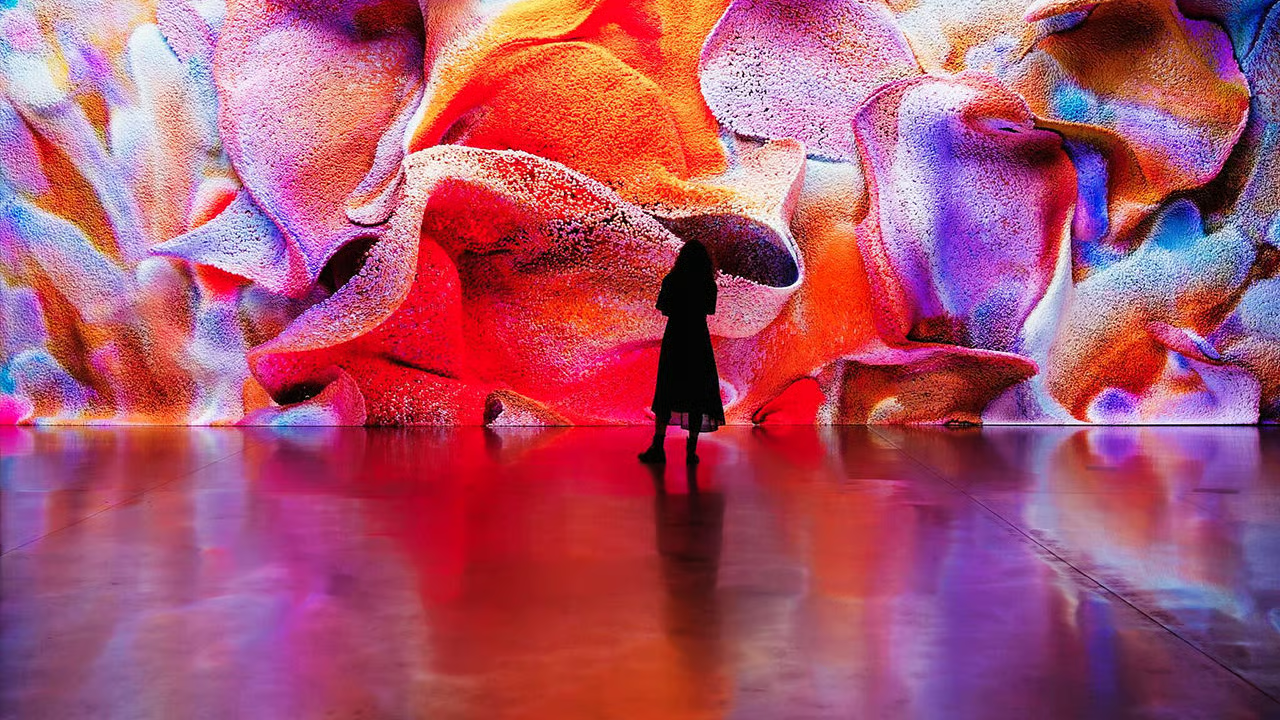
Photograph: courtesy Refik Anadol Studios.
MoMA and the Weight of Unsupervised
"Unsupervised," which occupied the first-floor lobby of the Museum of Modern Art from late 2022 through 2023, was in several respects the most ambitious thing Anadol had attempted. The conceptual premise was straightforward and almost audacious in its neatness: feed the museum's entire collection data — hundreds of thousands of works, spanning centuries, representing the institutional canon of Western modern and contemporary art — into a machine learning model and display the result in the lobby where visitors enter. Let the machine dream the collection. Put the dream where everyone can see it.
The institutional statement embedded in this gesture deserves its own paragraph. MoMA is not a neutral container. It is one of the primary organs through which the twentieth century decided what counted as art, which artists mattered, which movements were canonized and which were overlooked. To feed that entire apparatus — all of its curatorial decisions, all of its acquisitions and exclusions, all of its historical weightings — into a neural network and display the result in the lobby is to make the collection strange to itself. The model does not reproduce the collection. It finds the patterns in the collection and generates new images from those patterns. The result is, in a technical sense, what the collection looks like from the inside: the formal tendencies, the recurring structures, the unconscious preferences that accumulate over a century of institutional taste-making made visible as a continuous moving image.
Critics were divided. The positive reception noted the democratic accessibility of the work — it was free, it was in the lobby, it required no art historical preparation, it operated on visceral sensation before anything else. The negative reception, which we will come to, was sharper and not entirely wrong. What both camps agreed on was that the work changed the experience of entering the museum. You walked in and something was already happening, something enormous and moving and slightly uncanny, and you had to walk through it to get to the galleries. The collection you were about to see had already been dreamed at you. That disorientation was not accidental.
The Criticism, Taken Seriously
The critique of Anadol's work, stated honestly, goes something like this: it is spectacular without being substantive. The scale overwhelms. The beauty seduces. The technology dazzles. But once you have been dazzled, once the initial experience of standing inside the light field has passed, there is nothing left to think about. The work does not accumulate meaning over time. It does not reward sustained attention in the way that a painting or a sculpture rewards sustained attention. It is, at its worst, a high-end screensaver — a demonstration of what AI and computational power can produce when asked to produce something beautiful, which turns out to be something that looks like nature, or like the dreams we'd like to think machines have, or like what data feels like if data feels like anything. The criticism holds that Anadol has made a career out of the wow moment and has not yet been asked to answer for what comes after it.
This critique has real force. It is the critique you need to hold in your head while looking at the work, not because it invalidates the experience but because the experience is incomplete without it. There are Anadol installations that do feel more like event than art — that justify themselves through spectacle and leave you with nothing to carry out of the room. "Unsupervised" was not, in the view of several serious critics, much more than a beautiful technical demonstration. The MoMA collection is one of the most data-rich repositories of human aesthetic production in existence, and the machine's response to it — while genuinely strange and sometimes startling — did not obviously illuminate the collection or the institution or the relationship between historical cultural production and machine learning. It was beautiful. It was there. It was large. These are not nothing, but they are not quite everything the premise seemed to promise.
Where the critique starts to thin is when it implies that spectacle is disqualifying. The history of art is full of work that operates primarily on sensation — that stakes its claim on the quality of the experience and trusts that experience to carry more than analysis can easily parse. The sublime in the landscape tradition was not defended primarily by argument. Certain Rothkos resist intelligent description and operate instead on something that is either spiritual or physiological or both. To demand that Anadol's work yield a propositional reading — a meaning that can be stated apart from the experience — is to apply to new media art the expectations of a medium that new media art is not trying to be. The question is not whether the work has content in the sense a painting has content. The question is what the experience of standing inside a machine-generated field of living light actually does to you, and whether that doing constitutes art. Increasingly, it seems like the only honest answer is yes.
"The question is not whether the work has content in the sense a painting has content. The question is what the experience actually does to you."
Priya KapoorWhat New Media Art Is For
Anadol has spoken often and fluently about his ambition to make data legible — to take the invisible ocean of information that structures contemporary life and render it visible, beautiful, accessible. He talks about democratizing data, about bringing machine intelligence out of server rooms and into public space, about showing people what the world they are already living inside actually looks like when you find a way to see it. This agenda has obvious virtues and obvious risks. The virtues: it is generous, it is accessible, it is committed to public experience rather than private collection, and it takes seriously the idea that art can expand the perceptual repertoire of people who encounter it. The risks: the agenda can function as a justification that substitutes for the harder work of making something that survives the removal of its context.
What does it mean to make art from data in 2026? The question has become more urgent with each passing year, not less. We live inside data — inside the collected record of our movements, preferences, purchases, health metrics, social connections, emotional states as inferred from behavioral signals. This record is enormous, structurally invisible, and almost entirely controlled by entities with interests that are not our own. Most of us will never see it. Most of us will live and die inside a description of ourselves that we have no access to and cannot read. Anadol's project, at its most useful, offers a glimpse of what that description looks like when rendered visible — not our personal data, but data at the scale of the world, which is the scale at which our personal data actually operates.
Whether that glimpse constitutes understanding is a harder question. The installations are beautiful in ways that may or may not be consistent with what the data would want to look like if data had preferences. The machine learning models that generate the imagery are trained to produce coherent, visually compelling output — which means they are, at some level, trained to produce beauty, which means the beauty of the result is partly a function of what we told the machine beauty was. There is a circularity here that the most interesting readings of Anadol's work have begun to surface. We feed the machine images we consider beautiful. The machine generates images that share their features. We find the result beautiful. We have made a mirror and called it a window.
This is not an argument against the work. It is an argument for reading the work carefully — for holding the experience alongside the question rather than letting the experience crowd the question out. Anadol is, by his own account, an optimist about machine intelligence, about the creative possibilities of human-AI collaboration, about what happens when you give a neural network access to the full record of human cultural production and ask it to dream. The optimism is part of what makes the work feel like it does: expansive, generous, somehow hopeful in the face of a moment that does not often invite hope.
Whether you share that optimism will determine a lot about how you stand in front of the work. But standing in front of it is not optional, if you want to understand where art is going. Refik Anadol is building something — an argument, a practice, an institution, a visual vocabulary — that will outlast the debate about whether it qualifies. The machines are dreaming. The question is what we do while we watch.