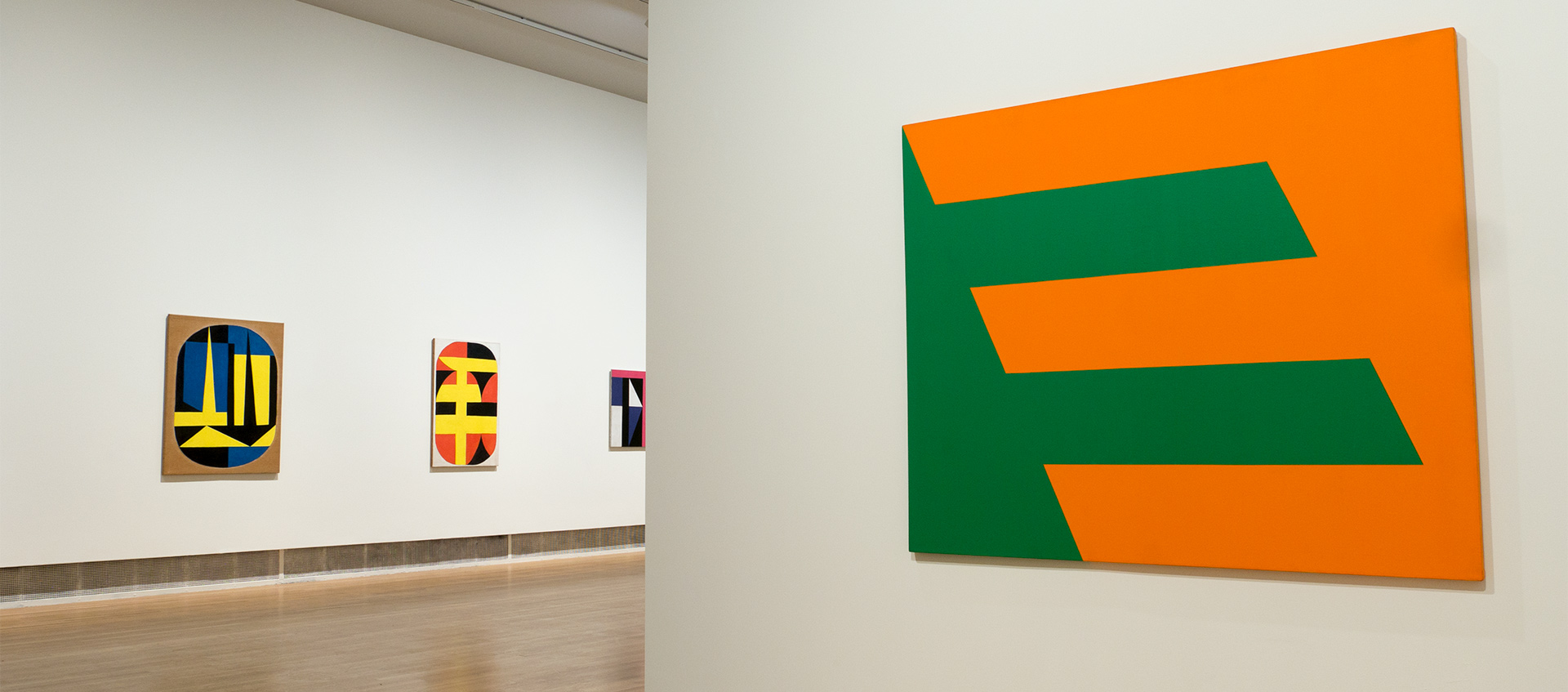
The paintings do not ask for your sympathy. That is perhaps the first thing you notice standing in front of a Carmen Herrera canvas — the complete absence of emotional appeal, the refusal to soften anything. Two planes of color meet along a precise diagonal or a sharp vertical line, and neither plane yields to the other. There is no blending, no modulation, no tremor in the brushwork. The green is fully green. The orange is fully orange. The line between them is the painting's only event, and it is an event of such compressed authority that you find yourself staring at it with an attention the work seems to have earned rather than solicited. This is what hard-edged geometric abstraction can do at its best — produce a visual tension that is physical before it is conceptual, something you feel in your eyes before you have words for it.
The paradox of Carmen Herrera's career is not simply that she went unrecognized for sixty years — plenty of artists go unrecognized, and the reasons are rarely so clean as pure injustice. The paradox is that her work was doing something precise and rigorous and right, something that art history would eventually have to acknowledge, and the art world of the mid-twentieth century looked straight at it and kept walking. She was working in Paris in the late 1940s alongside artists who became canonical. She was producing paintings that belong, by any formal standard, in the same conversation as Ellsworth Kelly, Josef Albers, Carmen's own contemporary hard-edge painters who were rewarded with museum shows and dealer representation and critical consideration. She sold her first painting at the age of eighty-nine. The distance between those two facts is the subject this piece cannot fully close, but must at least try to hold open.
Havana, then Paris, then a long silence
Carmen Herrera was born in 1915 in Havana. Her father was a journalist and publisher — a man with, by all accounts, the particular ambition of someone who had decided ideas mattered — and she grew up in a household where intellectual life was a given rather than an aspiration. She studied architecture in Havana before turning to painting, and that architectural training shows in every canvas she made for the next hundred years: the precision of the line, the structural thinking about how a plane sits within a frame, the refusal to use color as atmosphere when it could function as form. She married Jesse Loewenthal in 1948. He was an American, a high school English teacher from New York, a man who had the combination of emotional intelligence and practical solidity that a painter who is going to spend six decades not selling paintings requires in a partner. He believed in the work completely. He always had.
They moved to Paris together and stayed through the late 1940s, years that were, for the European and American artists gathered there, a period of furious recalibration. The war had just ended. The certainties that had organized Western culture were either destroyed or in the process of being dismantled and rebuilt on new terms. Abstraction — particularly the geometric kind, with its implication that form could carry meaning without borrowing it from the world of recognizable things — felt urgent in a way it is hard to fully reconstruct from this distance. Herrera was part of that Paris scene, showing in group exhibitions, making connections, working in a studio while Jesse taught. She was not peripheral to what was happening. She was in it.
Ellsworth Kelly was in Paris during the same period. He was making similarly rigorous investigations into the relationship between shape, color, and edge — and he has acknowledged, in the years since Herrera's late recognition began, that she was a presence he was aware of. The difference in their subsequent careers is not explainable by the quality of the work. It requires other kinds of explanation: gender, nationality, the specific economy of a mid-century art world that was prepared to crown certain kinds of painters and not others, that could imagine a Cuban woman in Paris but could not quite imagine her as the subject of a Whitney retrospective or a Castelli Gallery contract. These are not comfortable explanations, but they are the available ones.
"I just paint for the love of painting. But also, I am very ambitious."
— Carmen HerreraJesse, and the decades of private conviction
They returned to New York eventually, settling into a life organized around Carmen's painting and Jesse's teaching. He brought home the money. She made the work. This was an arrangement they both understood and neither, apparently, found demeaning — Jesse's commitment to her career was not the patronizing support of someone humoring a hobby but the genuine conviction of a person who understood what he was looking at. He talked about her work to whoever would listen. He managed the practical dimensions of a painter's life that she preferred not to manage. He was, by every account that survives, a good man who had correctly identified something important and given his life to supporting it.
What did those decades look like from the inside? Herrera has described them with the equanimity of someone who was never confused about what she was doing, even when the world was confused about whether it mattered. She painted in the morning. She maintained her discipline. She continued to develop the formal language she had arrived at in Paris — the flat planes, the bold palette, the line of division that is the painting's spine — refining it, pushing it into new configurations, working through series of related problems the way a mathematician works through related proofs. The work was not static. It was a living investigation. The absence of an audience did not make it less serious; if anything, it required a particular kind of seriousness, the kind that doesn't depend on external validation to sustain itself.
There is a version of this story that sentimentalizes the isolation — the pure artist, untouched by commerce, working in a garret for the love of the thing. That version is not quite right. Herrera wanted to be seen. She entered shows. She sought gallery representation. She was, by her own admission, ambitious — the word she used, and she meant it without qualification. The isolation was not chosen. It was the condition of the work's existence in a world that had not yet figured out what to do with her. Jesse died in 2000. He never saw her recognized in any of the ways her work deserved. After he was gone, the story began, quietly, to change.
The age-89 sale, and what it meant
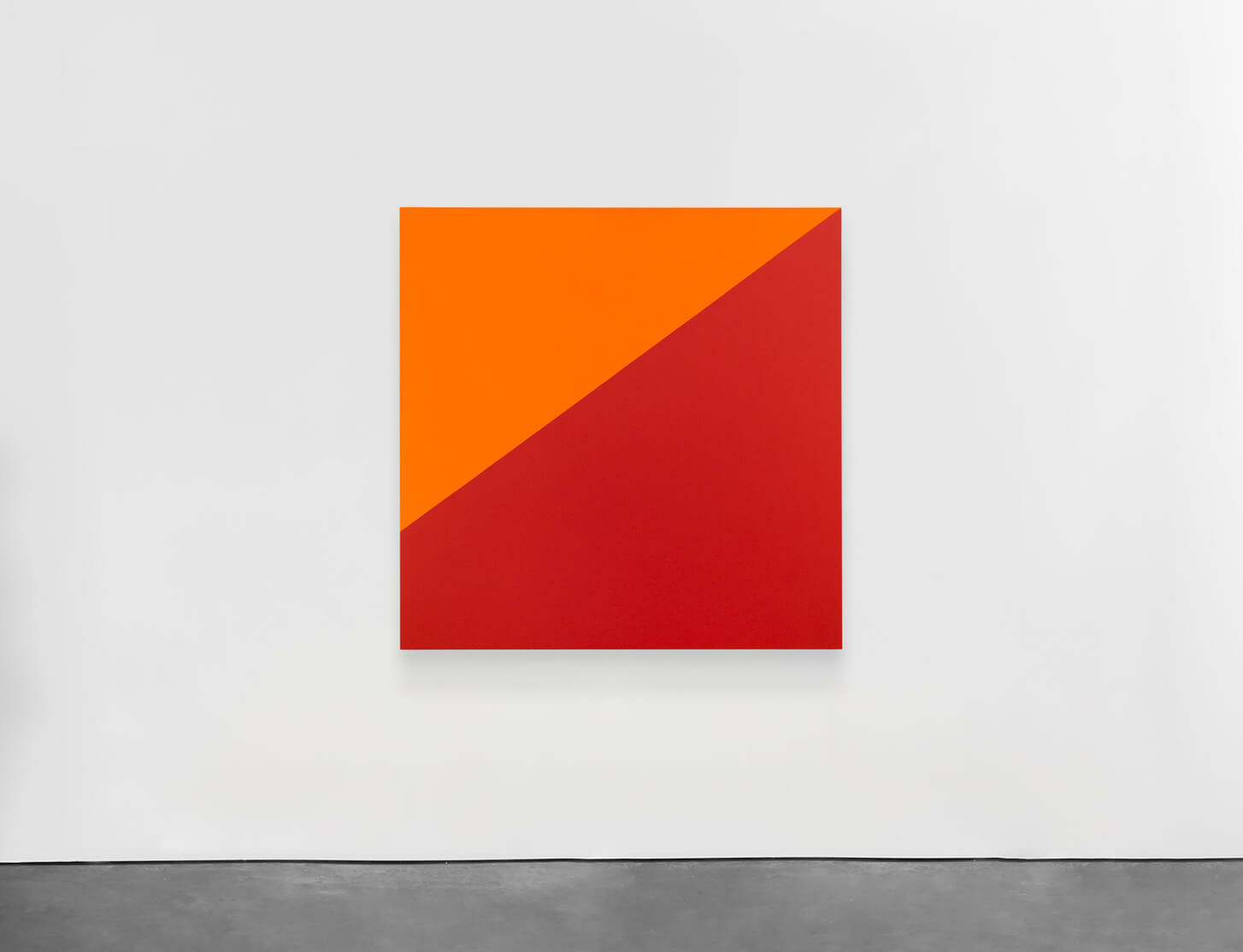
Carmen Herrera, Desierto Rojo, 2017. Acrylic on paper, 50 × 70 cm.
The Tony Shafrazi Gallery in New York acquired a Herrera painting in 2004 — she was eighty-nine. It was her first sale. The documentary filmmaker Frederico Tobon made a film about her in 2009, The 100 Year Show, which brought her to a wider public; the title, at the time of filming, was slightly premature, but she lived to make it accurate. The Museum of Modern Art, the Whitney, the Hirshhorn — the institutions that had been entirely absent from her career for sixty years — began acquiring her work. Lisson Gallery, one of the most respected contemporary galleries in the world, took her on. She received the Order of Arts and Letters from the French government. She was the subject of a major retrospective at the Whitney in 2016, when she was 101 years old.
None of this embittered her, at least not in any way she was willing to perform. She was clear-eyed about what had happened and what it meant. She knew the art world had failed to see something that was in plain sight. She said so, without particular anger, the way you might note a fact about the weather. What she was not, in any of the interviews and profiles that accumulated around her late recognition, was naive. She did not attribute the decades of invisibility to bad luck or poor timing. She knew the reasons. She named them when asked. She was a woman. She was Cuban. She had returned to New York rather than staying in Europe, which turned out to matter. These were the facts. She had kept painting through all of them, and the paintings were still the same paintings — uncompromising, precise, indifferent to the approval they hadn't received.
"I have been painting for a long time. I am not going to stop now."
— Carmen Herrera, at age 101The De Stijl comparison, and why it matters
Herrera's work belongs to a tradition that Mondrian's name usually stands for — the reduction of painting to its primary elements, color and line and plane, the elimination of representation in favor of pure formal relationship. But Mondrian arrived at his solutions through a specific philosophical and spiritual framework, Theosophy and its attendant notions of universal harmony, and his famous primaries — red, yellow, blue — carry that framework's freight. The grid is cosmic. The balance is metaphysical. The work has a religiosity to it that is inseparable from its formal achievement.
Herrera's geometric abstraction is something different. Her colors are not Mondrian's primaries, and her diagonals refuse his right angles. She was not working toward universal harmony; she was working toward a specific visual event, the confrontation between two planes of pure color along an edge that neither can cross. Where Mondrian's grids feel like they are resolving something, Herrera's diagonals feel like they are holding a tension in place — the two colors pressing against each other, neither winning, neither yielding, the line between them not a resolution but a standoff. It is a more violent kind of painting, underneath its composure. The composure is the point. The violence is what the composure contains.
The comparison to Ellsworth Kelly is more useful formally, though even there it breaks down in instructive ways. Kelly arrived at his hard-edged geometry partly through the observation of shadows and shapes in the natural world — he traced things, derived his forms from perception. Herrera's forms seem to arise from a different kind of logic, more purely internal to the rectangle of the canvas, more focused on what happens at the edge where two colors meet. Her paintings are propositions about color relationship first, and everything else — size, scale, surface, the decision about which color goes where — follows from that central question.
What the work actually does
The easiest thing to say about Herrera's paintings — and the least useful — is that they are beautiful. They are beautiful. But beauty is too soft a category for what they do. Stand in front of Green & Orange, the 1958 canvas that now hangs in major collections and fetches prices that would have seemed impossible during the decades when it was hanging unsold in her apartment, and what you feel is not the soft pleasure of beauty but something more like equilibrium tested. The green pushes. The orange holds. Or the orange pushes and the green holds. The painting doesn't resolve which is figure and which is ground, which is advancing and which is receding, and this irreducibility is not a failure but the painting's central achievement — it keeps you suspended in the question.
This is what geometric abstraction at its best can do, and what it requires a painter of Herrera's discipline to execute. The appearance of simplicity is deceptive. Two colors on a canvas, meeting along a diagonal — it sounds like something a student could do in an afternoon. But the specific green and the specific orange and the specific angle of the specific diagonal all have to be exactly right, or the painting doesn't hold. There are no marks to look at, no texture to follow, no narrative to trace. There is only the relationship. Get it wrong and there is nothing to look at. Get it right and the painting becomes one of those objects that you can stand in front of for a long time without fully exhausting.
Carmen Herrera died in 2022 at the age of 106. She was painting until very near the end — working on a series of canvases with the same patience and precision she had brought to every canvas for seventy years. The recognition that came to her in her final decades was genuine and deserved. The Whitney retrospective drew crowds. The prices at auction climbed to levels that would have seemed laughable to anyone who knew the story of the decades before. And the work itself remained unchanged — uncompromising, unmodified, indifferent to the validation it had finally received, exactly as it had been indifferent to the silence that preceded it. The paintings did not ask for your sympathy. They never had. They asked only that you look.