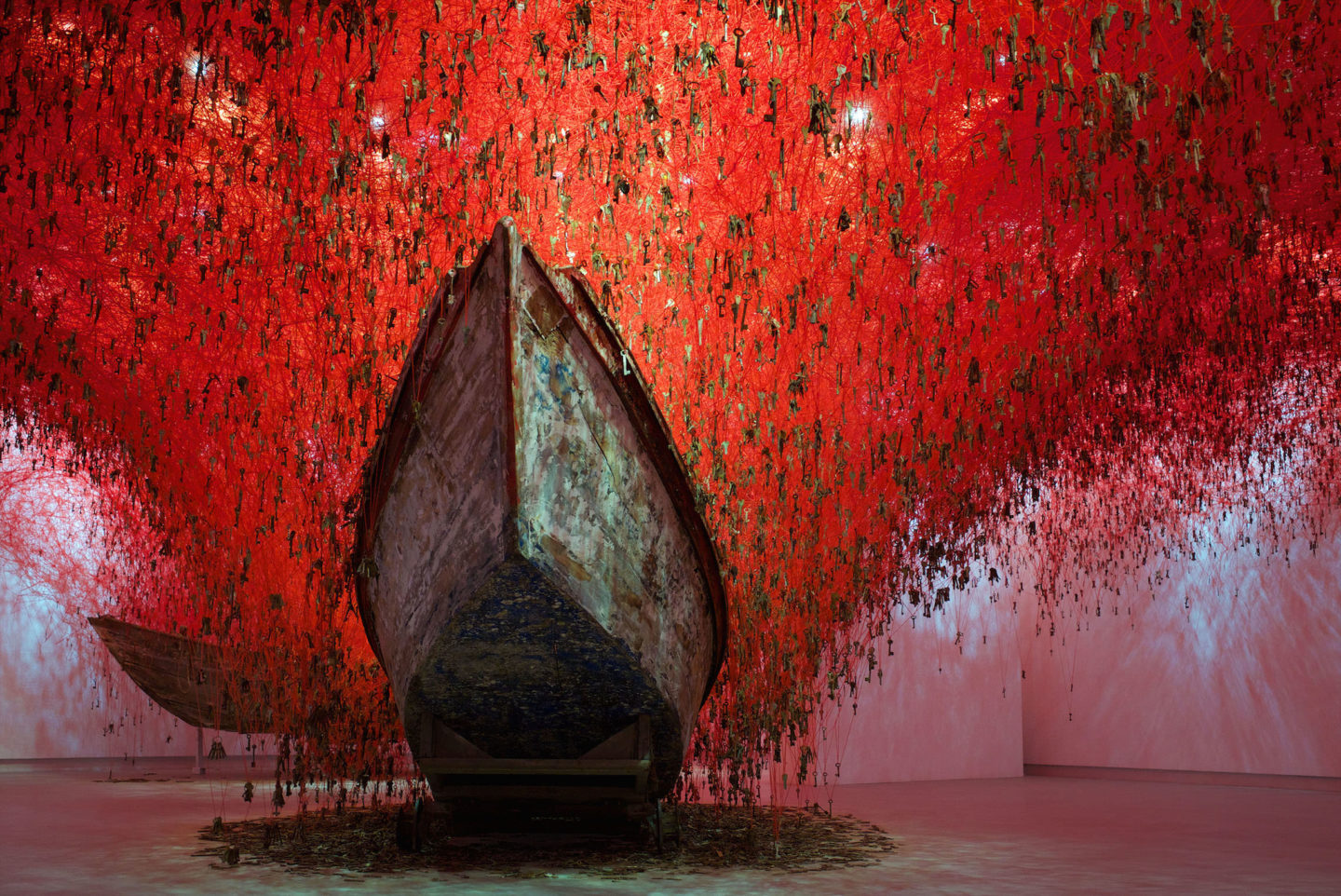
You step inside and the first thing you feel is that the room is breathing. That is not metaphor — or not only metaphor. The installation occupies the full volume of the space, filling it from floor to ceiling with threads so densely interwoven they seem less like individual lines and more like a single organism, suspended and alive. The threads are red. Thousands of them. And hanging from them, catching light in small metallic flashes, are keys. Tens of thousands of keys — house keys, car keys, cabinet keys, skeleton keys, keys so old their locks no longer exist — each one donated by a person somewhere in the world who held the thing in their hand and let it go. Underneath it all, at floor level, sit two wooden boats. They look like they are waiting.
This is The Key in the Hand, Chiharu Shiota's installation for the Japanese Pavilion at the 2015 Venice Biennale, and it is one of the most overwhelmingly beautiful things made by any artist in the last decade. It is also, though few people who saw it knew this at the time, the work of a person who had recently been told she might be dying. Shiota received her leukemia diagnosis in 2014, shortly before the Venice invitation arrived. She underwent chemotherapy while developing the concept. She was in treatment while her team stretched kilometer after kilometer of red thread across the pavilion's interior. She attended the opening in a body that was, by any clinical measure, still fighting to stay here.
The work was not made about cancer. Shiota does not make confessional art in any direct sense. But everything she has ever made has circled the same set of questions — about what the body holds, about what leaves when it is over, about the invisible threads that connect one person's life to another's — and when those questions arrived in Venice freighted with a new and personal urgency, the installation became something it might not otherwise have been. A meditation on survival. A room full of things people had used to open doors, now suspended in the air, going nowhere, going everywhere.
"I feel there is something inside the body — and when we die, that something goes somewhere. The body becomes empty. But where does it go?"
— Chiharu ShiotaA question from a cow's head
Shiota was born in 1972 in Kishiwada, a small city south of Osaka in the Kansai region of Japan. She describes her childhood as ordinary, a word that does not quite cover the fact that she grew up in a place with a 400-year-old castle at its center, in a country where the boundaries between the living and the ancestral are managed with considerable ceremony. She studied at the Kyoto City University of Arts and, by her own account, arrived there not yet knowing what she was looking for. She found it, or the beginning of it, in a formative experience she has described in interviews many times since: the dissection of a cow's head in an art class. She watched the teacher remove the flesh and the bone, working down toward the brain, and she felt, with a clarity she had not expected, that there was something inside the animal that she could not locate — something that had been present and was now absent. The body was all there. And something was gone.
This became the question that would organize her career. Not death, exactly, and not grief — though both are present in her work — but the specific puzzle of what the body contains that is not the body. She moved to Germany in 1996, initially to study at the Braunschweig University of Art, where she worked under Marina Abramović. The encounter was formative in the most literal sense: Abramović's practice, built on duration, endurance, and the physical limits of presence, handed Shiota a vocabulary for thinking about the body as a site of conceptual investigation. She later studied with Rebecca Horn and worked alongside Christian Boltanski, whose obsessive relationship with memory and with the traces that the dead leave behind shaped her thinking in ways she has acknowledged directly. Berlin became her home. She has lived there ever since, which means she has now spent more of her life in Germany than in Japan — a fact that runs quietly through everything she makes.
Thread as nervous system
The thread started early. In her 2002 work During Sleep, Shiota covered sleeping figures — students who agreed to spend nights in a gallery space — with webs of white thread, the material accumulating over them like a second skin or a cocoon, something both protective and enclosing. The figures could still breathe. They could still move. But they were also, unmistakably, caught. The work is eerie and tender in equal measure, and it announced several things at once: that Shiota's material of choice would be thread; that she was interested in the relationship between bodies and the space immediately surrounding them; and that sleep — that small daily rehearsal for absence — was a state that interested her.
She has used thread in almost everything since, though the color and the accompanying objects have shifted. Black thread appeared in In Silence, one of her most reproduced works: a burned piano, charred and collapsed, sits at the center of a web of black thread from which dead plants are suspended. The piano has been destroyed. The music it contained is gone. The thread holds the surrounding space in a kind of net — catching, perhaps, what escaped. The image is stark enough to seem obvious, and yet the experience of standing inside it is nothing like obvious. The thread is not decorative. It changes the room's physics. You become aware of air as a medium, of the space between objects as something that can be filled, felt, inhabited.
Shiota has described thread as representing blood vessels, nerves, the invisible connections between people. In Japanese and Chinese tradition, there is the concept of the red thread of fate — akai ito — an invisible cord said to connect people who are destined to meet, regardless of time, place, or circumstance. The thread may stretch or tangle, but it never breaks. Shiota has said she was aware of this idea when she began working with red thread, though she is careful not to reduce her installations to that single reference. The thread means more than one thing. It always does.
"The thread is not decoration. It is the space between people — the thing that holds us together even when we cannot see it."
— Chiharu ShiotaThe objects of a life
Thread alone would be enough for a career. Shiota is also, alongside the thread, a collector of objects — or rather, a collector of the category of object that carries the weight of a human life without being a human. Old suitcases. Worn shoes. Chairs. Windows salvaged from demolished buildings. Hospital beds. Boats. Each object class carries its own set of associations, and Shiota is systematic about this in a way that never feels schematic. The suitcases in Accumulation — Searching for the Destination (2014) are suspended inside a red thread web, hundreds of them, and they read instantly as journeys — arrivals, departures, the accumulated weight of transit. The shoes in earlier works are intimate in a different way: a shoe holds the shape of a foot that wore it, a specific person's specific foot, walking a specific direction. The object survives the person. The impression remains.
The keys in Venice belong to this logic and extend it. A key is an instrument of access — it opens a door that would otherwise be closed — but it is also one of the most personal objects a person can carry. You handle a house key many thousands of times over the course of owning a home. It passes through your hand so routinely that you stop noticing it, the way you stop noticing the weight of your own body. Shiota asked people around the world to donate keys, and they did, in extraordinary numbers — over 50,000 in total, accompanied in many cases by letters explaining what the key had been for, what it had opened, who had held it. The letters were not displayed. But Shiota read them all.
Venice, and what came before it
The 2014 leukemia diagnosis arrived, as serious illness usually does, at a moment that seemed to have no room for it. Shiota was in the middle of her career, showing widely, building toward something. She has spoken about the period of treatment with characteristic restraint — not dwelling on the physical particulars, more interested in what the experience clarified. The question she had been asking since that art school dissection in Kyoto became, briefly, not theoretical. She was the body now. She was the thing that might become empty. The something inside her was being asked, by the disease, to declare its intentions.
She has said that the experience of serious illness made her more certain of what she wanted to make, not less. The Key in the Hand was conceived during this period and is pervaded by it in ways that resist direct statement. The boats suggest journeys toward something unspecified. The keys suggest access — to what, exactly, is left open. The red thread connects everything to everything else in a web so dense it becomes its own kind of atmosphere. You are not looking at the work from outside; you are standing inside it, part of its connective tissue, another object suspended in the net.
The Biennale opened to enormous response. Shiota was not yet widely known outside the contemporary art world and installation-focused institutions; The Key in the Hand changed that. Images of the installation circulated far beyond the usual art press. People who had never heard her name recognized the work. This is a thing that happens occasionally — an image breaks out of its context and acquires a life in the general visual culture — and when it happens it is usually because the image is doing something that the image-making world needs, something it couldn't articulate the need for until the image arrived. What Shiota's Venice work offered was a way of picturing connection that wasn't sentimental or abstract but physical, spatial, overwhelming. A room full of other people's keys, held together by thread. You could step inside it and feel, for a moment, that you were held too.
The space between presence and absence
In 2019, the Mori Art Museum in Tokyo mounted a major retrospective of Shiota's work titled The Soul Trembles. It was her first large-scale survey in Japan, a homecoming of sorts for an artist who had made her reputation in Europe and whose relationship to Japan — geographic, cultural, artistic — had been mediated by distance for more than two decades. The show drew hundreds of thousands of visitors, a number that surprised nearly everyone, including the museum. Shiota was not a household name in Japan in the way that some artists become; but the work, presented at scale, found an audience that seemed to have been waiting for it.
The title comes from a phrase that Shiota uses to describe what interests her in the relationship between body and soul — the trembling, the moment of uncertainty when one is separating from the other. It is not a comfortable subject. Art that takes death seriously, that tries to look directly at what happens to the self when the body fails, tends to be either devastating or evasive, and Shiota is neither. She is more interested in the threshold than in either side of it — in the specific texture of the space between here and gone, between presence and absence, between the person who was here and the empty room they left behind.
Her work since the cancer and since Venice has continued this investigation with, if anything, greater patience. She has made pieces about skin, about the boundary of the body. She has made pieces about water, about the sea as a surface between worlds. She has returned, repeatedly, to thread — red thread, black thread, white thread — as if the material itself is inexhaustible, as if it keeps having more to say. In a 2022 interview, she described her practice as a form of conversation with questions she cannot answer. She is not trying to arrive at a conclusion. She is trying to stay inside the problem, to keep it alive, to stretch it across as much space as possible and hold it there, suspended, where it can be entered and felt.
"I don't think my work is about death. I think it is about the moment just before — and the moment just after. The trembling in between."
— Chiharu ShiotaWhat stays
There is a practical dimension to Shiota's installations that her interviewers tend to underreport. The thread is not hung by machine. Kilometer after kilometer of it is stretched by hand, by teams of assistants working over periods of days or weeks, under Shiota's direction and sometimes alongside her. The process is meditative and also physically grueling — reaching, pulling, tying, testing angles, adjusting tension. The final density of a piece cannot be fully planned in advance; it arrives through accumulation, through the decisions made during the making, through the patience of the people doing the work. Shiota has described the process as collaborative not in the credit-sharing sense but in a more fundamental one: the work knows what it wants to become, and the people making it follow it there.
This matters because it means the installations are not, at root, conceptual objects that have been realized. They are more like things that grew. The density of the thread in The Key in the Hand, the exact weight of all those keys, the specific red of the specific thread — these are not illustrations of an idea. They are the idea, arrived at through process, existing in the particular way that handmade things exist: with the time of their making inside them.
Shiota is still based in Berlin. She is 54 years old and by any measure in the middle of her career, which is to say she has been doing this for thirty years and shows no signs of being finished with the question that started with a cow's head in an art school in Kyoto. The leukemia is in remission. She works. When asked what she hopes people feel when they walk into one of her rooms full of thread and keys and objects from the lives of strangers, she tends to give variations of the same answer: she hopes they feel that they are not alone. That the connections are real even when they're invisible. That the thread, however thin, holds.