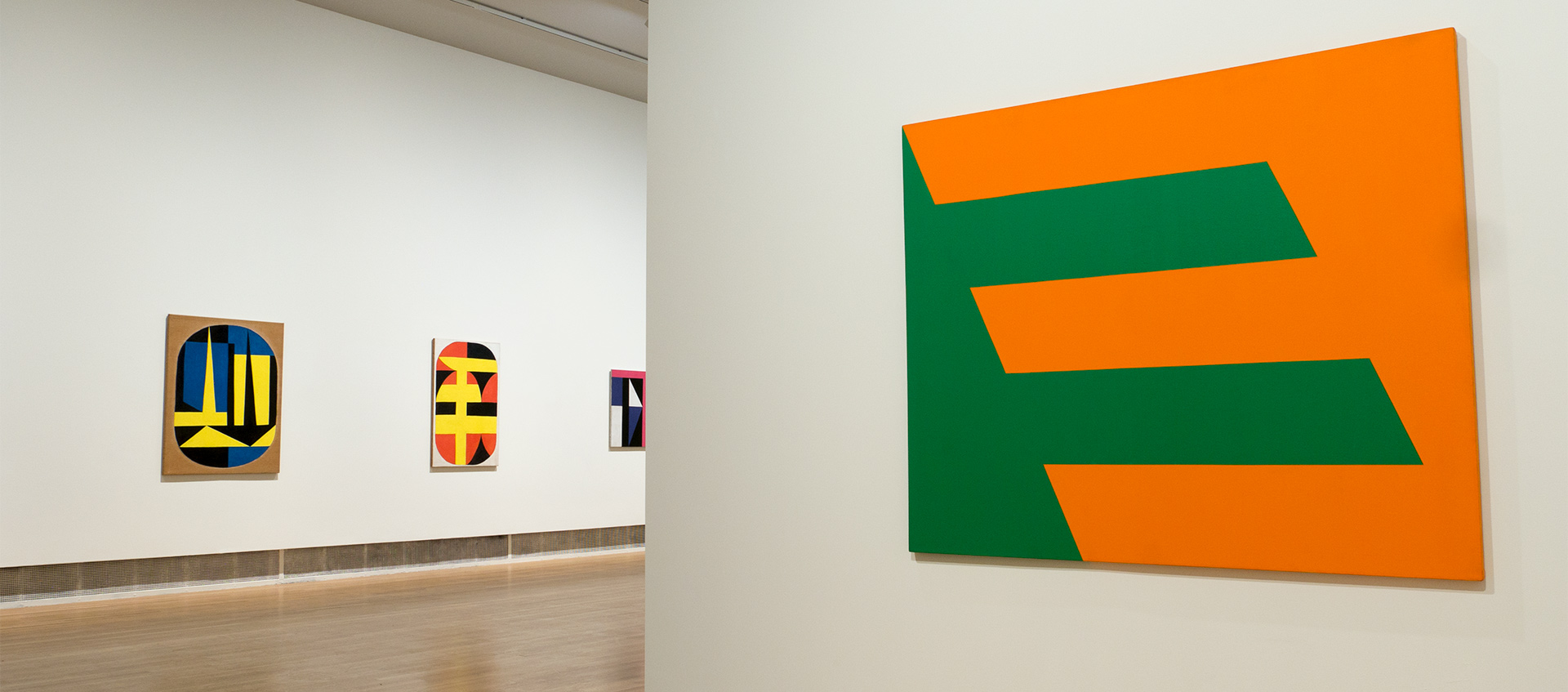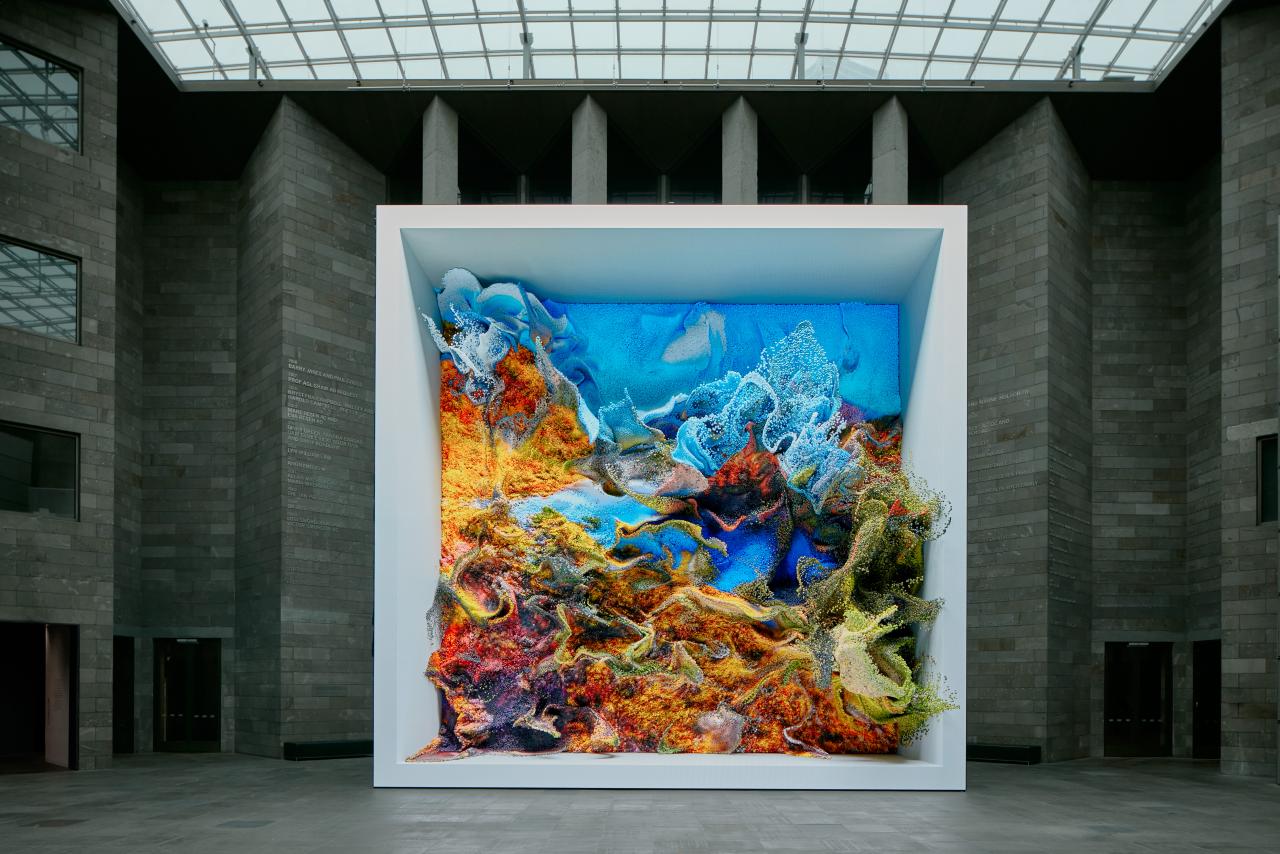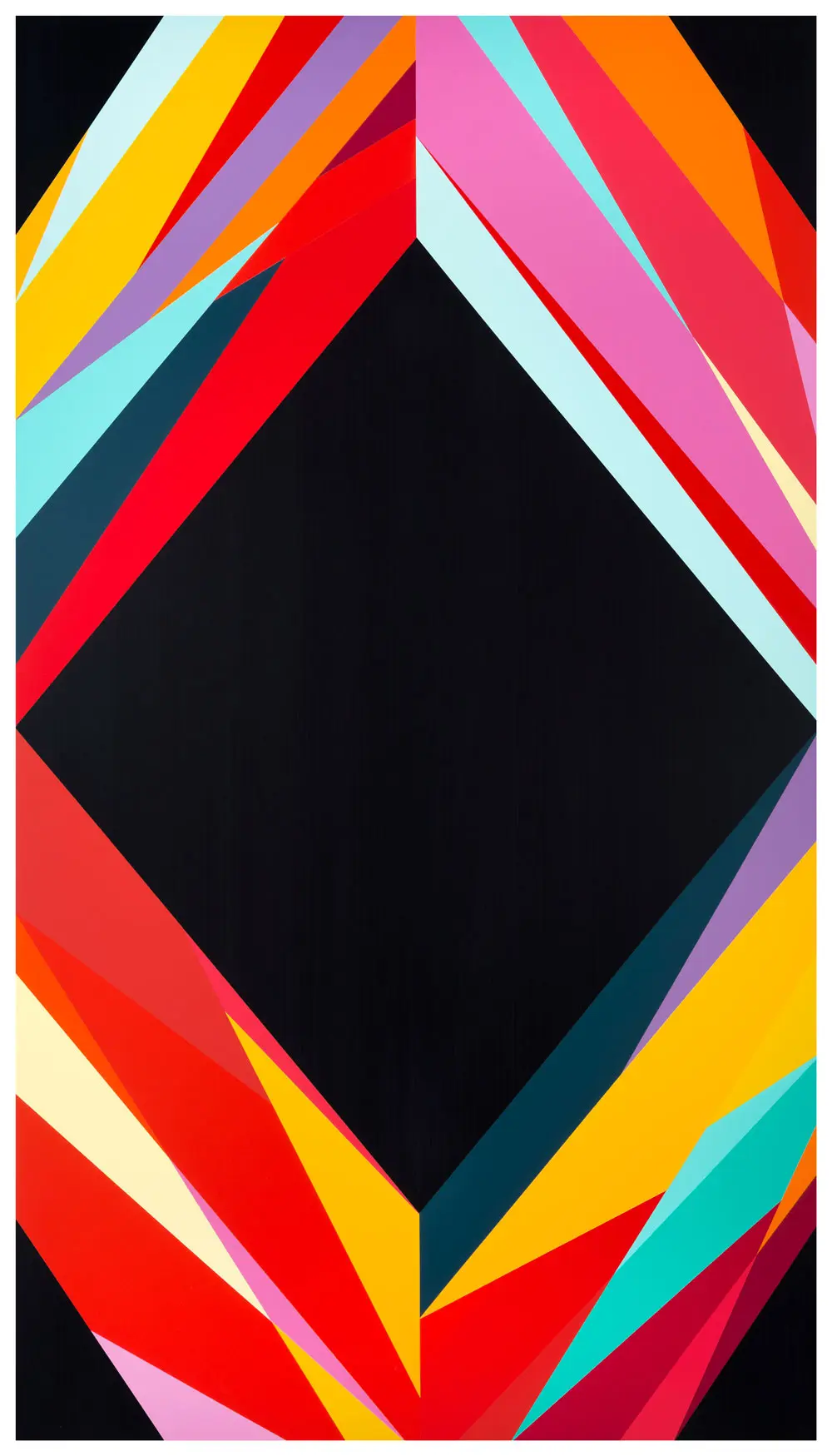
The wall does not recede. This is the first surprise. You walk into a room where Odili Donald Odita has painted a mural — or hung a large panel painting, or done both — and the wall you expected to be a surface behind the room becomes part of the room, becomes active rather than neutral, becomes something that presses back. The colors are not the colors of a background. They are organized into wedges, long triangular forms that taper toward the edges and collide at the center, and the colors are doing something to each other that you can feel more than name: advancing and retreating, pushing in opposite directions, holding a tension that should be uncomfortable and is instead vital. The room has changed. The wall is alive.
Odita makes paintings that refuse to behave like decoration. This is not a small thing in an era when abstract painting is constantly tempted toward the pleasantly resolved, toward the color combination that soothes, toward the composition that flatters the architecture it inhabits. His work does not flatter. It activates. The wedges of color he has developed over three decades are a formal language of sustained argument — every painting is a debate between the colors it contains, and the debate is not resolved by the time the painting is finished. The tension is the point. The refusal of harmony is the statement.
What makes this formally interesting — and what separates Odita's work from superficially similar geometric abstraction — is the specificity of the color relationships. He does not arrive at his palettes intuitively or aesthetically, by the standard means of putting colors next to each other and feeling what works. He studies what colors mean: across cultures, across histories, across the specific political and geographic contexts that have assigned particular significance to particular hues. He is making paintings about color as a language, and like any language, its meanings shift depending on where you are standing and what you have been taught to see.
Enugu, Ohio, and the formation of a palette
Odita was born in 1966 in Enugu, in southeastern Nigeria, and he grew up in the United States — Ohio, specifically, where his family relocated when he was young. This biographical trajectory is not incidental to the work. He is a person who has lived inside two visual cultures that assign different values to the same colors, who has had the experience of seeing a color mean one thing in one place and something quite different in another. He studied at Kenyon College and later at Yale, accumulating the formal training in Western art history that his practice would eventually put under pressure from outside itself — not rejecting the tradition but adding to it the color knowledge that the tradition, being a Northern European tradition, had never needed to develop.
African textile traditions are central to his visual thinking — the kente cloth of Ghana, the aso-oke of the Yoruba, the woven forms of the Igbo. These traditions share with Western geometric abstraction the commitment to pattern and to the formal relationships between shapes and colors, but they approach those relationships from a completely different set of assumptions. In African textile traditions, color is not primarily an aesthetic choice; it is a semantic one. Colors carry social meaning — status, occasion, lineage, ceremony. Patterns are not decorative; they are communicative. A cloth is a text in a language that its wearers can read.
Odita is not illustrating this tradition in his paintings. He is drawing on it as a source of thinking about what color can do — the full range of what it can do, rather than the narrowed range that Western abstract painting has typically assumed. When he places a deep burnt orange next to a cool manganese blue in a wedge composition, he is drawing on a knowledge of what those colors mean in multiple contexts simultaneously. The painting is legible as a formal investigation of color relationship, in the tradition of Albers' color studies. It is also something else — a painting built from colors that carry histories, that have been used to say things in different places, and whose placement next to each other produces a meaning that is richer and more contested than a purely aesthetic account can capture.
"Color is never neutral. Every color carries a history, a politics, a geography."
— Odili Donald OditaThe wedge: form as argument
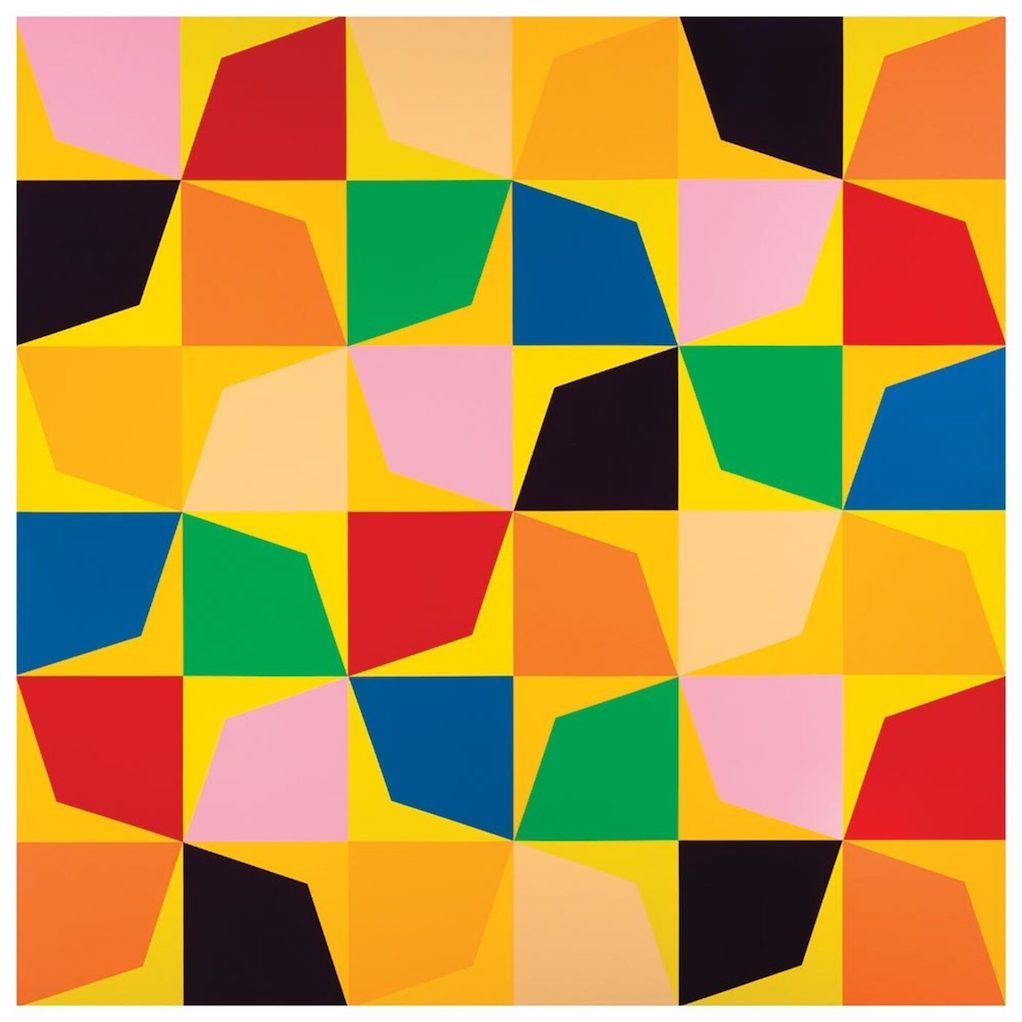
Odili Donald Odita, Flower, 2019. Acrylic on canvas, 60⅛ × 60⅛ × 1½ in.
The wedge shape that organizes most of Odita's compositions is not an arbitrary formal choice. It has specific properties that distinguish it from the other shapes available to geometric abstraction — the rectangle, the circle, the grid — and those properties are what he is working with. A wedge is directional in a way that a rectangle is not: it points, it moves, it has a leading edge and a trailing edge. When two wedges meet, their relationship is of collision rather than adjacency; they are moving in directions that intersect, and the meeting point is the place where two trajectories converge. In Odita's paintings, this convergence is the site of the picture's meaning — the place where the colors' conflicting claims are held in suspension, neither resolved nor abandoned.
The all-over quality of his compositions — the way the wedge pattern typically runs edge-to-edge without a privileged center, without a figure-ground distinction — is also a formal argument. It relates to African textile traditions' tendency toward compositional democracy: no part of the cloth is more important than any other part, no area is background to another area's figure. This refusal of hierarchy within the composition mirrors a refusal of hierarchy between the cultural systems his colors are drawn from. The Nigerian color knowledge and the Western color theory are placed in the same composition at the same level of importance. Neither is background to the other's figure. They collide, as equals, and the painting is what that collision produces.
The murals and what public art does differently
Odita has made a significant body of large-scale murals on institutional walls — museum lobbies, university buildings, civic spaces — and the mural work is related to but distinct from the studio paintings. The difference is not only of scale. When you paint a mural on a specific wall in a specific building in a specific city, the painting has to negotiate with its context in ways that a studio painting, which can go anywhere, does not. The architecture sets constraints. The community that uses the building has a relationship to the space that the painting will now be part of. The permanence is different — a mural is not sold, not moved, not seen differently by different collectors in different contexts. It is simply there, for the life of the building, part of the daily visual experience of whoever passes through.
Odita approaches his murals as site-specific in the full sense: he researches the location, the architectural conditions, the community that will live with the painting. His color decisions for a mural at a university in Philadelphia are different from his decisions for a museum in New York or a public building in another city — not because the formal logic changes but because the cultural context changes, and his colors are sensitive to cultural context in ways that more self-contained aesthetic choices are not. This makes his murals genuinely different from each other in a way that purely formal work often is not. They are not variations on the same palette; they are responses to specific places, built from specific color knowledge applied to specific situations.
He teaches at Tyler School of Art in Philadelphia, which means he has been part of a specific artistic community for years — the community of students and colleagues and fellow practitioners that a serious teaching practice generates. His influence on younger painters working in abstraction has been substantial, though it is the kind of influence that tends to work through formal permission rather than stylistic imitation. Seeing a painter who takes color as seriously as a political and cultural question, rather than an aesthetic one, changes what the painters who see him think is possible within abstraction. It expands the range of what the tradition is for.
"I want the painting to be something you feel in your body before you explain it in your mind. That is when the color is working."
— Odili Donald OditaThe De Stijl comparison, and the departure from it
Mondrian is the unavoidable reference in any discussion of geometric abstraction, and Odita's work invites the comparison more directly than most because he, too, is working with flat planes of color separated by hard edges, building compositions from formal relationships between colors. But the comparison illuminates the distance as much as the similarity. Mondrian's palette was a philosophical decision: the three primaries — red, yellow, blue — plus black and white, because these were the irreducible elements from which all other colors were derived, and in a cosmological system premised on universal harmony, the primary elements were the appropriate language. The grid was equally cosmic. The right angle was the language of rationality and order. The whole project was premised on the idea that there is a universal visual language that transcends cultural particularity — that the primary colors are primary everywhere, that the grid is meaningful to every human eye.
Odita's colors are not primaries. They are the colors of specific places and specific histories — the rich, complex hues of Igbo textile traditions, the deeply saturated tones of West African ceremony, colors that are not reducible to any universal system because they carry particular meanings in particular contexts. His compositions are not grids. They are wedges, which are directional and kinetic where Mondrian's right angles are static and resolved. The tension in his work is not the tension of a carefully balanced composition; it is the tension of an ongoing negotiation between incommensurable color systems that have been placed in the same frame and asked to coexist.
This is what he adds to abstraction: the knowledge that color is not a universal language but a collection of particular languages, that the choices available to abstract painting are richer and more culturally complex than the Western tradition assumed, and that a painting built from color knowledge drawn from multiple traditions simultaneously can produce an experience that no single tradition, working alone, can generate. The collisions in his paintings are not failures of harmony. They are the paintings' subject — the specific, unresolved beauty of things that come from different places and press against each other without either yielding, and find in that pressure something neither could have found alone.