When Alex Katz began making paintings in the early 1950s, the dominant mode in New York was Abstract Expressionism — the work of de Kooning and Pollock and Kline, paintings that placed the artist's gestural energy at the center of the work, that made the evidence of making a primary subject. Katz looked at this work, understood it, and decided to do something else. He decided to paint people he knew, in places he recognized, with a simplicity and directness that the prevailing climate considered naive. He has been painting this way for over seventy years. He has not changed his mind.
Against the Gesture
The argument against Abstract Expressionism that Katz was implicitly making was not a conceptual argument but a visual one. He was not saying that gesture was wrong or that interiority was uninteresting. He was saying that the things in front of him — the specific quality of light in Maine, the particular way his wife Ada's face organized itself when she was looking at something, the social world of downtown New York in the 1950s and 1960s — were more interesting than his own inner states, and that painting could be organized around looking outward rather than looking inward.
The flatness he arrived at was not the flatness of illustration or of commercial design, though it has visual affinities with both. It was the flatness of looking very carefully at something and deciding what you could take away without losing the thing itself. Katz was asking: what is the minimum information that makes this person recognizable as this person? What is the minimum color description that captures this quality of light? The reduction he arrived at is not simplification in the sense of making things easier — it is simplification in the sense of making things more exact.
The speed of his working method is central to this exactness. Katz paints fast — he has to, because the flatness he is after cannot accommodate hesitation. Hesitation produces overworking, which produces modeling, which produces depth, which is precisely what he doesn't want. The painting has to arrive in a single, confident gesture — each passage of color put down once and not corrected — and this requires knowing in advance what you're going to do. The speed is not a stylistic choice. It is the natural consequence of an extremely specific set of formal requirements.
"I'm not simplifying. I'm finding what's already there. Most painting is addition. I'm trying to find out what you can leave out and still have it be real."
— Alex KatzThe Cut and the Speed
The Maine landscapes — and Katz has been going to Maine every summer for decades, painting the light on the water, the tree lines, the specific quality of the northern sky — demonstrate what his formal approach produces when applied to landscape rather than figure. The reductions are different because the formal problems are different, but the underlying method is the same: observe precisely, decide what matters, paint it once.
What strikes you about the Maine paintings, seen in person, is their physical authority. The paint is thin — Katz works with diluted pigment on a gessoed surface, building up the image in fast, covering gestures — but the color is absolute. There are no equivocal passages. The blue of the sky is exactly that blue, placed in exact relationship to the green of the trees, and the relationship creates the light. You don't need to mix them optically or look for subtle transitions. The transitions are there, but they are structural transitions — one flat plane meeting another — rather than tonal ones.

Alex Katz, Yellow House 2, 2001. Oil on linen. 120 × 120 in.
The influence of Katz's flatness on subsequent painting is so pervasive that it has become invisible. The debt that an enormous amount of contemporary figurative painting — from the illustrational end of the spectrum through the high-art end — owes to what Katz worked out in the 1950s and 1960s is rarely acknowledged, partly because Katz's own practice is so consistent that it doesn't register as the influence it is. But the willingness to use color in flat, definite passages; the comfort with the cropped figure and the close-up; the understanding that scale can carry emotional weight that detailed rendering cannot — these are all things that painting learned from Katz, whether or not it knows it.
What Ada Knows
Ada Katz — Alex's wife, married in 1958 and present in the paintings ever since — is the most painted subject in American art of the second half of the twentieth century. She appears in hundreds of works, across every decade of the practice, in every conceivable scale and format. She is not always easily recognizable across all the paintings: the faces in Katz's work are types as much as individuals, and Ada's face has been subjected to the same formal reduction as everything else he paints. But she is always there — a constant within the variety of approaches, a human being who has agreed to be looked at for sixty-five years.
The poets of the New York School also appear repeatedly: Frank O'Hara, Ted Berrigan, John Ashbery, Anne Waldman, Kenneth Koch. Katz was embedded in that social world in the 1950s and 1960s, and his paintings of the poets constitute an informal portrait gallery of the literary culture of downtown New York. The 1967 portrait of Ted Berrigan — forthright, flat, almost disconcertingly frontal — gives you the poet as a specific physical presence, organized by the same formal decisions that Katz brings to all his subjects but inflected by the specific way Berrigan occupied space.
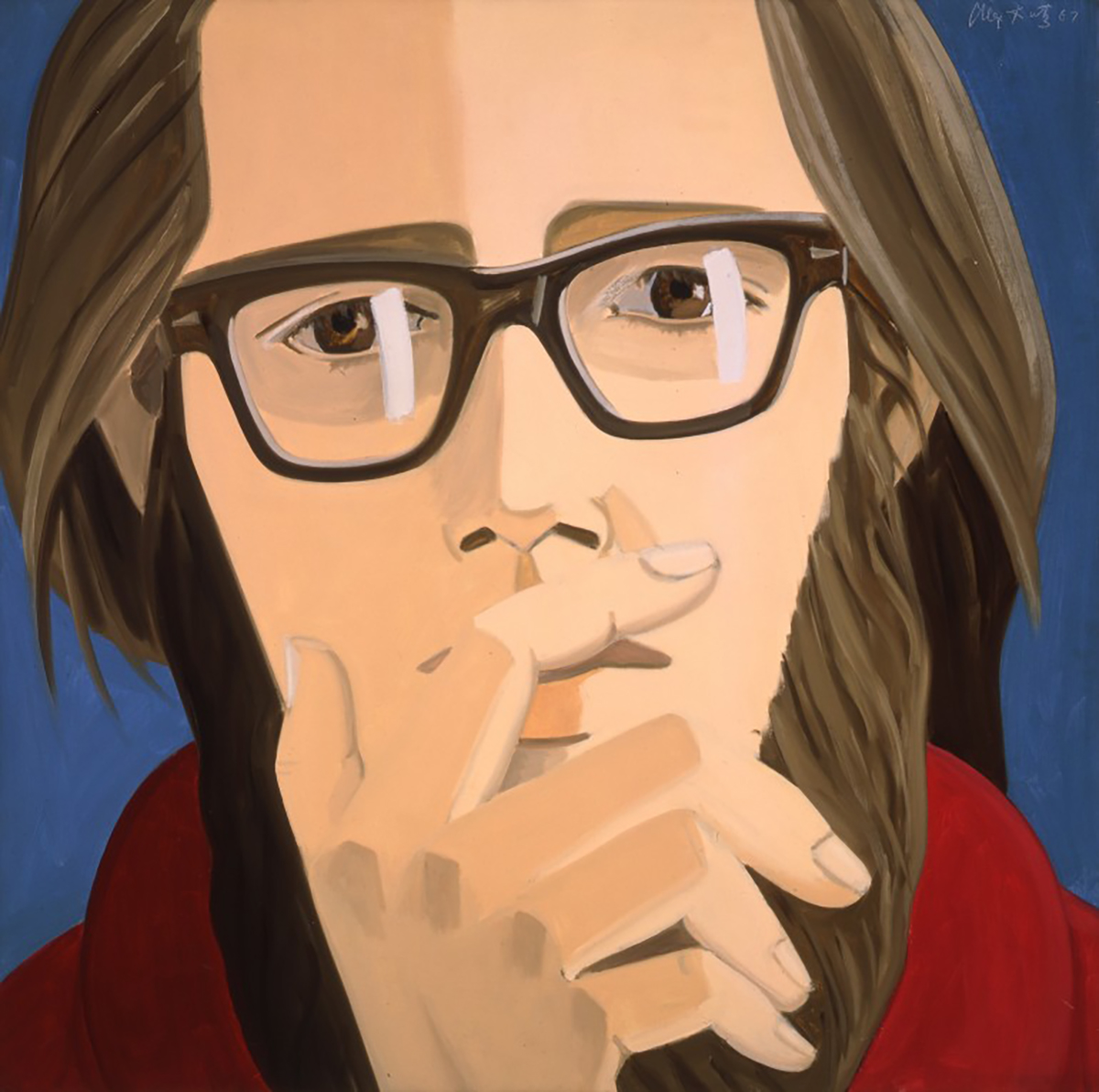
Alex Katz, Ted Berrigan, 1967. Oil on linen. 48 × 48 in.
What Ada knows — what all the subjects in Katz's paintings know, by the time they've been looked at with sufficient patience — is that to be painted by someone who is genuinely attending to you is a different experience from being photographed or described. The painting takes longer, costs more, and produces an object that will exist in the world for centuries. It is an act of sustained attention, and what Katz has given to the people he has painted over eighty years is exactly that: the thing that his particular brand of flatness and speed makes possible, which is the rendering of someone exactly as they are, without sentiment and without distortion, in the specific quality of light in which he found them. The paintings are still here. So is the practice.