The European portrait tradition is, among other things, a record of power. From Hans Holbein the Younger's images of Tudor courtiers to Velázquez's paintings of the Spanish royal family to the grand manner portraits of Joshua Reynolds, the history of formal portraiture in the West is the history of a specific class of people commissioning images of themselves that would endorse their position in the social order. The sitters were kings, merchants, aristocrats, church officials. The poses were derived from classical sculpture and from earlier portraits of other powerful people. The formats were large. The decorative elements — the drapery, the columns, the landscapes visible through windows — were chosen to communicate status and permanence. The tradition was not neutral. It was a machine for producing monuments.
The Street as Studio
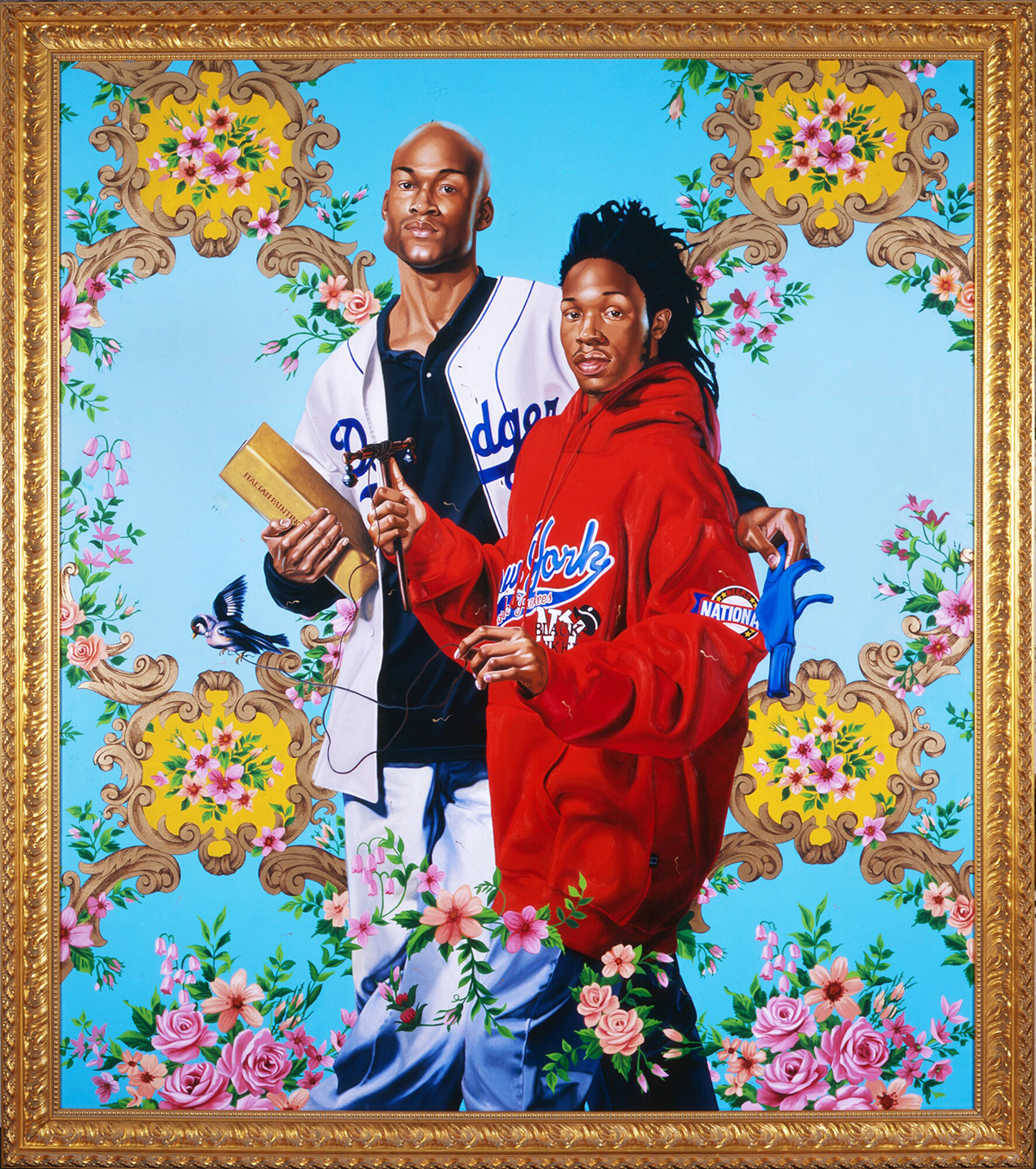
Kehinde Wiley's methodology begins with an interruption of the usual portraiture commission structure. He does not wait for subjects to come to him through institutional channels. He goes into neighborhoods — often in New York, but also in cities around the world as part of the World Stage series — and approaches people on the street, asking if they would be willing to sit for him. The subjects are typically young Black men, dressed in the specific contemporary vernacular of their time and place: streetwear, athletic gear, the visual language of contemporary urban culture. They are not people who would normally be the subjects of formal commissioned portraits.
He shows them prints of old master paintings and asks them to choose a pose. The choice is significant: they are not being asked to stand in front of a camera and look natural. They are being asked to assume the specific postures of historical power — the outstretched arm of a military commander, the languid ease of an aristocrat, the direct confrontation with the viewer that Reynolds gave to his most important sitters. They are being invited into the repertoire of poses that has been, for centuries, reserved for people who looked nothing like them.
The act of posing — the moment when a young man from Harlem or Lagos or São Paulo assumes the posture of a Rubens nobleman — is where the work's central argument becomes visible. The tradition of European portraiture encoded not just style but a claim about who matters, whose face deserves to be rendered in oil at monumental scale, whose existence is worth the resources and attention that a major painting requires. Wiley's methodology proposes that this encoding is a historical accident rather than a natural order, and that the poses belong to anyone willing to assume them.
"The old master poses are incredibly specific. They were developed to communicate power, grace, authority. Why should those things belong only to the people they were originally used to depict?"
— Kehinde WileyThe Pose and Its History
The technical quality of Wiley's paintings is essential to the argument they make. He is an extraordinarily skilled painter — his handling of fabric, his understanding of how to render the complex optical effects of dense decorative patterns, his control of the figure in space — and this skill is not incidental but constitutive. The old master tradition he is working within was itself a tradition of demonstrating technical mastery, and a less technically accomplished artist working with the same conceptual material would produce a different and weaker work.
The decorative grounds in Wiley's paintings — the intricate patterning that fills the space around and behind the figures — derive from multiple sources: Islamic tile work, Baroque ornament, West African fabric design, botanical illustration. They create a visual complexity that is at once historical and contemporary, drawing on the decorative traditions of multiple cultures to produce something that belongs to none of them exclusively. The figure placed against this ground is simultaneously inside the Western portrait tradition and outside it: the pose is European, the context is global.
When Wiley places a young man in a hooded sweatshirt in the pose of Napoleon crossing the Alps — as in the 2005 painting Napoleon Leading the Army over the Alps — what happens is not parody or irony. The painting takes the comparison seriously: the figure is monumentalized in exactly the way Napoleon was monumentalized, with the same scale, the same lighting, the same claims to heroic presence. The viewer is asked to consider what it means that the same formal apparatus that produced the Napoleon portrait can produce this portrait with equal conviction, and why one has been allowed to accumulate the weight of history while the other has been excluded from that weight.
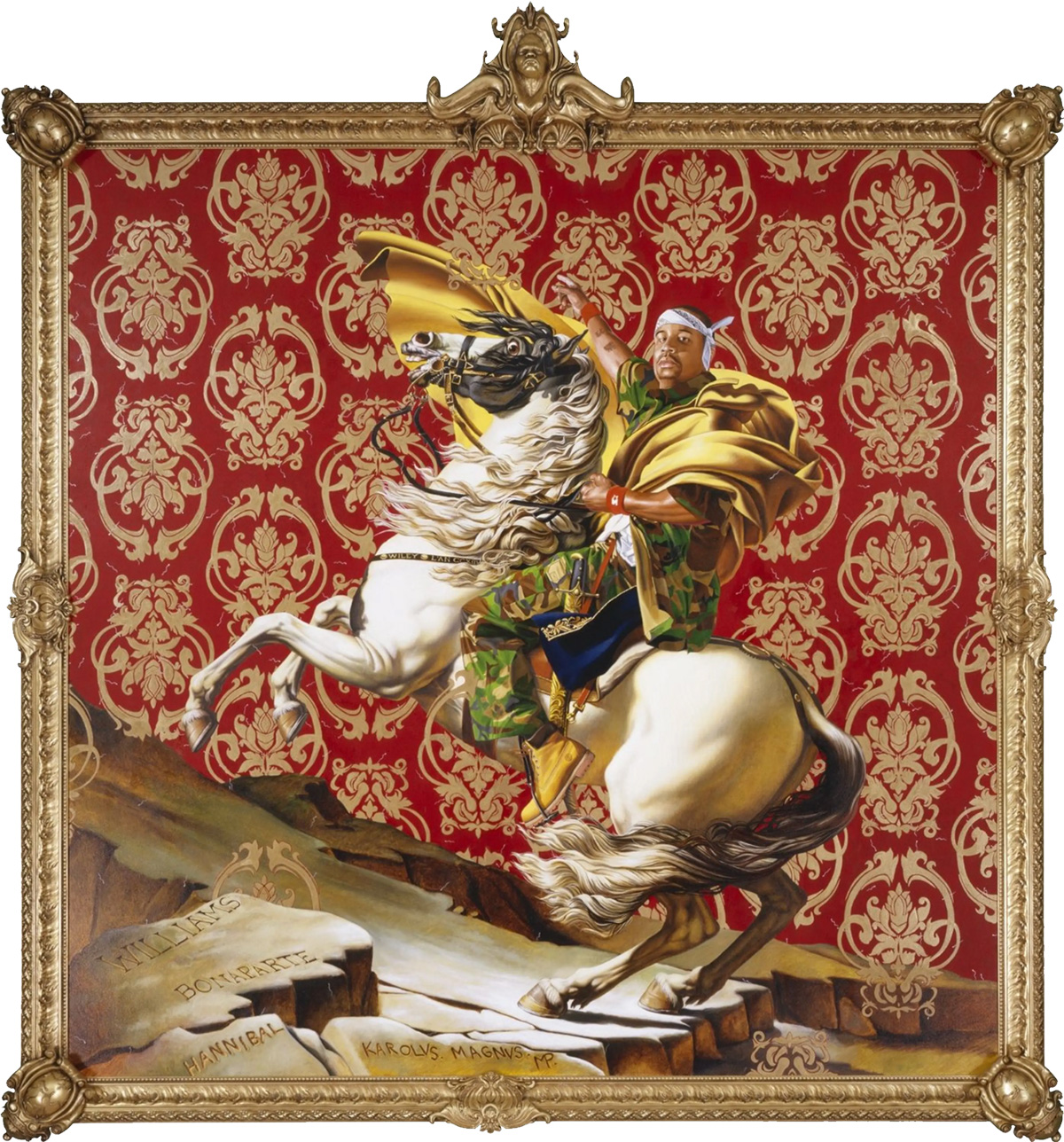
Kehinde Wiley, Napoleon Leading the Army over the Alps, 2005. Oil on canvas. 108 × 108 in. (274.3 × 274.3 cm).
What a Portrait Owes Its Subject
The commission from the Smithsonian National Portrait Gallery to paint Barack Obama's official presidential portrait — completed in 2018 and unveiled to widespread cultural attention — was the moment when Wiley's practice intersected with the broadest possible American public. The portrait placed Obama against a ground of flowers — specifically, chrysanthemums from Chicago (where Obama's political career began), African blue lilies referencing his Kenyan heritage, and jasmine from Hawaii where he was born — in a format that was recognizable as a presidential portrait while being entirely unlike any previous presidential portrait. It was formal and unconventional simultaneously.
The Obama portrait crystallized the cultural argument Wiley had been making for two decades: that the formal apparatus of European portraiture, with all of its associations with power and permanence, belongs to everyone, and that the choice to use it to depict people who have historically been excluded from it is itself a political act of great significance. The painting is now the most viewed in the history of the National Portrait Gallery. Whatever you make of it as a work of art, its cultural function — the statement it makes about who belongs in the tradition — is as clear as any painting's function can be.
What a portrait owes its subject is dignity — the willingness to look at someone carefully and render what you find in a way that takes them seriously. The European portrait tradition articulated this obligation and then, for most of its history, honored it only for a narrow category of people. Wiley's practice takes the obligation seriously without the limitation. His subjects are painted with the same care and the same scale and the same formal ambition that Rubens brought to his sitters, because there is no principled argument for why they should be painted with less.