The New York City subway in 1970 was already a strange canvas. It was vast, it was dangerous, it was public in the most unruly sense — anyone who rode it was a captive audience for whatever appeared on its surfaces. The writers who began painting the cars in the late 1960s and early 1970s understood this intuitively, even if they couldn't have articulated it in those terms. They were working in a medium without a name, in a tradition without precedent, toward an audience that hadn't asked to see them. Leonard Hilton McGurr, who was then a teenage kid from the Bronx with a name that would become Futura 2000, was among the first to understand that this medium's most radical possibility was not the letter but the departure from it.
The Letter That Became a Nebula
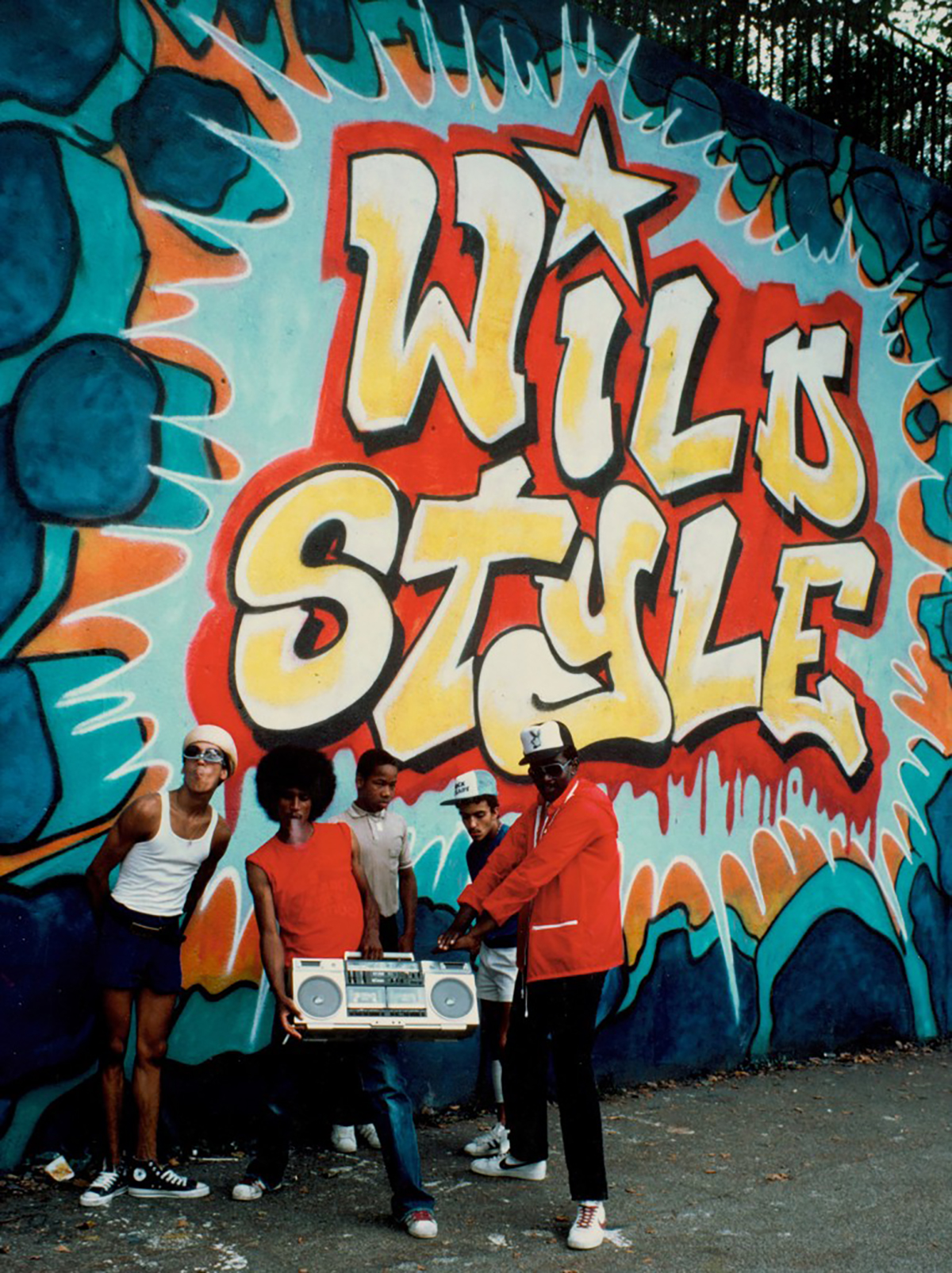
Graffiti's primary language in its foundational decade was typographic. Writers tagged their names, elaborated their letterforms, competed for visual complexity within the constraints of the alphabet. The tag was the fundamental unit: a stylized signature that identified the writer and marked their presence. From the tag emerged the throw-up, the piece, the masterpiece — each a more elaborate expression of the same underlying impulse to make your name visible in a city that had no formal mechanism for such visibility.
Futura was unusual from the beginning in his willingness to move away from this typographic foundation. While his contemporaries were developing increasingly complex letter structures — the wildstyle interlocking letterforms that would eventually become the dominant visual grammar of graffiti — Futura was looking at something else. He was looking at what happens when the letter dissolves: when the recognizable structure of the alphabet gives way to pure gestural mark, pure color relationship, pure spatial organization. He was painting abstraction on subway cars in 1973.
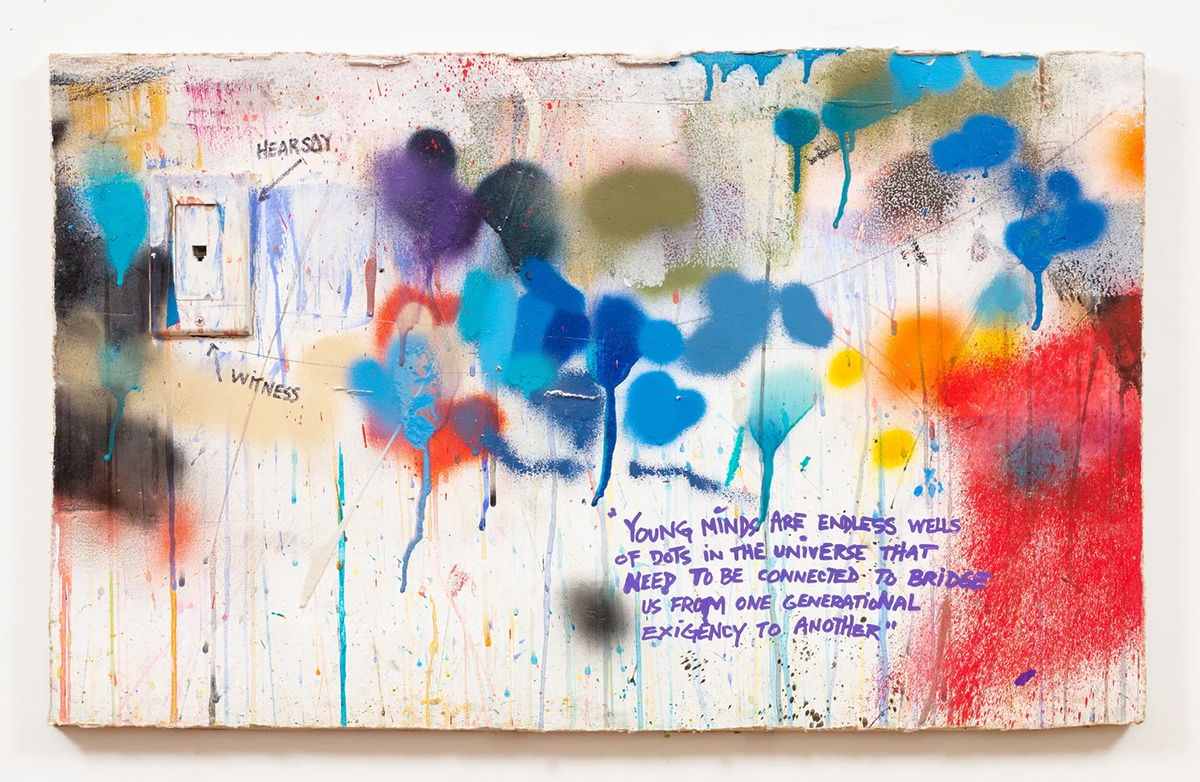
This is a fact worth dwelling on. Abstract painting in 1973 was not new — it had a fifty-year history in the galleries and museums — but abstract painting executed with aerosol paint on the exterior of a moving vehicle in a transit yard in the Bronx was something genuinely different. The conditions of production were nothing like a studio. The scale was predetermined by the car's dimensions. The materials — spray cans — had their own physics, their own limitations and possibilities. And the whole thing would be visible to hundreds of thousands of people on a given day, none of whom had chosen to look at it.
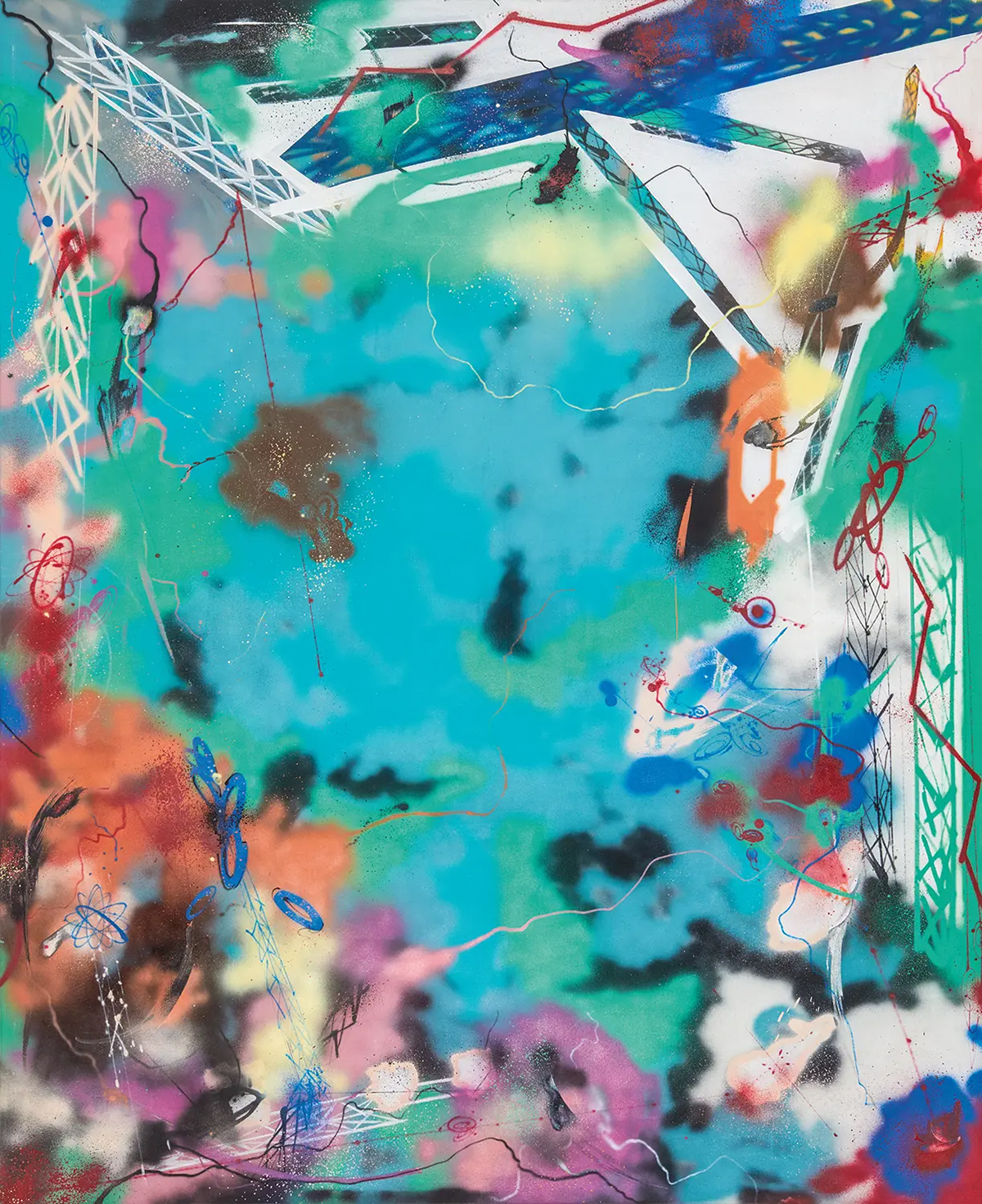
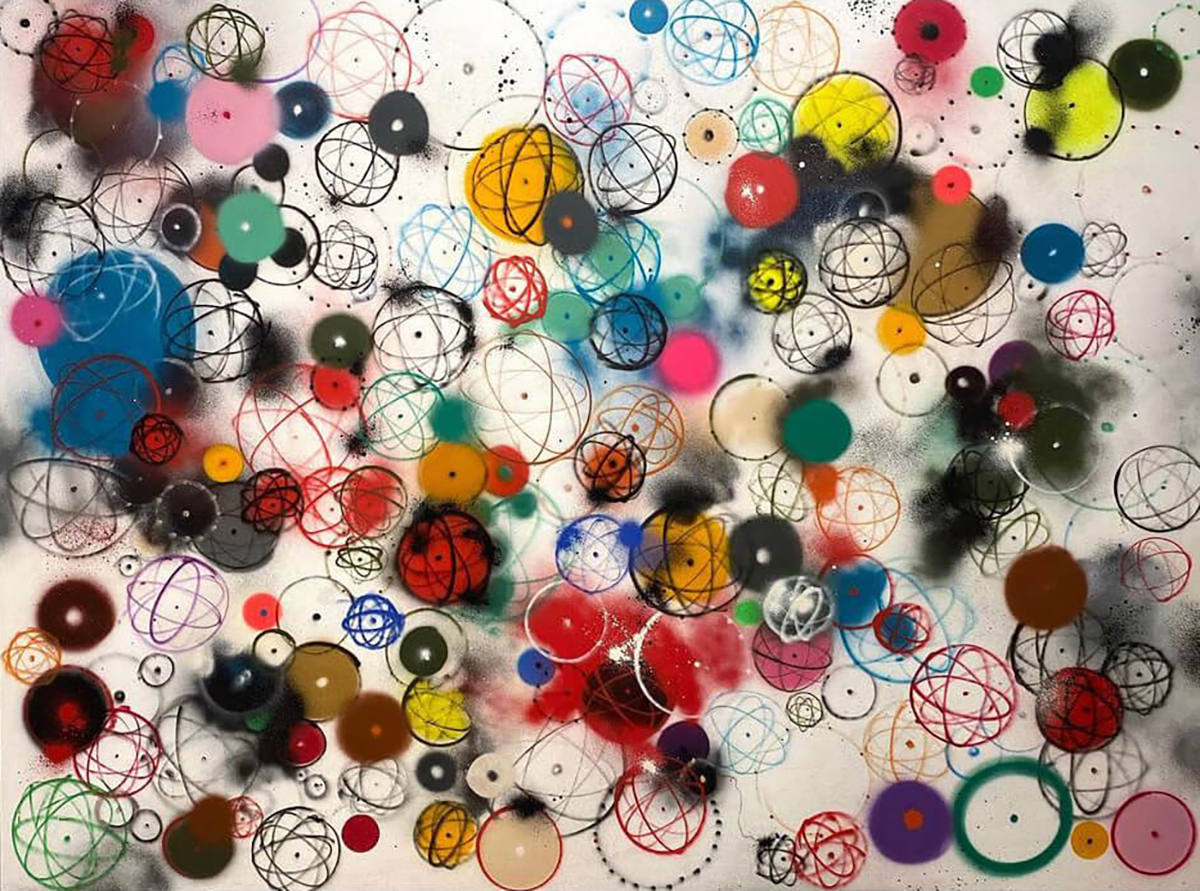
Futura 2000, Colorforms, 1991. Aerosol on canvas. 63 × 110 in. Collection of Patrick Lerouge. Courtesy the Bronx Museum.
"The train was moving before I finished. The audience was the whole city whether they wanted to be or not. That's a different relationship to looking than any gallery can produce."
— Futura 2000The Clash and the Canvas
By 1981 Futura was already known in the downtown New York art world — the same circuit of galleries and spaces that was beginning to exhibit Basquiat and Haring — but his trajectory into that world took a different and more unlikely route. When The Clash came to New York on their Sandinista! tour, their manager and primary architect Kosmo Vinyl had been paying attention to the culture around him, and he organized a collaboration: Futura would paint onstage at every concert of the Rude Boy Tour, creating a live work in front of the audience as the band played.
The logistics of this were essentially insane. You are asking someone to make a painting — or more accurately a large-scale aerosol work on canvas — in front of several thousand people, in a concert environment, while a band plays at performance volume. The work cannot be preliminary. It cannot be tentative. It has to be made in real time, with the confidence that what you're doing is worth watching, that the mark you're making right now is the right mark.
What the Clash tour gave Futura was something that the New York art world, for all its interest in his work, couldn't provide: an audience that was not pre-sorted. The people in those concert halls hadn't come to see art. They'd come to see a punk band. The art was happening in front of them regardless of their expectation, and it had to hold its own against the music and the lights and the sheer event of the thing. That the work survived this test — that audiences were watching Futura as well as the band — tells you something about its quality that no gallery review can.
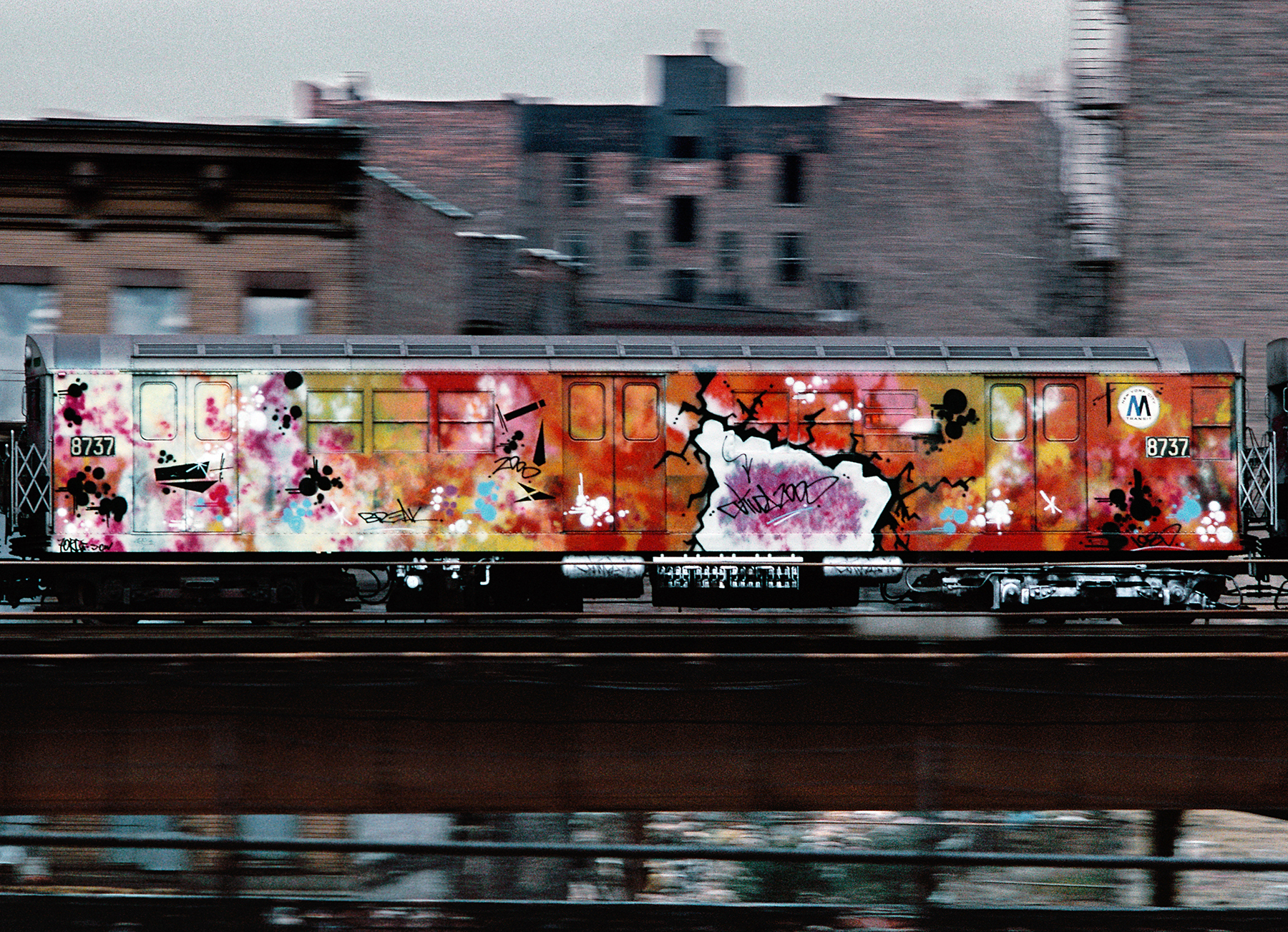
Futura 2000 breaking, 1980. Photo courtesy Martha Cooper.
The Bridge Between Worlds
When people discuss the first generation of graffiti writers who crossed into the gallery world, the names that come up most often are Basquiat and Haring. This is understandable — both had gallery representation early, both became cultural phenomena, both died young and their work has been the subject of sustained critical attention. But both of them were also working in figurative and typographic modes that were more immediately legible to the existing art world's frameworks. Basquiat's work drew on the traditions of Neo-Expressionism and African American vernacular culture; Haring's drew on commercial illustration and Pop. They were new, but they were new in ways that could be explained in existing terms.
Futura's work could not be explained in those terms because it had no precedent in the gallery tradition. Its nearest antecedent in the fine art world was Abstract Expressionism, but Futura hadn't developed his visual language through exposure to de Kooning or Kline. He'd developed it through the specific demands of aerosol paint on metal surfaces in transit yards, by looking at what spray paint does when it meets industrial primer, by learning to make marks that would remain legible at sixty miles per hour. This is a different education than any fine art training produces, and it resulted in a different sensibility.
The decades of commercial work — the Nike collaborations beginning in the 1990s, the Supreme drops, the Louis Vuitton partnership with Marc Jacobs, the Stüssy collections — are sometimes used to argue that Futura was distracted from or corrupted by commercial culture. This argument misunderstands what was happening. The commercial work was an extension of the same practice that had been operating since the subway years: making abstract marks on objects that exist in the world rather than in galleries, in relationship to audiences that extend far beyond the art-world circuit. The Nike shoe was not a different kind of object from the subway car. Both were canvases that moved through the city.
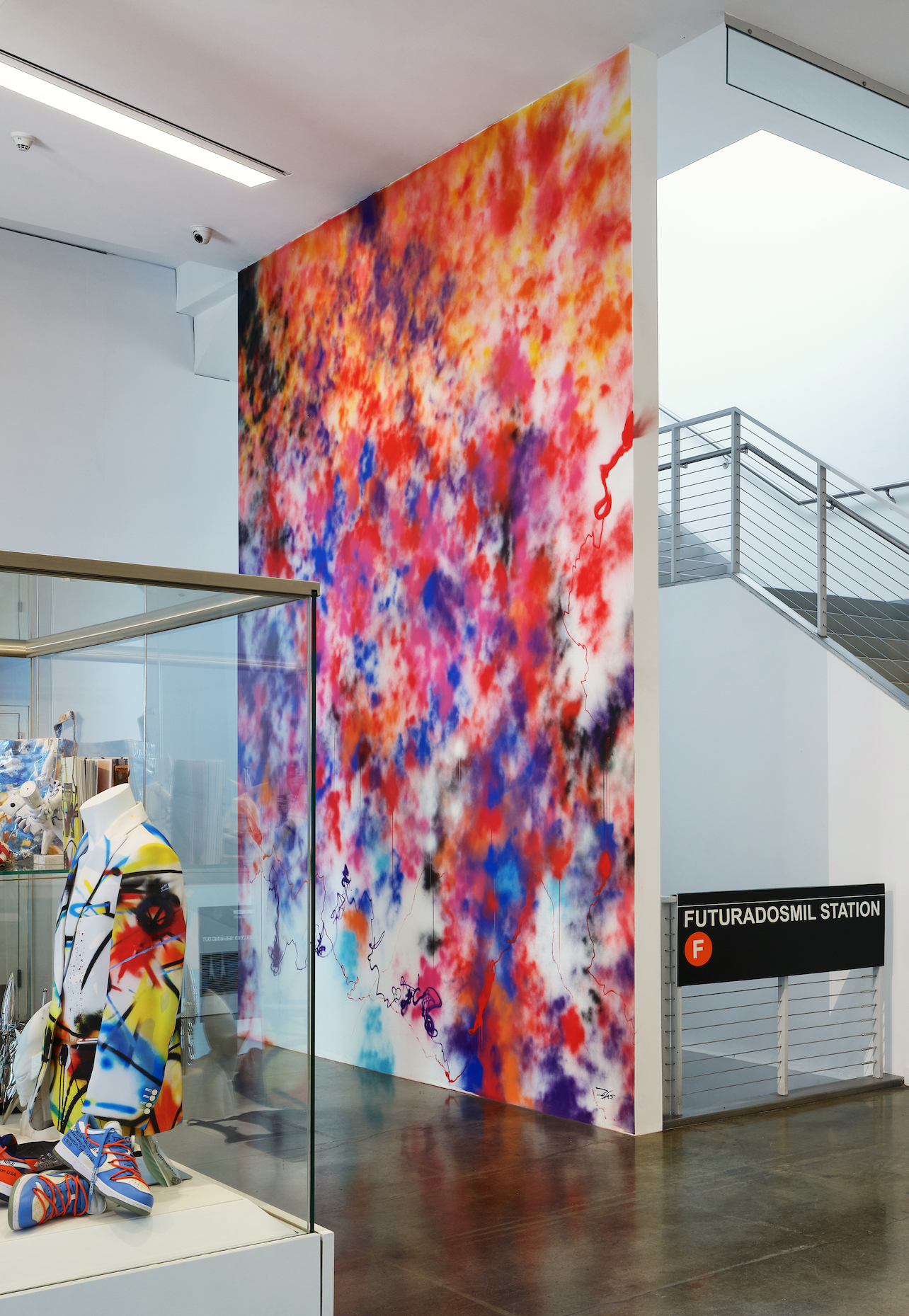
Installation view, Futura 2000: Aerosol Aesthetic, 2024. The Bronx Museum. Photo: Argenis Apolinario.
The Bronx Museum and the Record
The 2024 retrospective at the Bronx Museum of the Arts, titled Futura 2000: Aerosol Aesthetic, was the kind of institutional recognition that arrives late enough to feel like an argument won rather than a career celebrated. Futura had been making work for over fifty years at that point. The subway cars were long gone — the MTA's buff program had removed virtually all painted trains by 1989 — and what remained were the canvases, the collaborations, and the legacy visible in the work of every artist who followed.
The retrospective did what only an institution can do: it placed the work in a room where it could be looked at together, where the development from the raw subway-influenced marks of the early gallery work through the more refined aerosol paintings of the 1990s and 2000s could be seen as a continuous investigation. The paintings, viewed in sequence, tell the story of an artist who found a visual language early and then spent five decades testing what it could say. The language didn't change because it didn't need to — it was precise enough to accommodate everything Futura wanted to express about color, space, movement, and the residue of human energy in abstract form.
There is a photograph in this issue — Kenny, Keith Haring, and Futura together in 1981 — that captures something important about that particular moment in New York's cultural history: the accidental proximity of artists who were each doing something genuinely new, who were operating in the same city at the same historical moment without necessarily sharing a program or a theory. What they shared was a willingness to work in modes that the existing art world hadn't sanctioned, to trust that what they were making was worth making regardless of institutional approval. Futura is still making work. The trains are gone. The line continues.
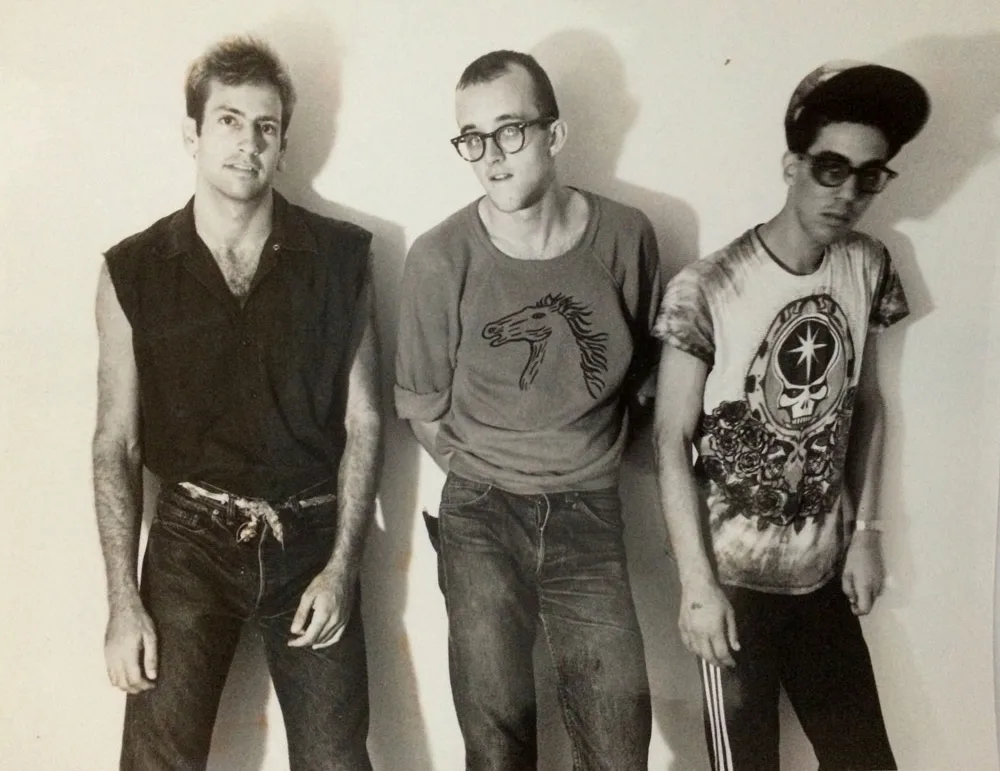
Kenny, Keith Haring, and Futura 2000, 1981. Photo: Gregg Smith.