To understand what it meant to paint a whole subway car in the South Bronx in 1975, you have to understand what those cars were. They were not galleries. They were not sanctioned art spaces. They were moving objects maintained by a transit authority that was legally and practically unable to keep up with them, running through a city that was in the process of its most severe fiscal and social crisis since the Depression. The trains ran on barely maintained tracks, through neighborhoods that were burning, past stations that had been abandoned and left to deteriorate. They were the nervous system of a city that was failing to keep itself alive. And Lee Quiñones, who was fifteen years old, decided to paint the whole side of one.
The Train as Canvas
A whole car — the designation for a piece that covers an entire subway car from end to end, top to bottom — was the highest achievement of the graffiti writer's hierarchy. It required more time than most pieces allowed, more paint, more exposure to the dangers of the yards, and a compositional intelligence that went well beyond the single throw-up or two-panel piece. You had to think across a span of roughly sixty feet, understanding how elements at one end would relate to elements at the other, how the colors would read at speed, how the design would hold up when seen through dirty scratched windows by riders who were not looking for art.
Lee was doing whole cars at sixteen. This was unusual — most writers took years to develop the technical command that whole cars required — and it suggested something beyond mere precocity. He had an instinct for large-scale composition, an understanding of how visual information distributes across a wide surface, that formal art training tries to produce and usually can't. The trains were his education, and they were an extraordinarily demanding one: you got immediate feedback in the form of the buffed panel or the unreadable blur, and you had no option but to learn from it.
The works he made on those cars in the late 1970s and early 1980s — documented by Martha Cooper, Henry Chalfant, and others who were paying attention — included social commentary that was years ahead of the kind of institutional critique that would eventually occupy galleries. He painted about environmental destruction when no gallery was showing work on that subject. He painted about the failure of municipal government, about the conditions in his neighborhood, about a world that the people who controlled most art institutions could not see or did not want to. The trains carried these arguments through the whole city, whether anyone had authorized them to or not.
"The train went everywhere. Brooklyn, Queens, Manhattan, the Bronx — the same work seen by everyone. That's what a museum does, but nobody asked permission."
— Lee QuiñonesAfter Wild Style
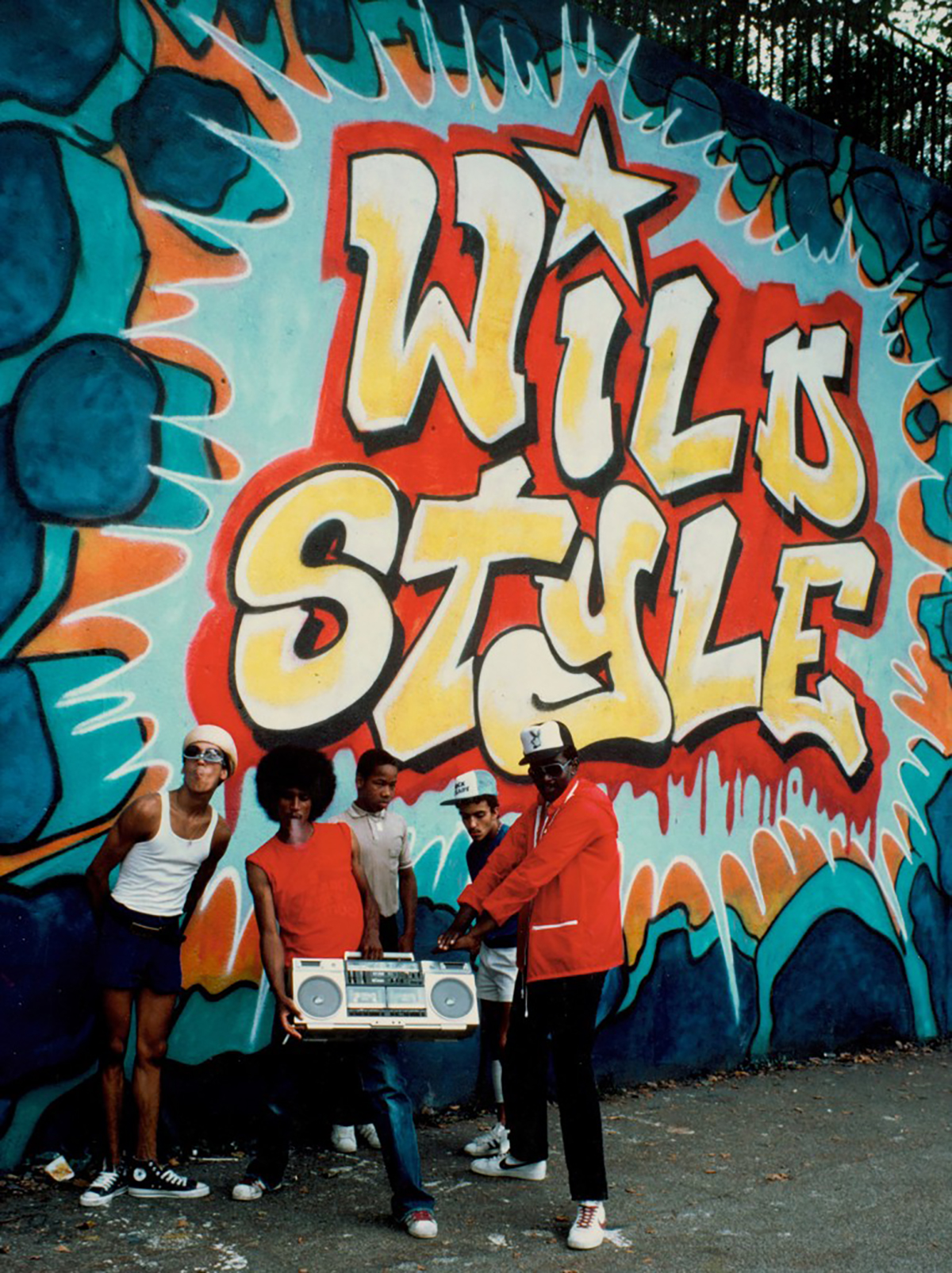
Charlie Ahearn's Wild Style (1983) cast Lee as Zoro, a graffiti writer navigating the tension between his underground practice and the downtown gallery world that had begun to take notice of graffiti. The character was close enough to the person that the distinction barely mattered: both were young, both were extraordinarily skilled, and both were facing the same question that the film was structured around — what happens when something that lived outside institutions is invited inside them?
The film's release made Lee known internationally in a way that preceded the internet and therefore had a particular intensity: people who saw it in Tokyo or London or Paris did not have access to additional information. What they knew about Lee Quiñones was what the film showed them, and what the film showed was a painter of exceptional ability operating in conditions that no studio could simulate. The European response to the film was particularly strong — it reached audiences in cities where graffiti was already developing its own traditions, and Lee became a reference point for writers who had never been to New York.
The transition from the yards to the studio happened gradually, and not without the difficulties that always accompany such transitions. The studio does not offer the specific pressures of the yard — the time constraint, the physical danger, the certain knowledge that what you make will eventually be destroyed — and some artists never fully replace those pressures with anything as useful. Lee replaced them with something more austere: a commitment to sustained attention on a single surface, over months and years rather than hours.
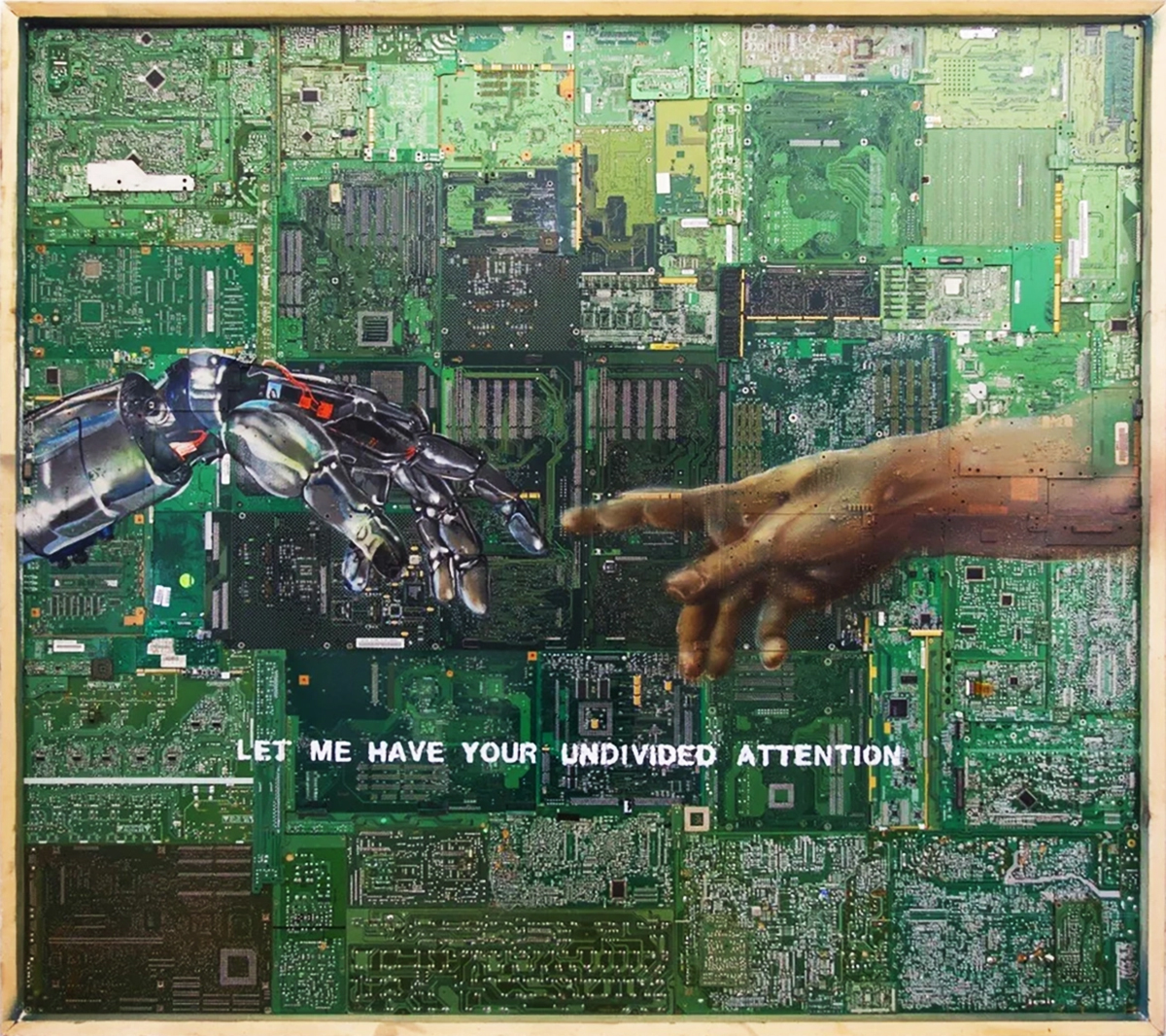
Lee Quiñones, Soylent Green, 2014. Spray paint and oil paint on mounted motherboard. 60 × 54 in.
What Obsolescence Holds
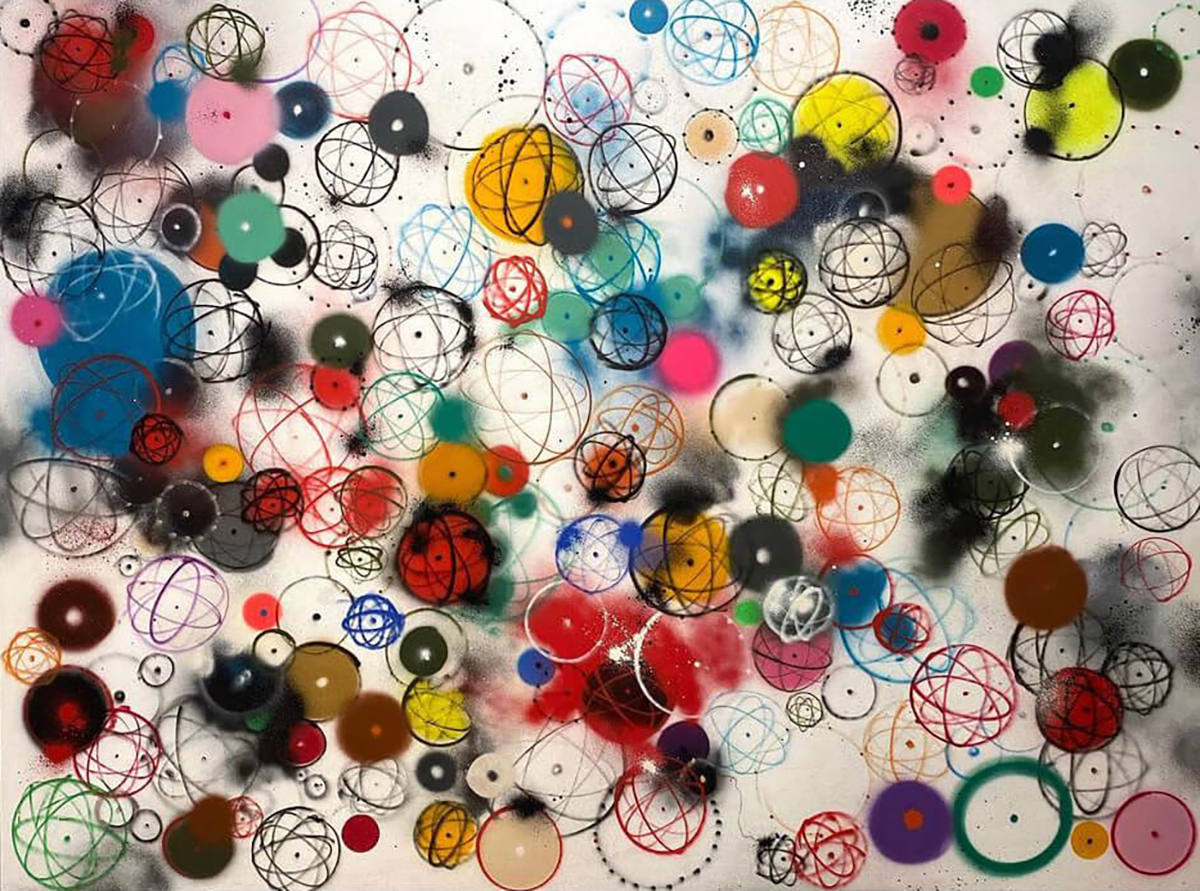
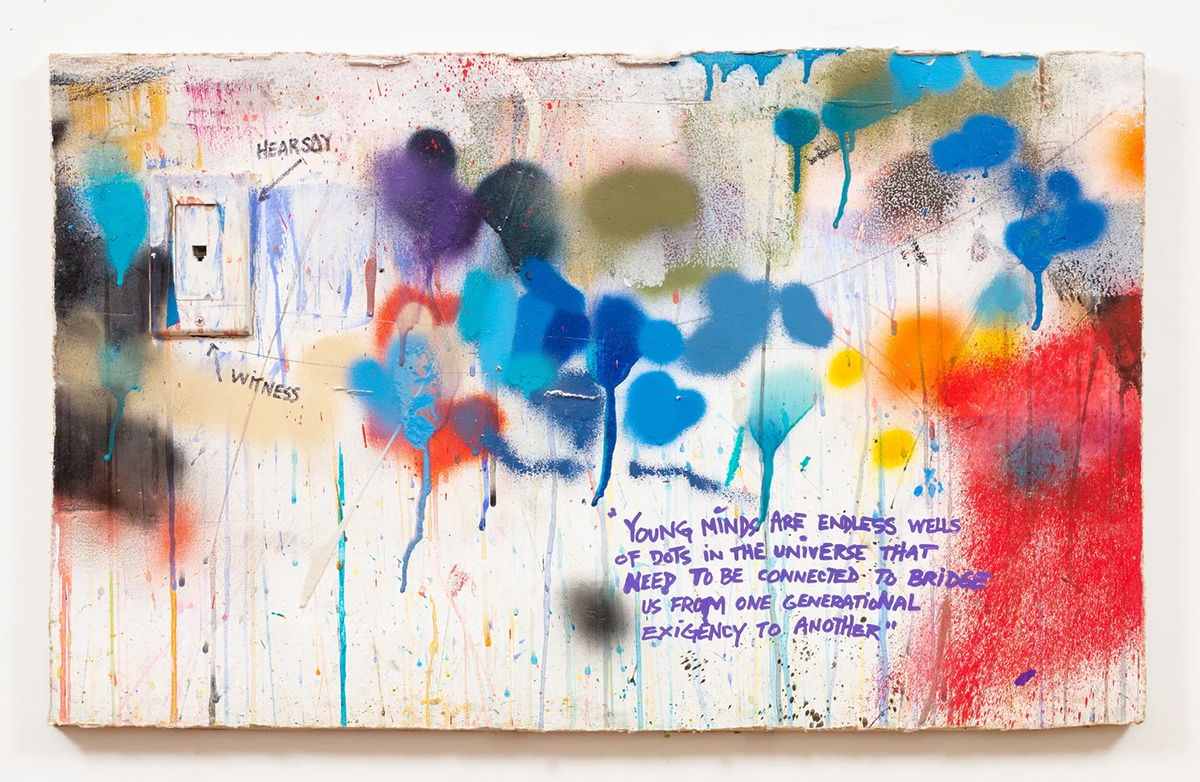
The gypsum board works — the Tablets, as Lee calls them, a series that extends from 2005 through the present — are among the most formally rigorous things he has made. Gypsum board absorbs spray paint differently than the metal of a subway car: the paint sinks into the material rather than sitting on its surface, producing a matte quality that is entirely different from the glossy reflectivity of painted steel. The colors are different. The relationship between the image and its support is different. But the compositional intelligence is continuous with the whole-car work of forty years ago.
The mounted motherboard pieces take this logic further. A computer motherboard is an industrial object that has been through its own life cycle — designed for a specific purpose, manufactured, installed, used, and ultimately discarded when the machine around it became obsolete. When Lee mounts one and paints on it, he is working on an object that already carries encoded information, that has a visual complexity independent of anything he adds to it, and that has been released from its original function. Soylent Green (2014) places spray paint and oil paint on a motherboard in a way that makes the painted surface and the board's own circuitry part of the same image: one layer of information laid over another, the human mark over the machine logic.
What obsolescence holds, in Lee's hands, is the possibility of new use. The discarded material is not simply repurposed; it is read, its existing patterns understood and engaged with, and the painting is made in response to what's already there. This is not very different from what he was doing in 1975, reading the surface of a subway car — its existing markings, its previous painting, its specific character — and making something that responded to all of it. The train was the world's canvas first. He was working with it, not over it. Forty years later, the practice is the same.