Light is the only medium that exists only in the present. A painting carries the evidence of its making — the dried paint, the pentimento, the accumulation of decisions made over time — and presents it all simultaneously to the viewer, who can look as slowly or as quickly as they want. Video is recorded, which means it has a past even as it plays in the present. But light, the unrecorded kind, exists only in the moment of its emission and disappears the instant it ceases. You cannot preserve it. You cannot refer back to it. You can only stand in it, right now, and register what it does to you.
From Screen to Object
James Clar came to light art through cinema rather than through the fine art tradition. Trained as a filmmaker, he was thinking about screens before he was thinking about objects — specifically about the relationship between the screen as a technology and the viewer as a body, about what it means to be a person who sits in front of a glowing rectangle and allows it to restructure your attention, your time sense, your relationship to the physical space you occupy.
The shift from cinema to sculpture was a shift in the terms of this investigation rather than a change of subject. Where cinema asks you to surrender your time to a predetermined sequence, a light sculpture places you in an open relationship with an object that you can approach or withdraw from, look at directly or peripherally, spend ten seconds with or ten minutes. The temporal relationship is yours to determine, and this changes what the light can mean. In cinema, light is an instrument of immersion. In sculpture, it is an instrument of encounter.
The LED — Light-Emitting Diode — is the specific technology that Clar works with, and its specific properties are central to the work. LEDs produce light of extraordinary intensity with very little heat and very little energy consumption. They can be programmed to produce almost any color in the visible spectrum. They can be made extremely small. They can be made to pulse, to shift, to change over time in precisely specified ways. For an artist interested in the cultural meaning of light — in what artificial light says about the society that produces it — LEDs are the most culturally loaded technology available, because they are the technology that now produces almost all the artificial light we live in.
"The screen is the most powerful tool for shaping attention that humans have ever made. I want to understand it from the inside — not critique it from outside, but inhabit it and see what it knows."
— James ClarThe Lineage of Light
The tradition of light art in the fine art context begins, in its most cited genealogy, with Dan Flavin's fluorescent tube works of the 1960s, which took the most ordinary artificial light source — the fluorescent tube found in offices and factories — and placed it in gallery space as an art object. The gesture was Minimalist in its refusal of composition and its embrace of industrial materials, but it was also something else: a demonstration that the quality of light in a room is an aesthetic fact, that the light we live in is a design decision that has been made without our participation and that we could make differently.
James Turrell extended this investigation in a different direction: rather than placing light sources in gallery space, he built rooms in which light itself was the primary perceptual material, creating experiences that made visible the construction of visual perception — the way the eye and brain collaborate to produce what we experience as seeing. Robert Irwin worked with diffused natural light in architectural interventions that changed how a space felt without adding any visible object to it.
Clar's work is in conversation with all of these predecessors while being clearly distinct from them. Where Flavin was interested in the cultural meaning of the industrial object, Clar is interested in the cultural meaning of the digital screen. Where Turrell strips away the cultural associations of light to reach its perceptual essentials, Clar loads his light with cultural meaning — making work that can only be understood in the context of a world saturated with screens. And where Irwin dematerializes, Clar builds specific objects that call attention to their own construction, that present themselves as made things with a particular relationship to the viewer's body and attention.
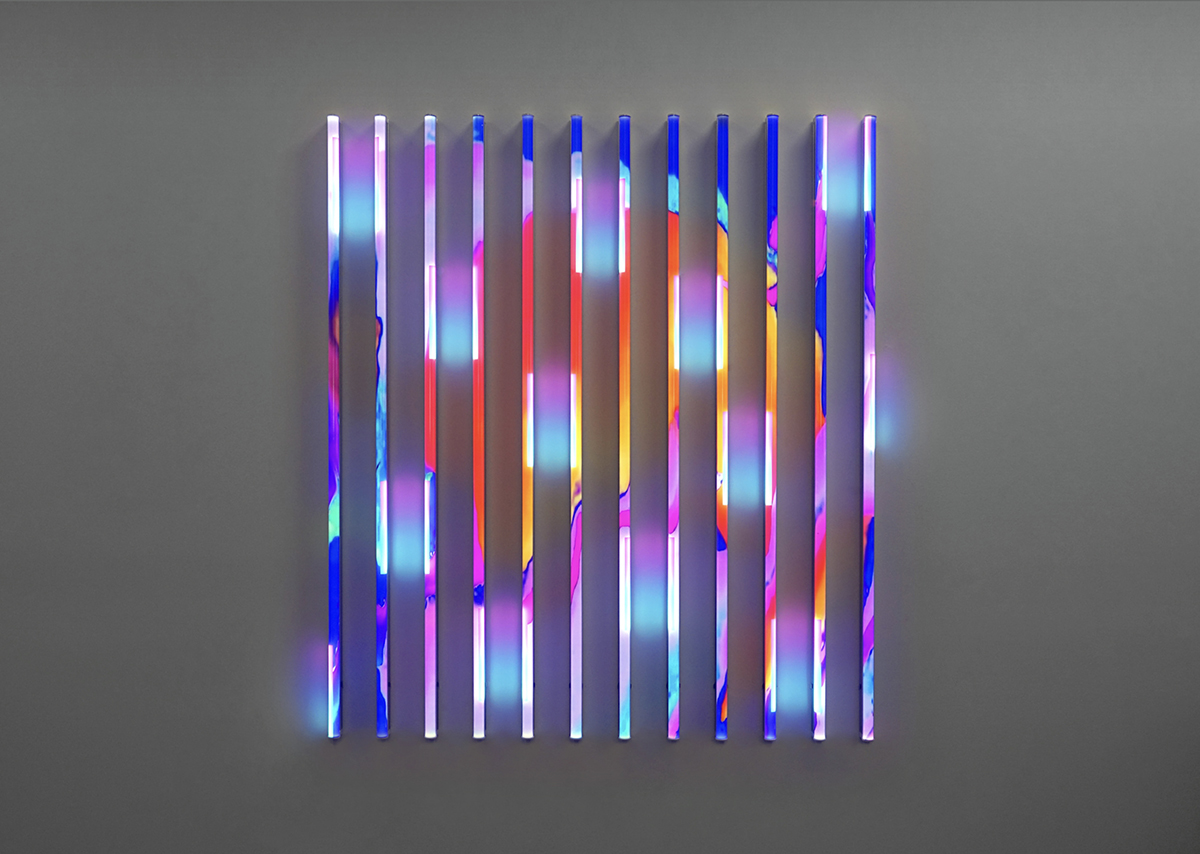
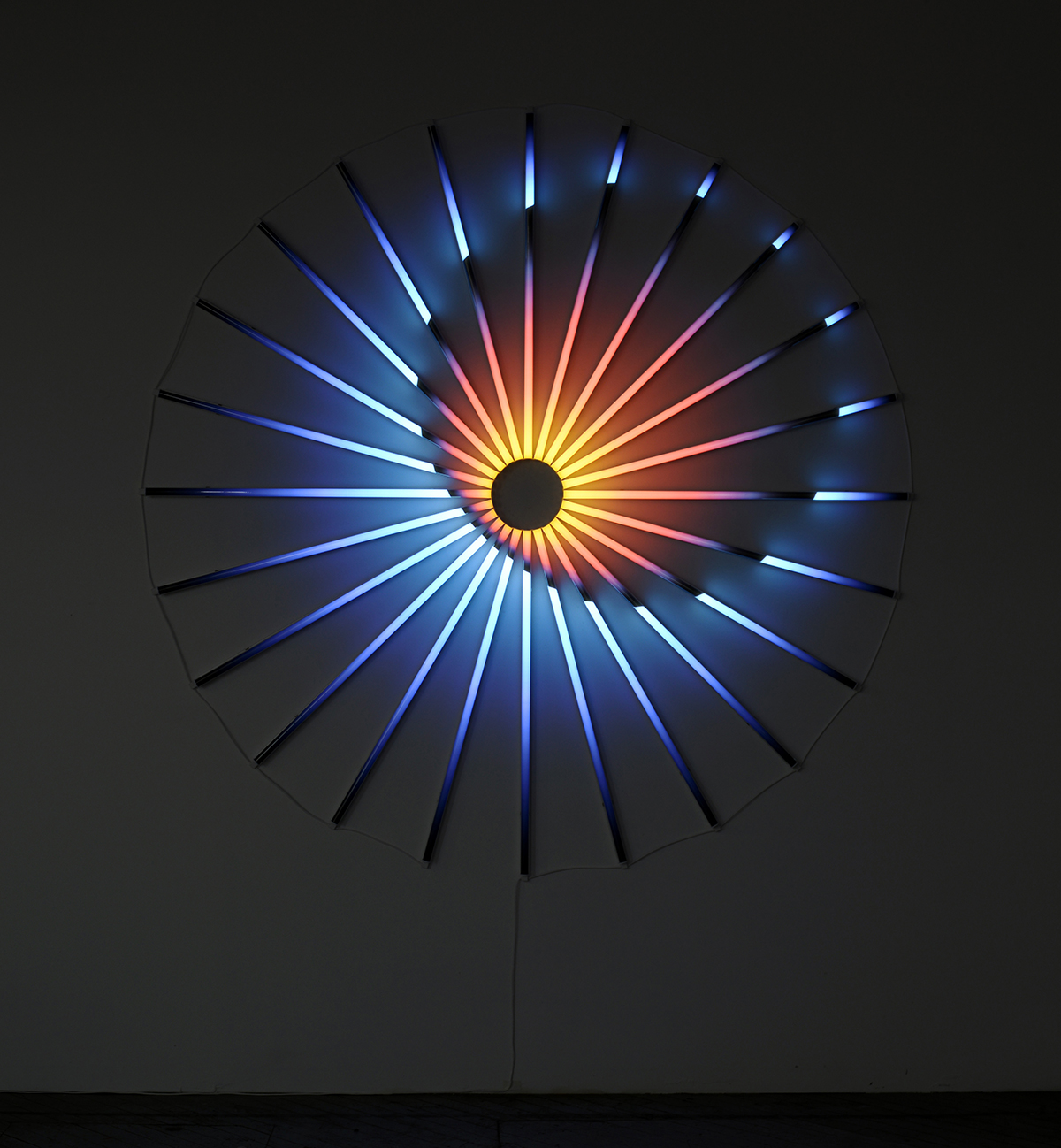
James Clar, A New Dawn, 2019. LEDs, filters. Edition of 3. 47.24 × 47.24 in. (120 × 120 cm).
What the LED Knows
Awake While You Sleep (2016) is a circular work approximately two meters in diameter — the scale of a large painting, the shape of a clock face or a moon or an eye. Its LEDs cycle through a slow program of color shifts, moving from warm to cool to warm again in a rhythm that is slightly off-sync with any biological rhythm you bring to it. The title names the condition it represents: the state of artificial wakefulness that contemporary life demands, the way screens extend the day past its natural limits and keep consciousness alert when the body would rather be dormant.
A New Dawn (2019) is square and smaller — a forty-seven-inch panel that presents itself more directly as an object in the tradition of a painting or a screen. Its program moves through gradations that simulate a sunrise without representing one: the colors shift from near-black through blues and oranges to a warm white that suggests daylight without depicting it. In a world in which the sunrise can be seen on any number of screens in any number of formats, Clar is asking what it means to make an object that evokes this elemental experience through the same technology that usually mediates it. Is this a sunrise? Is it a screen pretending to be a sunrise? Is the distinction meaningful?
What the LED knows — what any artificial light source knows — is that it was made. It was designed, manufactured, programmed, and placed in a specific relationship with a viewer by someone who made decisions about all of these things. Natural light doesn't know this. The sun has no agenda. But the screen in your pocket knows exactly what it wants from you, and the LED sculpture in the gallery knows something too, and Clar's work is organized around making that knowledge visible. Stand in front of one of these pieces long enough and you will understand something about why you look at screens the way you do, and what looking at them has done to you, and what it might mean to look at light differently.