In the mid-1990s, a young graphic designer named Brian Donnelly was working in New York, doing animation cel production work that didn't satisfy him, and spending his weekends doing something more interesting: breaking into bus shelter advertising cases, removing the advertisements inside, painting them, and putting them back. He was not vandalizing the advertisements in the conventional sense — he was not defacing them with his name. He was intervening in them, inserting small painted figures into the commercial imagery, then returning the manipulated images to their original positions. The resulting works traveled the advertising circuit, riding buses and appearing in shelters across the city, seen by thousands of people who had no reason to know they were looking at something that someone had deliberately made.
The Advertisement as Canvas
The conceptual move in the bus shelter and phone booth work — substituting art for advertising while maintaining the advertising's physical context and distribution mechanism — was precise and sophisticated. It engaged with the history of institutional critique (Duchamp's readymade, Warhol's appropriation, Barbara Kruger's deployment of advertising language) while doing something none of those precedents had done: it put the work back in the advertising system and let that system carry it. The audience was not self-selected. You did not have to go to a gallery to encounter a KAWS intervention. You just had to take the bus.
The figures that Donnelly — now working under the name KAWS — inserted into these advertisements were not random marks. They were developed characters with consistent formal qualities: the X-eyes, the cartoony anatomy, the specific gesture vocabulary. They derived their visual language from the vernacular of American commercial animation — Mickey Mouse, the Michelin Man, characters whose forms had been refined over decades of commercial deployment for maximum legibility and emotional resonance. KAWS was not appropriating these characters directly; he was working in the tradition they represented, developing his own characters with the same tools and the same attention to how a drawn figure communicates affect at a glance.
"The paintings exist in their own space. The argument about what they mean is happening somewhere else. I'm trying to make something that matters in the room."
— KAWSCOMPANION and What It Carries
COMPANION — the primary character in KAWS's practice, a figure that derives its basic form from Mickey Mouse while replacing the famous ears with a skull-like head structure and covering its face with the X-eyes that appear throughout the work — is one of the most recognizable figures in contemporary art. It exists as vinyl toys in dozens of scales and colorways, as limited-edition fashion collaborations, as monumental inflatable sculptures that have floated in harbors from Hong Kong to New York, and as the central figure in the large-scale paintings that are the foundation of the practice.
What COMPANION carries — what the figure means — is harder to articulate than what it looks like. It is not simply a branded character in the way that, say, the Michelin Man is a branded character. It carries an emotional register that commercial character design does not typically aim for: something melancholy, something exhausted, something that suggests the experience of being a consciousness inside a cute exterior. The X-eyes, which read initially as a comic convention (the cartoon character who has been hit on the head), read on sustained looking as something else: a refusal to be seen, or an inability to see, or both simultaneously.
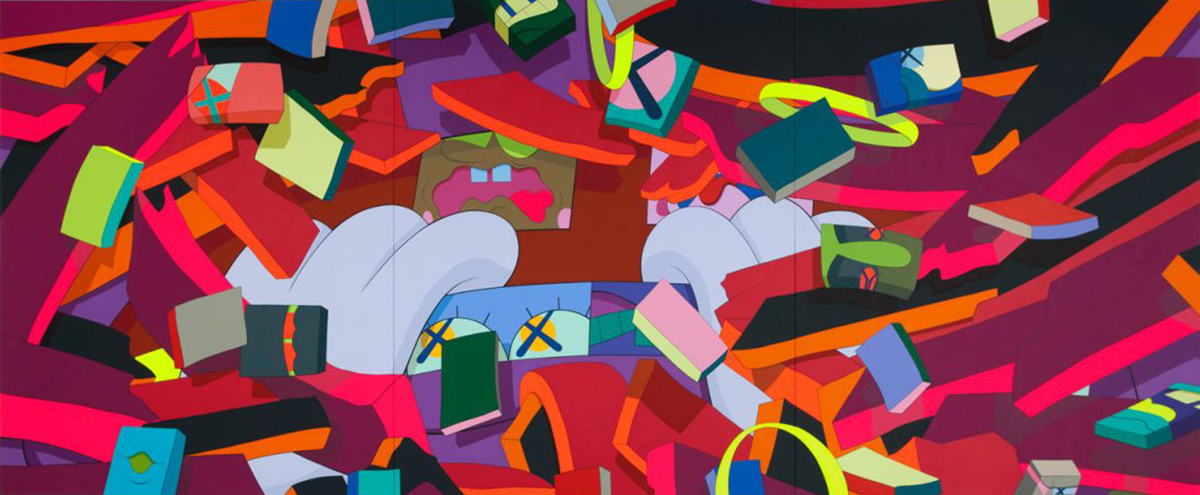
The large paintings — Untitled (Kimpsons #1) from 2004, the Silent City triptych from 2011, works at scales that require you to move through them rather than simply stand before them — are where this emotional complexity is most fully developed. The painting is not illustration. It does not simply render the characters that exist in other media; it does something with paint that can only happen in paint, creating surface relationships and spatial tensions that the toys and the clothing cannot carry. The color in these pictures is specific and non-decorative. The scale creates a kind of pressure that smaller formats cannot generate. The paintings are serious works by any formal measure.
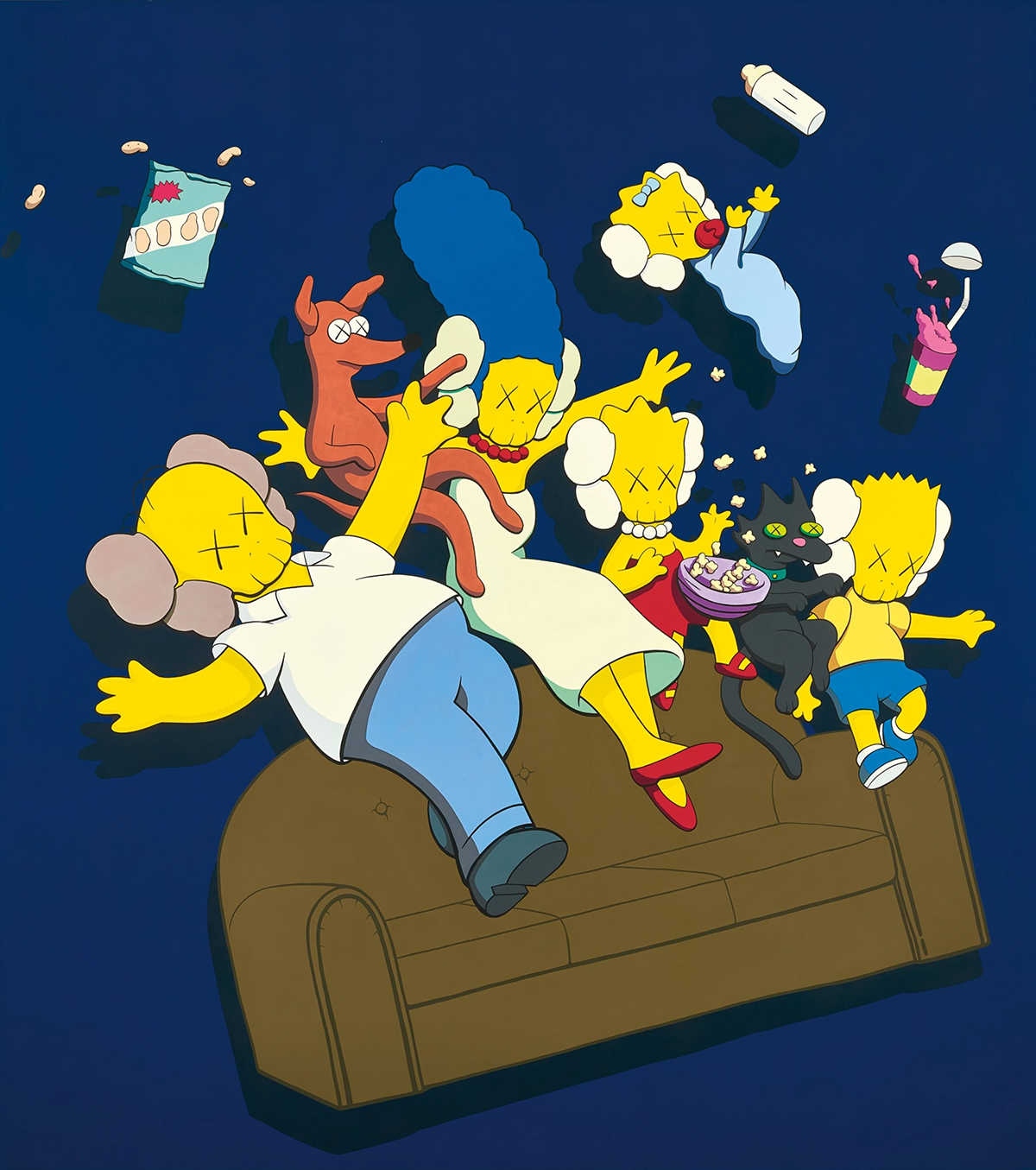
KAWS, Untitled (Kimpsons #1), 2004. Acrylic on canvas. 107⅞ × 96 in. (274.5 × 244 cm).
The Argument About KAWS
The critical argument about KAWS is usually structured as follows: his popularity proves that his work is not serious; his commercial relationships with fashion and toy companies prove that he is primarily interested in money; his collector base, which includes young people who came to him through streetwear rather than through galleries, proves that the work is accessible in a way that is suspicious. The conclusion, usually left unstated, is that serious art is serious precisely because it is not popular, not commercial, and not accessible.
This argument is worth examining not because KAWS particularly needs defending, but because it reveals something about how the contemporary art world constructs its valuations. The assumption that popularity and commercial relationships are incompatible with artistic seriousness has a history that includes Warhol, Haring, Jeff Koons, and Takashi Murakami — all artists who made comparable decisions and attracted comparable criticism, and all of whom are now treated as central figures in the history of contemporary art. The criticism of KAWS is not new. It is the same criticism, applied to each new generation of artists who choose visibility over institutional gatekeeping.
What the argument consistently fails to engage with is the actual quality of the paintings. Standing in front of Silent City — a triptych of panels each measuring ten feet high, depicting COMPANION figures in a grey urban landscape — you are not standing in front of a product or a brand. You are standing in front of a painting that makes specific decisions about color, scale, and emotional register, and those decisions are the right ones. The paintings reward looking. They do not explain themselves or pander to their audience. They occupy the room with the kind of assurance that comes from someone who knows exactly what they're doing and has spent decades learning how to do it. The argument about KAWS will continue. The paintings will continue to exist, unchanged by the argument, doing what good paintings do.