Horror knows things that other genres won't admit to knowing. It knows that the body is fragile and that what we do to protect it is sometimes worse than what we're protecting it from. It knows that the things we fear most are often the things we've built — the institutions, the systems, the structures of safety that become structures of control. It knows that the monster is always a projection, that what we put outside ourselves is drawn from what is already inside, and that the outside dark is a mirror. These are not comfortable things to know, which is why horror is a genre rather than a philosophy: the genre form provides the distance that direct knowledge can't.
The Genre as Argument
Jillian McDonald's use of horror and science fiction conventions is not pastiche — she is not making work that comments on these genres from the outside, that collects their visual signifiers as ironic citations. She is working from the inside of the genres, taking their conventions seriously as tools for producing specific kinds of attention and emotion, and using those tools to investigate questions that the genres themselves usually foreclose. The horror genre promises that the monster will be defeated. McDonald is more interested in what the monster represents than in its defeat, and she builds her work around the tension between the genre's promised resolution and the absence of any easy resolution to what the monster actually is.
The specific conventions she reaches for — the bunker, the dark corridor, the isolated landscape, the body subjected to forces beyond its control — are not chosen for atmosphere. They are chosen because they encode specific historical and political content: the bunker is a Cold War object, produced by a specific historical relationship to the possibility of mass destruction; the isolated landscape is where civilization's margins have always been tested; the body under extreme conditions is where questions about individual agency and systemic power become unavoidable. McDonald uses genre conventions because they carry this content efficiently, in ways that viewers who know the genre can receive directly without extended explanation.
"Horror is a genre that takes the body seriously. It takes fear seriously. It takes the possibility that something terrible is actually happening seriously. That's rarer than it sounds."
— Jillian McDonaldThe Bunker and the Body
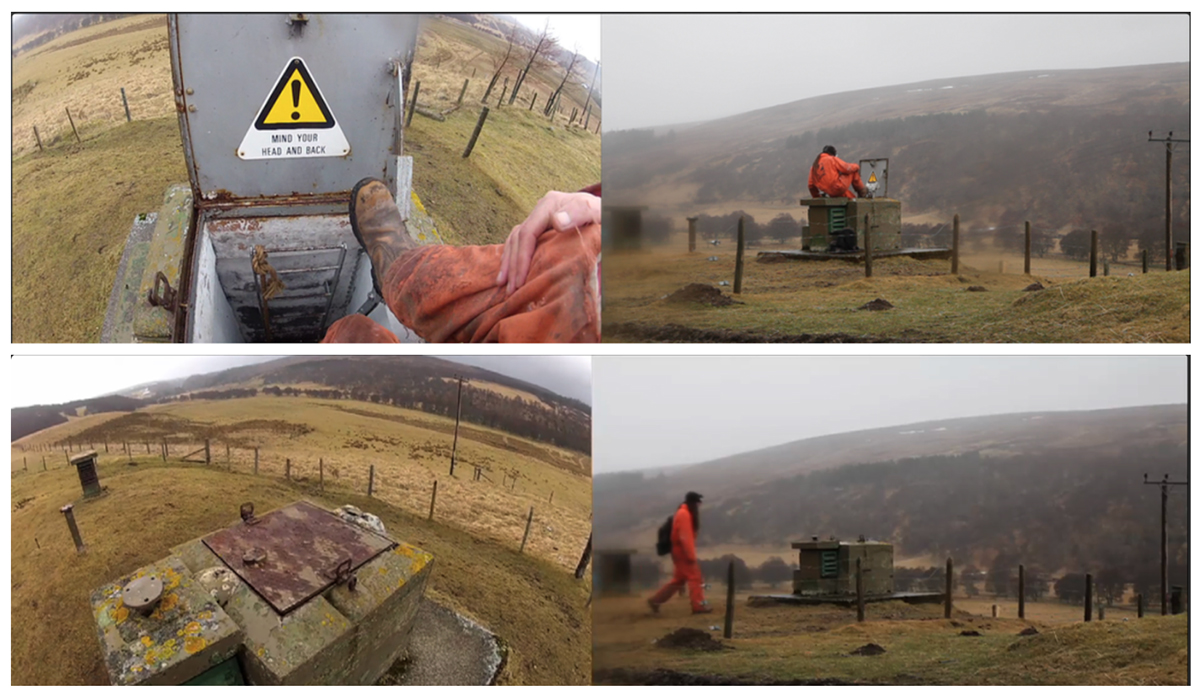
The Hatch (2018) was made during a residency at Glenfiddich Distillery in Dufftown, Scotland, and edited at Signal Culture in Owego, New York — two residency programs that McDonald has returned to repeatedly, and that shape her work in ways that are visible in the finished pieces. The Glenfiddich residency gave her access to the landscape and culture of northern Scotland, including the Cold War bunkers that dot the region — structures built to protect a small number of people in the event of nuclear attack, and that now stand as architectural evidence of a historical moment's particular relationship to fear and power.
The two-channel format of The Hatch creates a perceptual tension that is central to its effect: two screens, each carrying a different but related image, installed so that the viewer must choose where to look while remaining aware of what they are not looking at. This structure mirrors the horror film's essential mechanism of the unseen threat — the thing happening off-screen is often more frightening than the thing happening on it — but it also mirrors the more everyday experience of divided attention, the way contemporary consciousness is structured around the management of multiple simultaneous information streams.
The bunker as a location encodes a specific and uncomfortable historical logic: the decision to build shelters for some people rather than all people is a decision about which lives matter, made in the certainty of disaster. Being inside the bunker in The Hatch is not safety but complicity — you have survived, but at the cost of being the kind of person whose survival was deemed worth planning for. McDonald's video makes this logic visible without making a polemic of it. She is inside the bunker. So is the viewer, in the two-channel room. The question of what that means is left open.
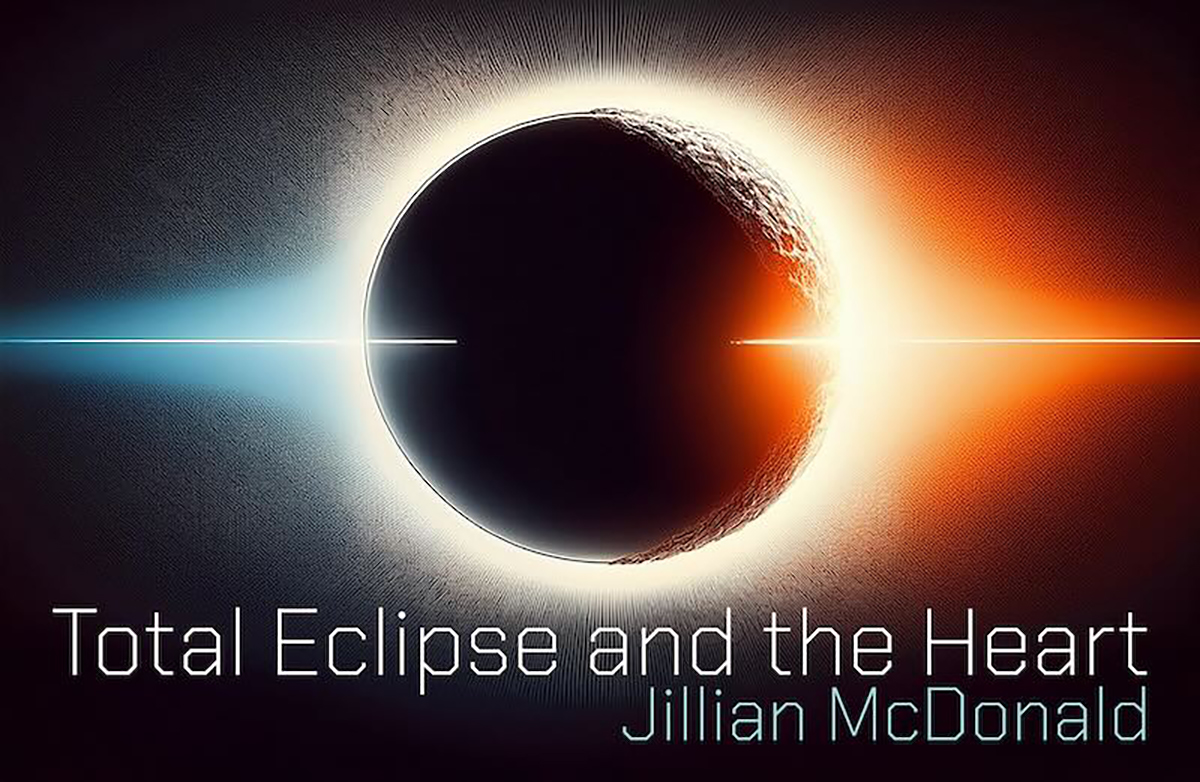
Jillian McDonald, Total Eclipse and the Heart, 2025. Video. Inspired by the solar totality of 2024.
What the Eclipse Showed
The 2024 solar eclipse — the total solar eclipse that crossed North America in April, creating a path of totality through populated areas in a way that had not happened for decades — produced one of those rare moments of genuine collective attention: millions of people stopping what they were doing, going outside, and looking at the same thing at the same time. The eclipse was not a media event in the usual sense. It was an event that the media could only approximate; the actual experience was available only to people who were physically present in the path of totality and willing to look up.
Total Eclipse and the Heart (2025), McDonald's video work responding to this event, is interested in what happened to people in that moment — specifically in the relationship between the individual body and the collective experience of something that was simultaneously intimate and overwhelming. The solar eclipse is a science fiction scenario made real: the sun disappears, the temperature drops, the birds stop, and for two minutes you understand viscerally that you are a small thing on a small rock in a large system of forces that do not take you into account.
McDonald's work is, in the end, about what we do with the knowledge that horror gives us — the knowledge of fragility, of contingency, of the structures that are supposed to protect us and don't, of the body's absolute limits. She does not make work that resolves this knowledge or makes it comfortable. She makes work that holds it in a form — the genre conventions, the residency locations, the two-channel structure — that allows it to be looked at rather than looked away from. What horror knows is that looking is the beginning, not the end. McDonald's work agrees.