The signs are gone now. The triple-X marquees, the blinking liquor store placards, the peep show neons in their reds and ambers and clinical whites — all of it has been replaced by the current regime of LED screens cycling corporate slogans fifty stories high. But Jane Dickson was there when the signs were still running, and she did something that only a handful of artists had the unfashionability to do: she looked at them carefully, and then she painted what she saw.
The Art of the Ugly Block
In the late 1970s and early 1980s, Times Square was not yet a subject for nostalgia. It was simply where certain people in New York lived and worked, including an overlapping cluster of artists, musicians, filmmakers, and troublemakers who would later be grouped under the loose category of the downtown scene. Jane Dickson arrived in this world through Colab — the Collaborative Projects collective founded in 1977 that organized group exhibitions in unofficial spaces, including the famous 1980 Times Square Show, mounted in a vacant massage parlor on Seventh Avenue and 41st Street.
The Times Square Show was a defining event: over three hundred artists contributed work to a building that participants simply took over without permission, and the resulting exhibition — chaotic, confrontational, and genuinely surprising — put a certain kind of New York art-making on the map. Dickson was there, as was Jean-Michel Basquiat, Jenny Holzer, Kiki Smith, and dozens of others. But where many of the show's participants were working in conceptual registers — text, appropriation, institutional critique — Dickson was painting. Specifically, she was painting the neighborhood around her.
This was not the fashionable thing to do. The art world of 1980 was still largely organized around the aftermath of Abstract Expressionism on one side and the cool ironies of Minimalism and Conceptualism on the other. Urban realism — painting the actual visual textures of the contemporary city without aesthetic distancing — felt anachronistic in sophisticated circles, the kind of thing that belonged to Social Realism or illustration rather than serious contemporary practice. Dickson proceeded anyway.
"The thing about artificial light is that it tells the truth about what people want. Nobody lights a sign to describe what something is. They light it to describe what it feels like to want something."
— Jane DicksonAstroturf as Medium
The surface Dickson chose to work on is itself a kind of argument. Astroturf — the synthetic grass material manufactured for sports fields and suburban lawns — is not a traditional artist's support. It has no precedent in the history of painting. When Dickson began using it as a ground for oil paint in the early 1980s, she was making a choice that was simultaneously practical and conceptually charged: here was a material that was already artificial, already a simulation of nature, already belonging to the same register of fake authenticity as the signs she was depicting.
But astroturf also does something physically specific with oil paint. Its texture — the dense synthetic pile, the slight give — traps paint differently than canvas. The brushstrokes catch on the fibers, and the resulting surface has a shimmer that canvas cannot replicate: light diffracts off the synthetic material and through the paint layer simultaneously, producing an effect that is somewhere between a painting and a photograph and a neon sign itself. When Dickson paints neon on astroturf, the surface seems to glow from within.
There is also the simple fact that astroturf is a democratic material. You can buy it at a hardware store. It is not precious. In choosing it, Dickson was aligning herself with the actual textures of the world she was painting — a world that was not precious, that had not been chosen by curators or approved by galleries, that simply existed in its synthetic, blinking, slightly desperate way. The support and the subject were making the same claim about what deserved to be looked at.
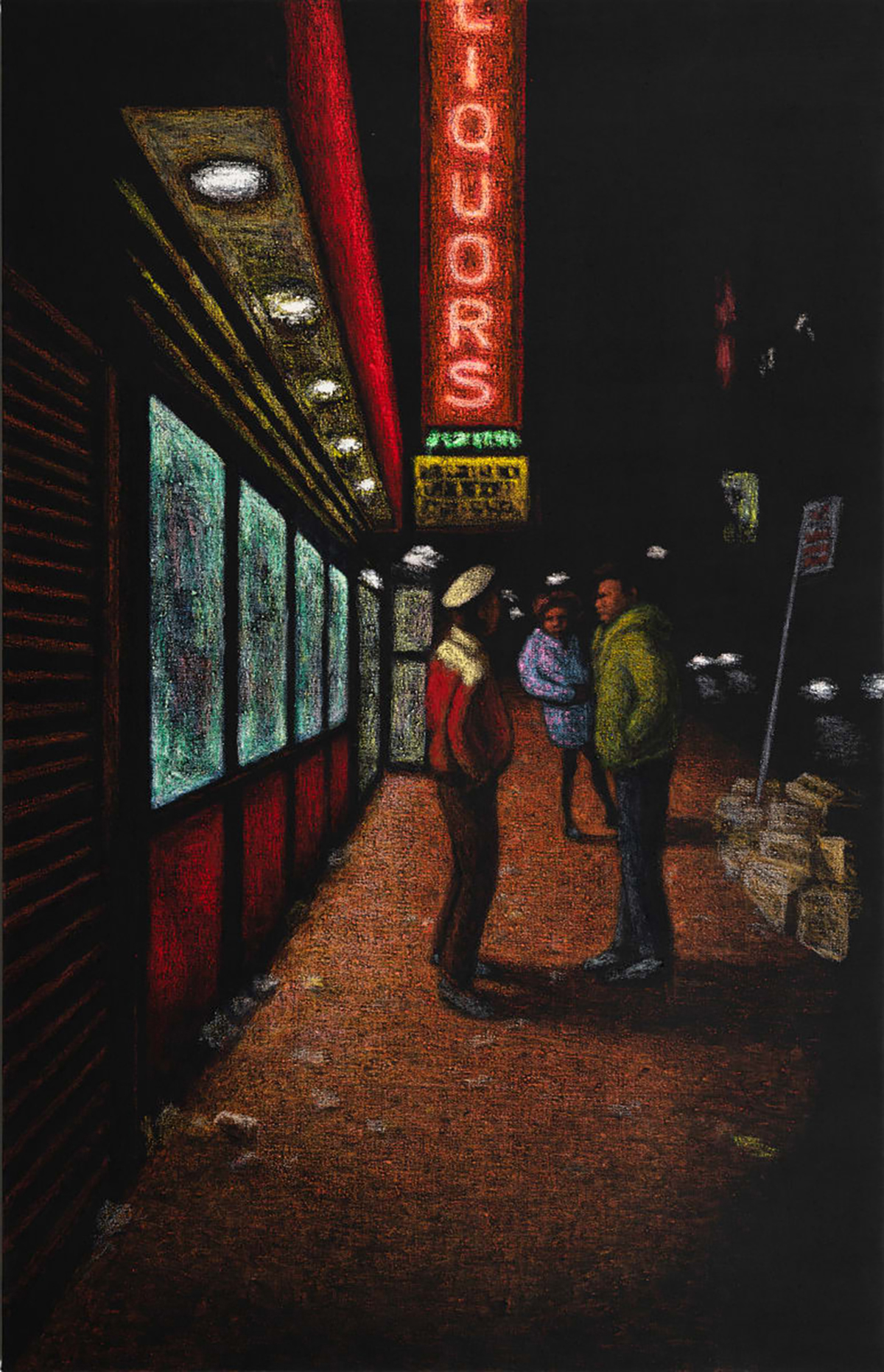
Jane Dickson, Liquors Conversation, 2020. Oil stick on linen. 56 × 36 in. (142.24 × 91.44 cm).
Her later paintings on linen — including Liquors Conversation from 2020 — brought this same commitment to artificial light into a more traditionally fine-art register without compromising its essential quality. The oil stick has a different drag than oil paint on astroturf, producing a rougher, more gestural surface, but the light in the paintings remains the same: halated, urban, specific. The liquor store glows in its particular way; the street outside is dark in its particular way. You feel the temperature of the air.
What Artificial Light Tells the Truth About
The Times Square that Dickson painted through the 1980s and 1990s was comprehensively destroyed by the city's mid-decade cleanup campaign and the subsequent waves of corporate redevelopment that replaced the pawn shops and sex clubs with chain restaurants and themed entertainment. The Disney Company's renovation of the New Amsterdam Theatre in 1994 is usually cited as the symbolic turning point — the moment when Times Square officially became family-friendly and the old neighborhood became subject for nostalgia rather than navigation.
What Dickson's paintings preserve is not primarily the facts of the place — the addresses, the businesses, the faces — but its quality of light. And the light of old Times Square was genuinely unlike anything that has replaced it: it was warm and specific and variegated, produced by thousands of individual signs in different states of age and maintenance, some bright, some flickering, some barely working at all. It created a visual environment that was dense and enveloping and slightly overwhelming, and it told you something true about the desires that were operating in that neighborhood — the hunger for stimulation, the promise of transformation, the half-kept covenant between commerce and fantasy.
The current light of Times Square is produced by massive LED screens running brand campaigns, and its quality is entirely different: cold, homogeneous, impossible to escape, organized around the imperative of attention rather than invitation. Standing in Times Square now, you are not being promised something; you are being subjected to something. Dickson's paintings, which were not nostalgic when she made them, have become an inadvertent archive of a different relationship between city and citizen — a relationship organized around desire rather than data.
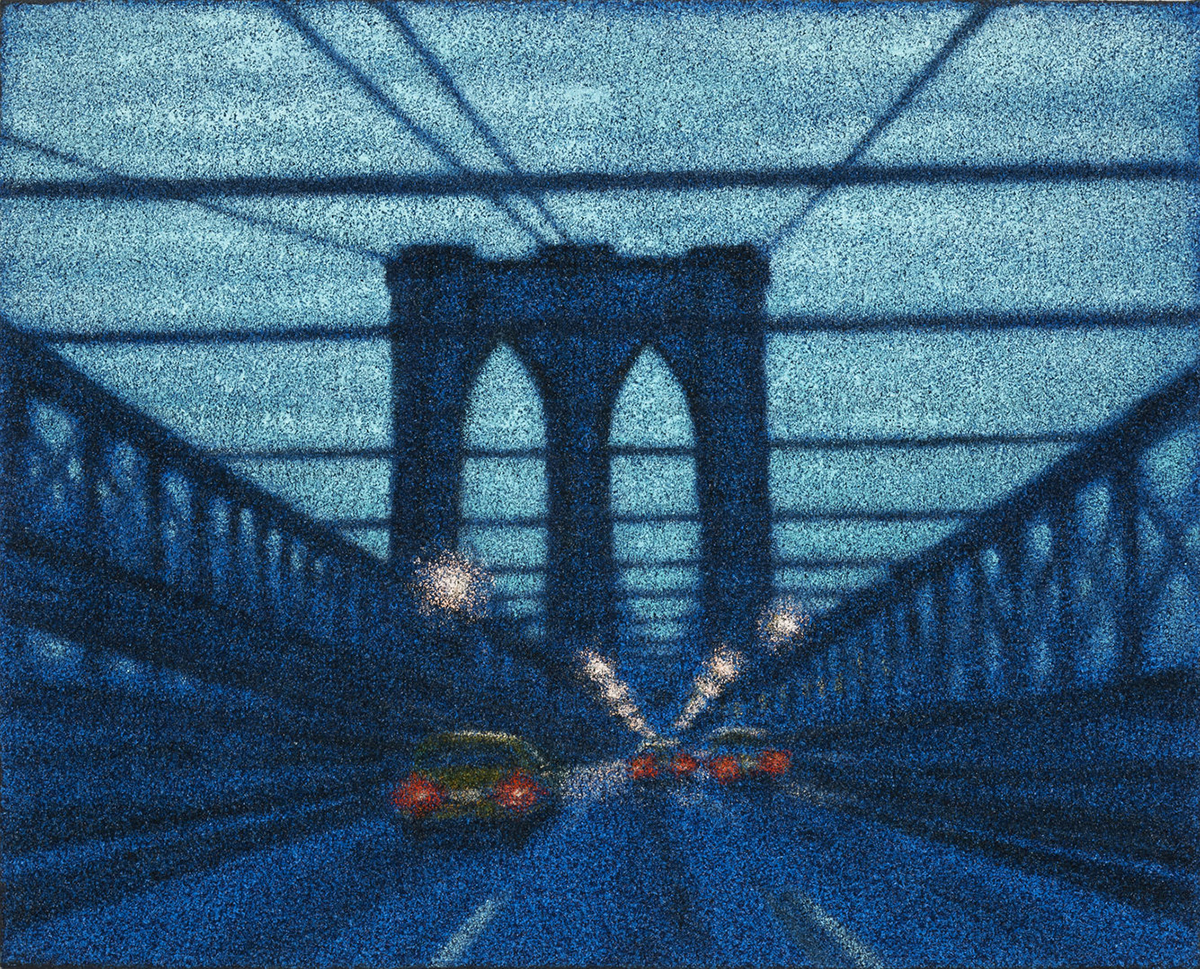
She has kept painting through the city's successive transformations, and the work has not softened. The diners, the cab windows, the bridges seen from the water at night — everything is still rendered in that same quality of attention, that same willingness to take the artificial surface of the world seriously. In the art world's current moment of return to painting, Dickson has acquired new admirers, but the work itself has not changed to accommodate them. It remains what it always was: an argument, made in oil on strange surfaces, that the city's worst-lit corners are also its most truthful ones.