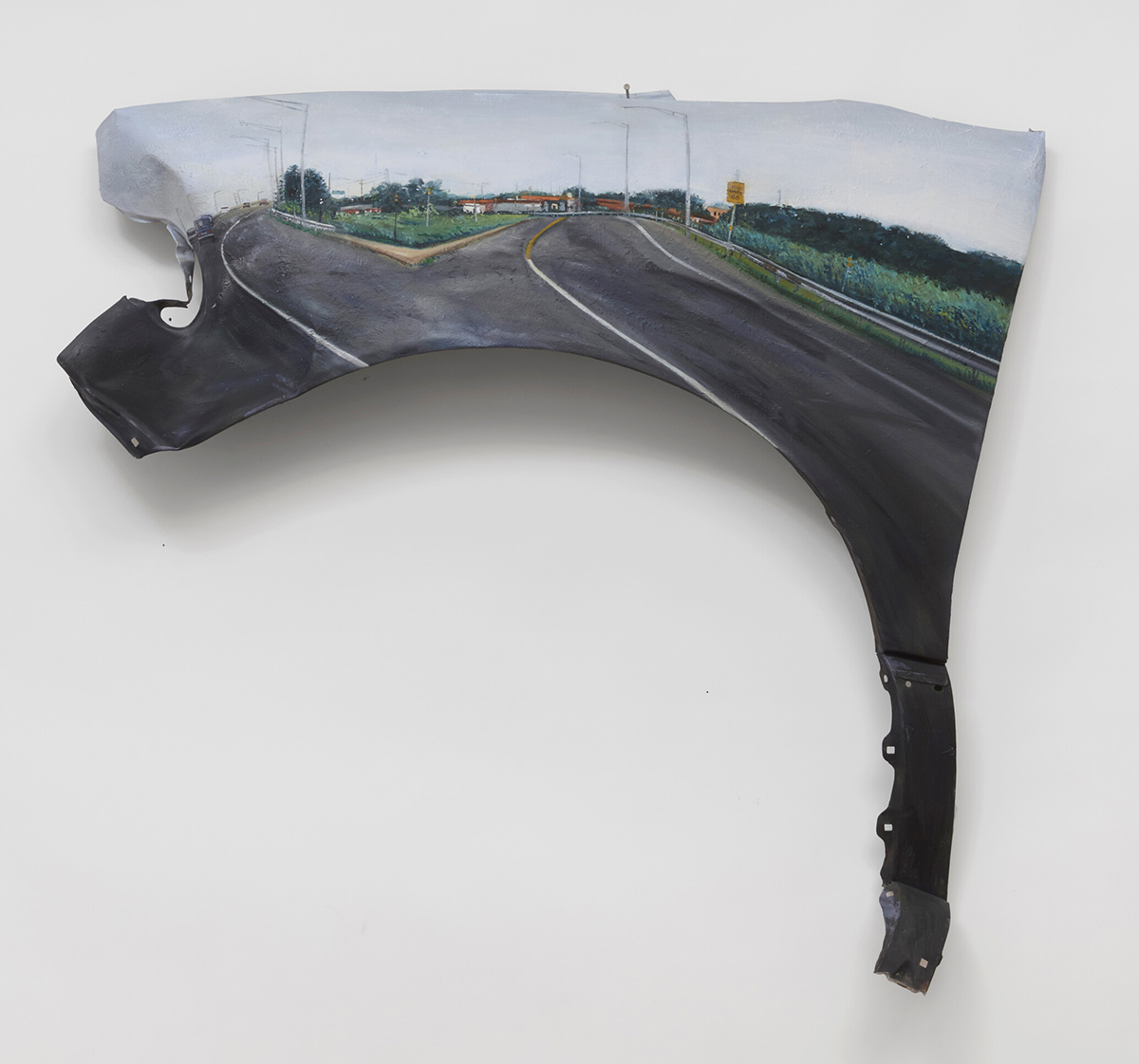
A quarter panel from an automobile is not, technically, a found object. It is a manufactured component, produced to tolerances, shaped by industrial process, and then — if it ends up in Linda Gottesfeld's studio — detached from its original context through collision, age, or the simple obsolescence of the vehicle it belonged to. By the time Gottesfeld gets her hands on these panels, they have already been through the world. They carry the memory of that passage in their curves, their dents, their surface oxidation. She paints on them without removing those histories.
The Panel as Found Object
Gottesfeld's decision to work on industrial metal rather than canvas was not arbitrary. She came to it through a sustained investigation of what painting is when it is separated from its traditional supports — the kind of investigation that abstract painting undertook in the 1960s and 1970s and then largely abandoned. When you paint on a car panel, you are painting on an object that already has a shape — a curvature determined by aerodynamic engineering, a volume determined by the requirements of the vehicle it surrounded. The painting you make has to negotiate with that shape rather than ignoring it.
The result is work that exists somewhere between painting and sculpture: the oil paint sits on the metal surface and the image it creates is inseparable from the form it inhabits. Exit 39, from 2000, protrudes from the wall at seven inches of depth — you can walk around the edges and understand the object's physical presence even as you read the painted surface as an image. This doubling is not incidental. It is the point: Gottesfeld is interested in objects that carry multiple identities simultaneously, that refuse to be either pure painting or pure sculpture.
"The metal already knows what it is. I'm not imposing anything on it. I'm just finding what's already there."
— Linda GottesfeldNew Jersey as Subject
The choice of New Jersey as subject matter is itself an aesthetic position. The state is not famous for its pastoral landscapes or its picturesque towns — what it offers instead is a particular kind of industrial sublime: the Turnpike running through the chemical corridor, the refineries rising against the sky, the overpass interchanges generating their own geometric complexity. This is not beautiful in any conventional sense, but Gottesfeld has spent years demonstrating that conventional beauty is not the only kind worth pursuing.
The New Jersey Series, developed between 2016 and 2017, takes the specific visual language of highway infrastructure — the signage, the overpasses, the industrial structures visible from the road — and renders it in oil on sheet steel. The small scale of these works (twelve by six inches) creates a paradox: the landscapes they depict are vast, organized around the overwhelming scale of industrial architecture, but Gottesfeld compresses them into objects you could hold in two hands. The effect is not miniaturization but concentration, as if the essential quality of these spaces could be distilled into a small, dense object.
There is something specifically American about taking the industrial corridor seriously as subject matter. The tradition in American art of treating industrial subjects as worthy of sustained attention — from the Precisionists through Charles Sheeler through the painters of the Ashcan School — runs alongside the more celebrated landscape tradition but has always received less institutional support. Gottesfeld is working in that alternative tradition, and the steel panels she paints on are both medium and metaphor: the same material the infrastructure around her is built from.
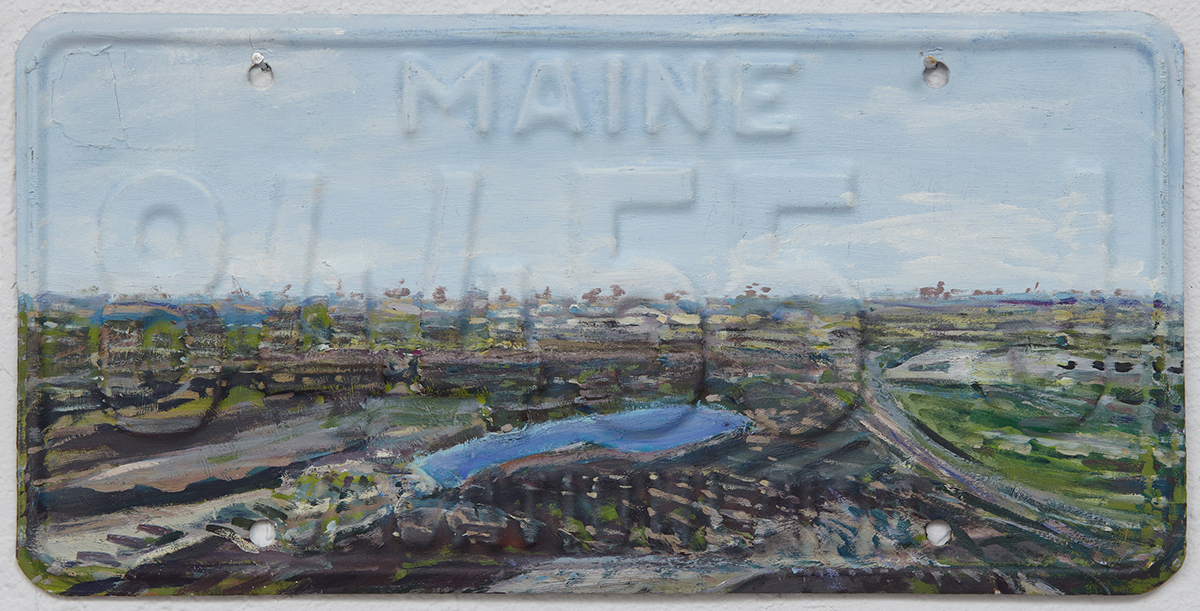
Linda Gottesfeld, New Jersey Series (Dwasline), 2016–17. Oil on steel. 12 × 6 in.
What Rust Remembers
The specific quality that makes Gottesfeld's work distinctive within current painting is its insistence on material memory. The panels and steel sheets she works on are not blank surfaces; they carry the evidence of their previous existence in the form of surface marks, oxidation patterns, the ghostly traces of paint that was there before hers arrived. She does not conceal these histories. They become part of the image, visible under and through the oil paint she applies, creating a layering that is temporal as much as visual.
This relationship to material history connects Gottesfeld's work to a longer tradition of process-oriented art-making — Arte Povera, assemblage, the use of non-traditional materials in post-war American art — while remaining entirely her own formal language. The key distinction is that she is primarily a painter: the oil paint is not incidental to the object but constitutive of it, and her decisions about mark-making, color, and composition are as considered as those of any painter working on canvas. The industrial support changes what painting can mean without changing the commitment to painting as a practice.
What rust remembers is the contact between metal and atmosphere over time — a record of exposure, of the interaction between a manufactured object and the environment it lived in. Gottesfeld's paintings are full of this kind of memory, accumulated evidence of lives led in proximity to highways, refineries, and the slow oxidation of everything the industrial economy produces and eventually discards. They are historical documents of a different kind than the ones in archives — physical records of ordinary industrial time, preserved in oil and metal.