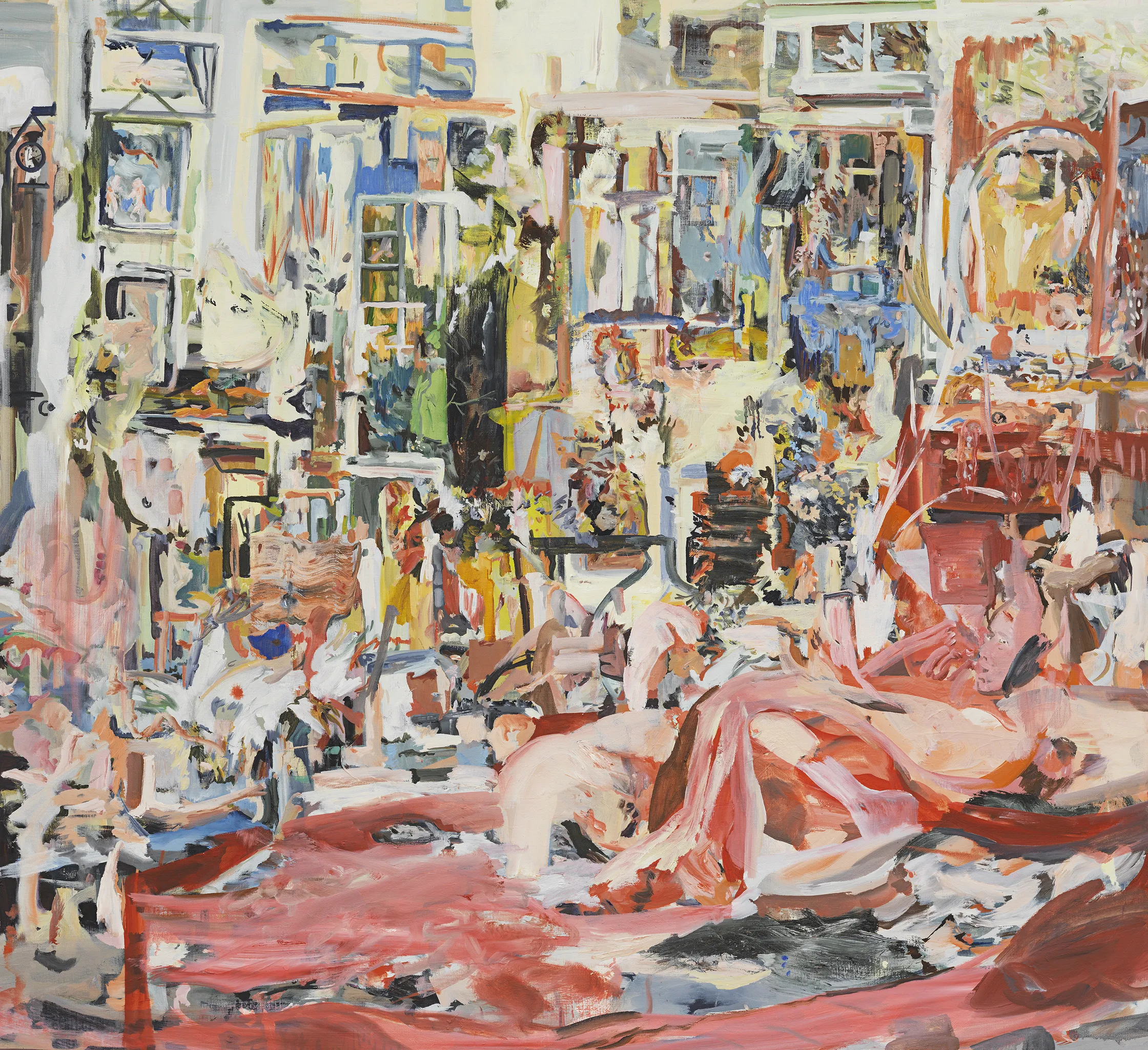
The first impression is pure sensation: a large Cecily Brown hits you the way weather does, as something arriving from everywhere at once. Pigment in every corner, the canvas worked to a density that feels almost pressurized — and then, slowly, the eye begins to find things inside the chaos. There: something that might be a leg, bent at an angle that suggests urgency or abandon. Here: what seems to be a face, half-submerged in ochre and crimson, the features just barely implied. Foliage, or maybe cloth, or maybe flesh — you cannot be certain, and the painting does not intend to let you be. You keep looking. The forms keep appearing and retreating. The painting is doing something specific with your attention, working you the way a magician works a room, and the pleasure of it is exactly the pleasure of almost-knowing: the moment just before the figure resolves, held indefinitely, made into the substance of the work itself.
Cecily Brown has been painting this way for more than twenty-five years, and the conversation around her has never quite settled into an agreed-upon verdict, which tells you something important about what she does. She is too figurative for the pure abstractionists, too wild for the classical realists, too sensual for those who want their painting to keep its distance. She occupies a position that is genuinely her own — not a compromise between modes but a territory she has carved out through sheer persistence of vision, a place where the figure exists without being fixed, where the body is always arriving or departing, never standing still long enough to be pinned down and declared.
What London made
Brown was born in London in 1969 and grew up, by her own description, in the thick of the art world without quite being inside it. Her father is the critic David Sylvester — the man who produced the long series of interviews with Francis Bacon that remain the most searching sustained interrogation of any British painter's practice — though Brown did not grow up with him and rarely speaks about this inheritance. What she absorbed from her environment was less a specific aesthetic than a general quality of seriousness about looking: the understanding that painting was not merely craft but argument, that the decisions made on a canvas were ideas expressed in pigment and had to carry the weight of ideas.
She studied at the Slade School of Fine Art in London, where the emphasis on drawing — on the primacy of the mark, on the hand's relationship to the eye — left a residue she has never shed. But the Slade also gave her access to the National Gallery, and Brown spent a great deal of time there, not in front of the twentieth century but in front of the seventeenth and eighteenth: Rubens, above all, with his piled flesh and his almost indecent abundance; Fragonard and Boucher, the rococo masters of pleasure rendered in paint so light and quick it seems to have been applied in the moment of perception. These were not painters she studied academically. They were painters she absorbed viscerally, in the way that young painters absorb work that is doing something their own instincts recognize. The lush, the excessive, the erotic, the body treated not as a moral category but as a purely aesthetic one — this was the tradition she wanted to be inside.
She moved to New York in the mid-1990s, and the city changed her in the ways that New York changes painters: it gave her scale. British painting of the period tended toward the contained, the precise, the modest in ambition if not in quality. American painting — the painting she was encountering in Chelsea galleries, in museums, in the studios of friends — operated at a different register. The canvas could be enormous. The gesture could be enormous. Willem de Kooning, whose Women series had been dissolving and reassembling the female body since the early 1950s, became an obsession. Francis Bacon — the painter whose practice her father had spent a career mapping — was already in her blood, but New York helped her understand what she could do with Bacon's lessons about figure and distortion without simply repeating them.
"I want the painting to be on the verge of something — never quite resolved, never quite legible."
— Cecily BrownThe argument against resolution
Brown's early New York work was charged with what could only be called erotic energy — figures entangled with each other and with landscape and with paint itself, the body's surfaces dissolving into the surfaces around them. Critics reached for adjectives that were sometimes accurate and sometimes revealing of their own discomfort: "carnal," "orgiastic," "unruly." What the language often missed was the rigorous intelligence underneath the apparent wildness. Brown was not simply flinging paint and hoping for the best. She was making a very precise argument about what the figure can and cannot do on a canvas — about what gets lost when you resolve a form into clean contours, when you let the body become too legible, too knowable, too easily consumed.
The refusal to fix the figure is the central formal decision of her career, and it is not a failure of resolution but an active philosophical position. When you can see exactly what you're looking at, you stop looking. The painting hands you something and you take it and move on. What Brown does instead is maintain a state of suspended recognition — a condition in which you keep looking because the painting keeps withholding the final clarification. The figure is always almost there. The shoulder is clearly a shoulder. The gesture is unmistakably human. And then the paint does something to it, buries it, transfigures it, and you are back in the territory of almost-knowing. This is not frustration. Or rather, it is a particular kind of productive frustration, the kind that keeps you in front of the painting longer than you expected to be.
Her process is physical in ways that most painting is not. Brown builds up layers over time — oil on linen, applied and scraped back, painted over and reconsidered, the surface accruing a history of decisions and revisions that is partially visible in the final work. She does not paint from photographs or from posed models; she works from a kind of interior pressure, from the image in her head that is always shifting, and from the painting itself, which she describes as having its own demands. "I let the painting tell me what it wants," she has said, and while this sounds like mystification it describes something real about what happens when a painter works responsively — when the mark on the canvas generates the next mark rather than executing a predetermined plan.
Old Masters and their lessons
The debt to Rubens is worth dwelling on because it is structural, not merely stylistic. Rubens's great paintings — the Descent from the Cross, the mythological scenes, the hunting pictures — operate through a particular organization of bodies: figures pressed together, limbs overlapping, the composition so packed that individual forms lose their edges and merge into collective masses of flesh and movement. There is no breathing room in a Rubens. The bodies are always touching, always entangled, and this compression is the source of the paintings' energy. What reads as abundance is actually a very specific answer to the question of how to make a figure feel alive: you put it into contact with everything around it, you deny it the luxury of isolation, you make it exist only in relation.
Brown took this lesson and pushed it further, toward a condition where the entanglement becomes so extreme that individual figures can no longer be disentangled at all. The bodies in her paintings are not merely touching; they are partly dissolved into each other, into the landscape, into the paint. You cannot always say where one person ends and another begins — or where a person ends and a tree begins, or where foliage becomes hair, or where cloth becomes skin. This is Rubens taken to a logical extreme, the logic of touch taken to the point where touch becomes merger. And it is also, though Brown rarely frames it this way, a very specific thing to do with the erotic: to represent desire not as a relationship between distinct individuals but as a force that dissolves the distinction between them.
Fragonard matters differently. Where Rubens gives Brown the compositional logic of compressed figures, Fragonard gives her the quality of light — that luminous, almost frivolous surface that treats pleasure as a natural condition of the world, that paints the body without apology or moral weight, that makes linen and flesh equally beautiful through the same handling of pigment. Brown's surfaces have this quality, at their best: a joy in paint as such, in the act of making a mark that records itself as having been made by a living hand moving with intention and pleasure. The brush stroke as evidence of being present, alive, deciding. This is what connects her to de Kooning most directly: the sense that the painting records a life being lived at the level of the mark.
Selfie: painting the self through indirection
Selfie, made in 2020 during the first year of the pandemic lockdown, is one of Brown's most compelling recent paintings and one of her most personal — though personal, in her work, always means something indirect. She did not paint herself in any conventional sense: no mirror-facing self-portrait, no physiognomic record. What she did instead was compress the canvas space, reduce the scale slightly from her usual large formats, and fill the resulting rectangle with an intensity of gesture that reads, somehow, as a record of interior rather than exterior experience. The painting is made from what was available: the room, the body, the accumulation of days inside a single constrained space.
The title is both a joke and an argument. A selfie is the most literal form of self-representation currently available — the phone held up, the face recorded, no mediation — and Brown's version refuses every aspect of this. The self is present only in the marks: the specific decisions made on this canvas during these months, the pace of the work, the things that got buried and the things that survived. This is self-portraiture as process record, as autobiography-through-touch, and it is far more intimate than any accurate rendering of her face could be. A face tells you what a person looks like. A canvas worked like this tells you how a person thinks, what they are afraid of losing, what they are trying to hold onto when everything else has been removed.
The compressed space of Selfie — figures pushed close to the picture plane, forms crowding against each other without the usual sense of expansiveness — translates the experience of lockdown without illustrating it. You do not see a person alone in a room. You see a canvas that has been lived in, worked over, argued with, the physical compression of days when the available world had contracted to the dimensions of a studio. This is the kind of thing Brown does better than almost any painter working now: she finds the formal equivalent of an experience without narrating the experience, makes the painting feel the way the circumstance felt rather than depicting it.
"The figures in her work are always almost there — you see a shoulder, a leg, something that might be a face — and then it escapes back into paint. This is not failure. It is the whole argument."
— On Cecily BrownThe figure that refuses to stay
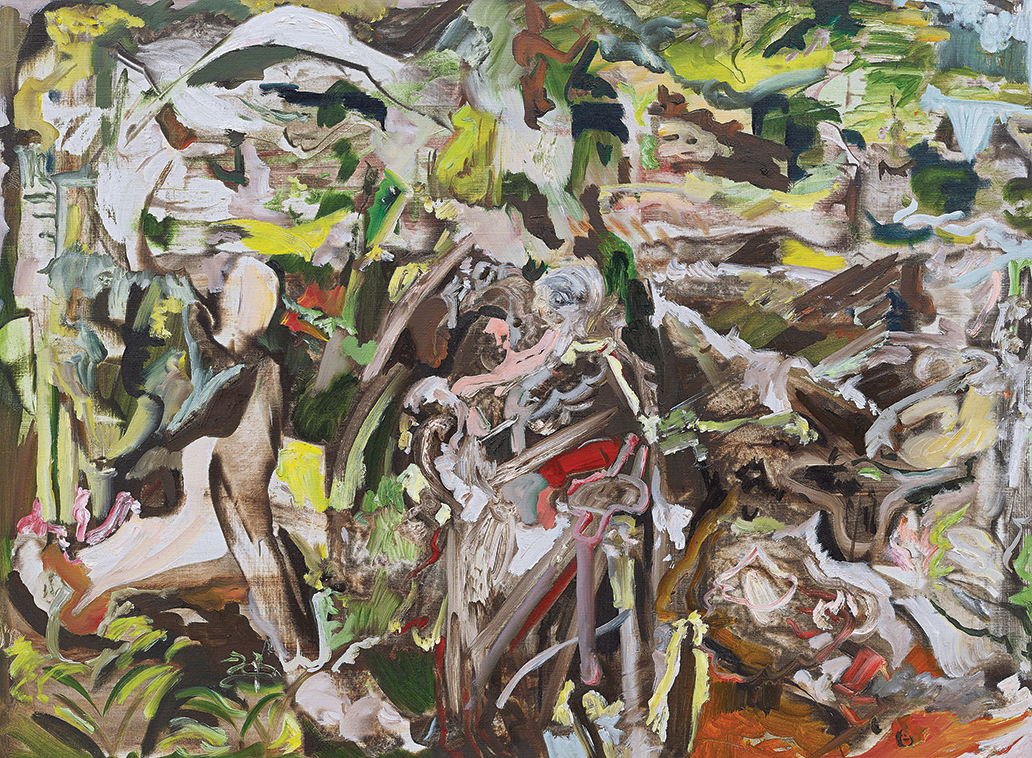
Maid in a Landscape (2021) places Brown in a specific art historical conversation — the tradition of the figure-in-landscape as it runs from Giorgione through Poussin through Constable — and proceeds to dismantle the tradition's central assumption, which is that the figure commands the landscape, stands against it, is legible against it as figure against ground. In Brown's painting, the figure dissolves into the landscape rather than commanding it. The maid — whoever she is, whatever she is doing — cannot be separated from the foliage and the sky and the light that surrounds her. She is part of the scene in the most literal sense: made of the same pigment, worked with the same brush, indistinguishable by medium from the world she inhabits.
This is Brown's intervention in the tradition of figurative painting, stated clearly in a relatively small canvas: the figure does not transcend its environment. It does not stand out against the world. It is continuous with the world, subject to the same forces, composed of the same materials. The Old Masters put figures in landscapes in order to make arguments about the relationship between the human and the natural — about dominion, about pastoral, about the scale of the human against geological time. Brown puts a figure in a landscape in order to dissolve the figure, to refuse the hierarchy, to suggest that the human form has no special purchase on separateness.
This is why the figure's resistance to legibility in Brown's work is not a formal game or a hedge against critical categorization. It is a position about what the body is — continuous, permeable, always in the process of becoming something other than itself. The figure escapes back into paint because paint is what it was made of, and this return is not failure but completion. The painting that will not declare what it contains is the painting that most honestly reflects what containment costs.
Where she stands
Brown is represented by Gagosian, which means she operates at the highest commercial altitude of the contemporary art world, and this fact sits oddly with the quality of difficulty in her work — the refusal to be immediately pleasing, the demand that the viewer stay and work. But the market for ambitious painting has grown considerably in the twenty years since Brown first started showing, and she has been part of the reason for that growth: she demonstrated, at a moment when painting was regularly declared dead or irrelevant, that the medium could carry genuine ideas, that it could be as rigorous and as difficult as any other form of art-making while retaining the specific pleasures that only paint can provide.
What she inherits from the Old Masters is obvious and has been well mapped. What she refuses from them is equally important and less often discussed. She refuses their relationship to the figure as a thing that can be fixed, known, possessed by the painting and therefore by the viewer. She refuses the stability of the body as a category — the assumption that a figure is something you represent rather than something you experience. And she refuses the separation of the erotic from the aesthetic, the body from the landscape, the flesh from the paint. In doing so, she has made a body of work that is genuinely irreducible: paintings that you cannot summarize or paraphrase, that require you to be physically present in front of them, that change as you look, that give you different things on different days.
That irreducibility is the achievement. In a period when so much contemporary painting arrives at the viewer already explained — the press release, the title, the artist statement all conspiring to foreclose the experience before it begins — Brown makes paintings that cannot be explained in advance because they are not organized around a thesis. They are organized around a question, the same question she has been asking for twenty-five years: what is the figure, and what do you lose when you make it too clear? The answer is always in the paintings themselves, never quite finished, never quite legible, always on the verge of something. Which is exactly where she wants to be.