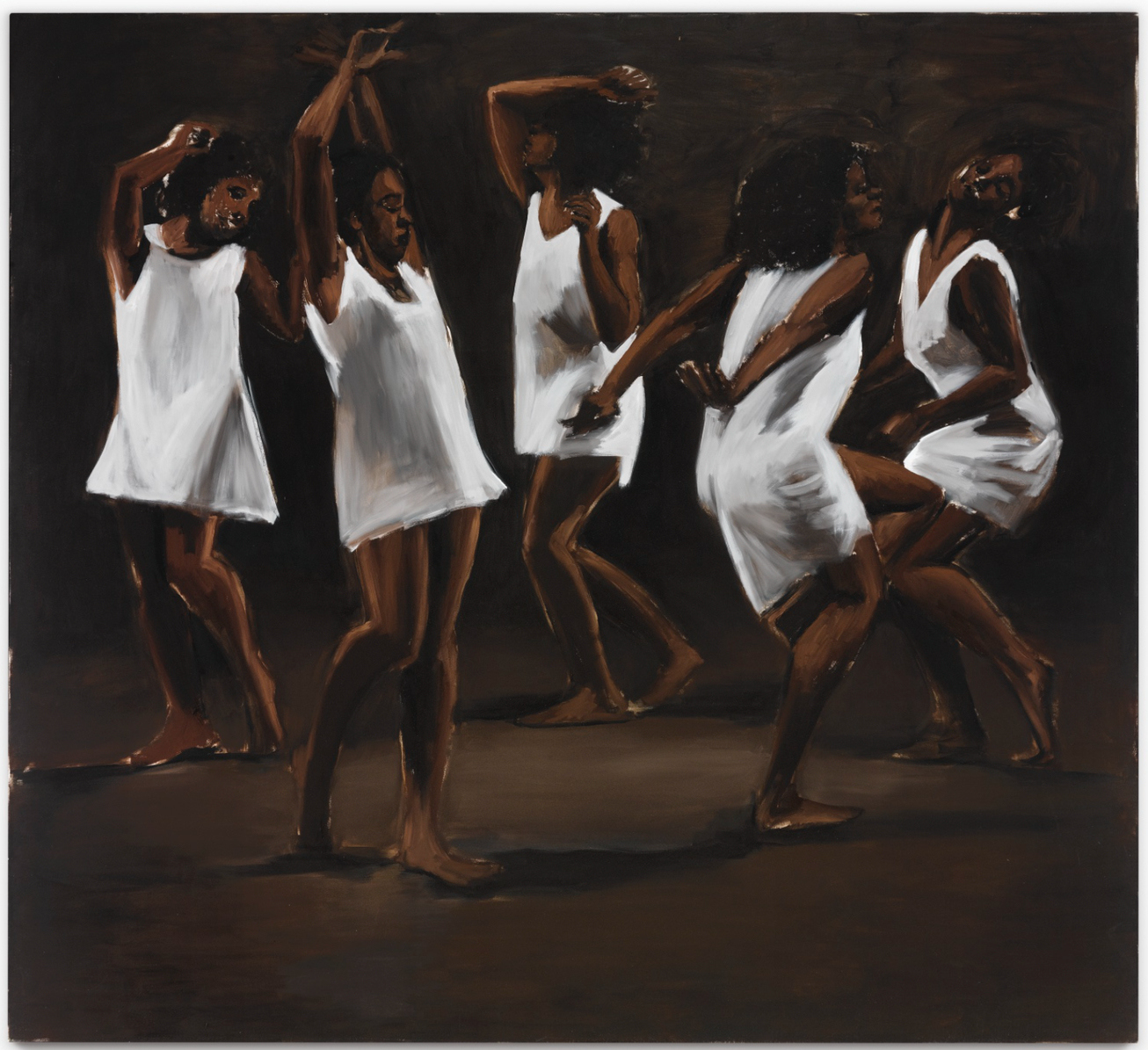
The figure emerges from the dark the way a thought arrives — not announced, not explained, simply there. He is seated, or standing, or caught in some attitude between the two that the painting refuses to resolve. His face is turned at an angle that gives you his profile and withholds his eyes, and the background behind him is a warm brown so deep it is almost black, and from this darkness he is continuous with his surroundings rather than placed against them. There are no props, no setting, no narrative markers that would tell you what he is doing or thinking or about to do. There is only him — his particular posture, the specific weight of his shoulders, the suggestion of a mood that has no name — and the paint itself, applied with a confidence that reads as intimacy, as if the painter knew exactly who this person was.
He does not exist. He has never existed. Lynette Yiadom-Boakye painted him in a single day, from imagination alone, and gave him a title that is a fragment of something — "The Hours Behind You," "Any Number of Preoccupations" — that sounds like it belongs to a story she has not told. Then she moved on to the next painting. This is her practice: invent a person, paint that person in a day, give the painting a title that opens a door without revealing the room behind it, and let the thing stand on its own. She has been doing this for twenty years. The figures accumulate. None of them exist. All of them are more present than most people you have met.
The disorientation this produces in a viewer is worth sitting with. You know, at some level, that the person looking back at you — or not looking back, which is more common, since Yiadom-Boakye's figures tend to avoid direct eye contact — is a fiction. The knowledge doesn't help. The figure's presence overrides the information. This is the fundamental question her work poses, and it is not a simple one: what is a portrait, actually, if it can produce the specific experience of encountering a specific person without there being any actual person to encounter? What does it mean that imagination, applied with sufficient skill and conviction, can generate the feeling of presence? And what does it say about portraiture as a tradition that the invented figure can be more vivid, more particular, more alive than many paintings made from direct observation of a real sitter?
London, art school, and the refusal of documentation
Yiadom-Boakye was born in London in 1977 to Ghanaian parents, and she has lived and worked there for most of her life, with periods in New York. She studied at Falmouth College of Art, then at Central Saint Martins, then at the Royal Academy Schools — a rigorous and extended training in the techniques and traditions of painting that gave her everything she would need before she decided what to do with it. The Royal Academy's teaching at that time remained close to the tradition of direct observation: you learned to paint what you saw, to work from the model, to build a picture from the evidence of your eyes. Yiadom-Boakye absorbed this and then, with what seems in retrospect like clarity of purpose, set it aside.
The decision to paint only invented figures — to refuse real sitters entirely, to work from imagination rather than from photographs or life — was not arrived at gradually. She describes it as something she knew early, a conviction about what painting could do that made the alternative feel like a lesser option. "I'm not interested in documenting anyone," she has said. "I'm interested in the image." This distinction — between documentation and image — is the load-bearing wall of her practice. A portrait made from observation of a real person is, among other things, an act of record. It says: this person was here, they looked approximately like this, and I have fixed them on this surface. Yiadom-Boakye does not want to fix anything. She wants to generate something — a presence, a mood, a specific quality of attention — that is genuinely new rather than derived from what already exists.
This is a more ambitious claim for painting than it might initially appear. It means that she is not using the medium to copy or capture or document. She is using it to create, in the strictest sense: to bring into being something that was not there before. The invented figure is not a lesser thing than the documented sitter; in Yiadom-Boakye's hands, it may be a freer and more fully realized thing, because it is not constrained by the particular face or posture or expression of any actual person. The painter can go exactly where the painting needs to go, without the negotiation with reality that observation always requires.
"I'm not interested in documenting anyone. I'm interested in the image."
— Lynette Yiadom-BoakyeOne day per painting: urgency as method
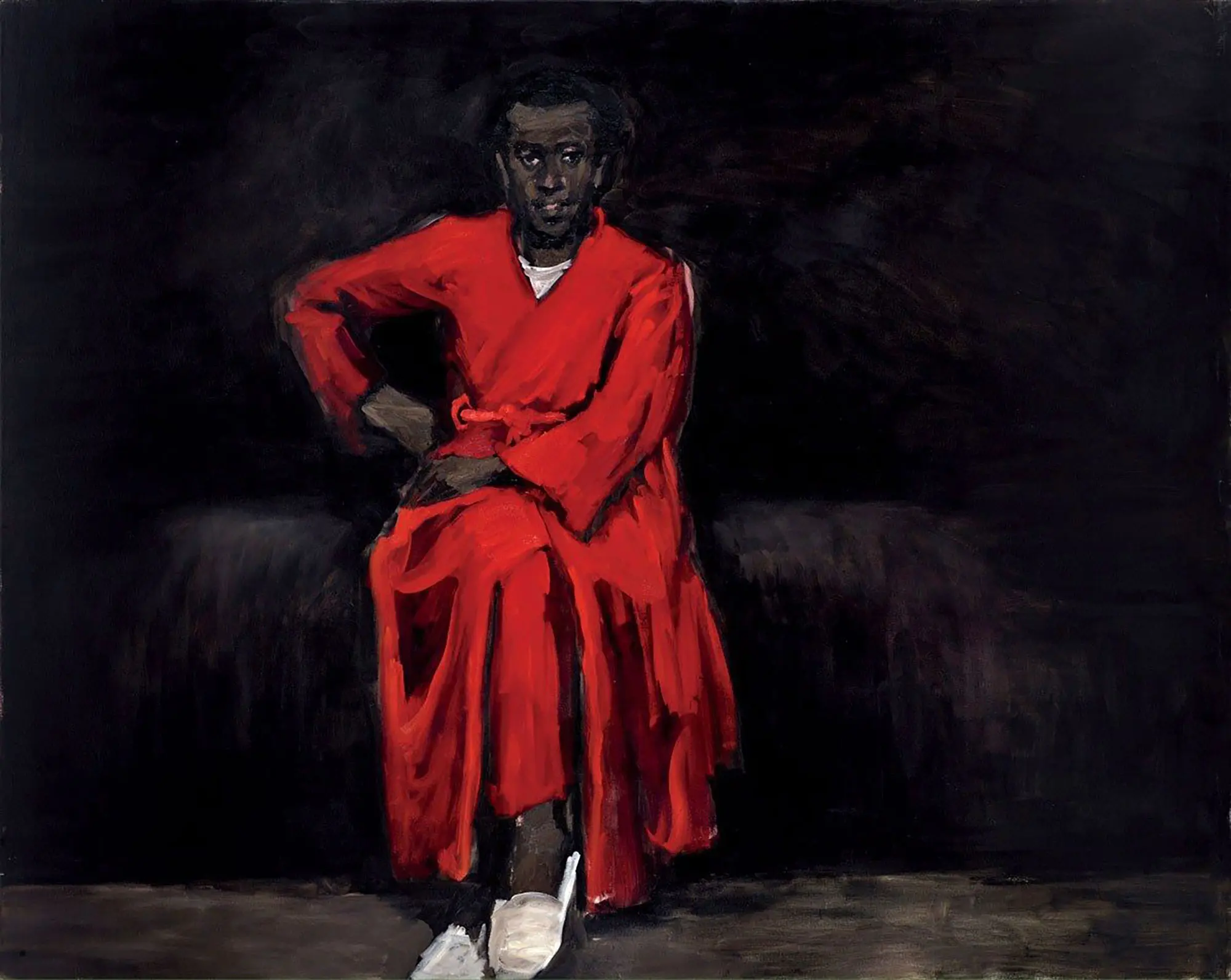
Lynette Yiadom-Boakye, Any Number of Preoccupations, 2010. Oil on canvas, 60 × 80 in.
Each painting is completed in a single day. This is not a constraint imposed from outside but a rule she has set for herself, and understanding why she set it is essential to understanding the work. A figure painted in one sustained session retains something that a figure painted across many sessions tends to lose — a quality of aliveness, of having been made in one breath, of being fully present to a single act of attention. When you look at a Yiadom-Boakye canvas closely, you can see the marks accumulate: the brushwork is confident and fast, each stroke placed with an assurance that comes from not having the option of going back. The paint layers are thin. The decisions are visible. The figure arrived quickly and was allowed to stay.
This speed connects her practice, in an oblique way, to the tradition of the sketch — the esquisse, the rapid study that captures something the more finished painting sometimes fails to. Painters have long observed that the first, quick version of a thing often has a life that careful elaboration can smother. Yiadom-Boakye has turned this observation into a formal principle: the sketch is the painting. The urgency is not preliminary. It is the point. When you look at a figure who has been invented and painted in a single day, you are looking at a pure act of imaginative projection — someone called into being by the painting itself, without time for second-guessing or correction.
The subjects that emerge from this process have a specific quality of suspension. They are always in the middle of something — a thought, a feeling, a moment between one action and the next — and the painting catches them there, neither before nor after but exactly in the midst. This temporal quality is different from the conventional portrait's attempt to fix an expression or a moment. Yiadom-Boakye's figures are not fixed. They are caught, which is a different thing: caught in the act of being, briefly visible in the dark background from which they emerged.
Titles as a parallel art
The titles are, by any measure, another creative act running alongside the paintings. "The Hours Behind You." "Any Number of Preoccupations." "A Concentration." "Condor and the Mole." "To Wander and Wonder." They are not descriptive — they do not tell you what you are looking at or who the figure is. They are more like the titles of poems, or fragments of poems, or the first lines of stories that will not be told. Yiadom-Boakye also writes — she has published poetry and short fiction — and the sensibility that informs her writing is legible in the titles: a feeling for compressed language, for the image or phrase that holds more than it says, for the way words can generate a mood without pinning it down.
The titles arrive, she has said, during or just after the painting — they are not pre-planned but discovered, the way the painting itself is discovered. This means that the title and the painted figure are in a relationship rather than a hierarchy: neither explains the other, neither is more authoritative. You bring the title to the figure and the figure back to the title and find that the space between them has expanded rather than closed. "The Hours Behind You" tells you something about time, about something that has passed, about the position of the viewer in relation to a receding past — and placed next to a painted figure in a warm dark ground, it produces an experience that is richer than either the words or the image could produce alone.
This doubling — the painting and the title as two parallel and equally incomplete accounts of the same imagined person — is part of what makes Yiadom-Boakye's practice genuinely novel within portraiture. The traditional portrait title is functional: the sitter's name, the date, perhaps a social role. It locates the painting in a specific life. Yiadom-Boakye's titles do the opposite. They locate the painting in an atmosphere, a feeling, a quality of time — and they make the invented figure more rather than less elusive, which is the condition that keeps the paintings alive.
"Painting is my primary language. Writing is another way of thinking through the same questions."
— Lynette Yiadom-BoakyeAll her subjects are Black
Every figure Yiadom-Boakye has ever painted is Black. This is not incidental and not polemical — it is, as she has described it, a simple and unwavering decision about who she paints, which is the people who look like her and the people she knows. The decision is so fundamental to her practice that she does not discuss it often or at length; it is simply the condition of the work, the way that oil on canvas is the condition of the work. And yet what it means, in the context of the history of Western portraiture, is considerable.
The Western portrait tradition is, with some important exceptions, a tradition of painting white subjects — and the exceptions are often precisely that: exceptions, marked as such, subjects whose presence in the frame is freighted with the specific weight of their exclusion from the tradition. Yiadom-Boakye's figures are not exceptions. They are the norm, the given, the default population of an imaginary world she has built canvas by canvas over two decades. They are not presented as remarkable for being there. They are simply there, in the warm dark of her backgrounds, living the interior lives her titles gesture toward, present with the full weight of presence.
The Tate Modern retrospective in 2022, titled Fly in League with the Night, brought this accumulation into visibility at scale. Walking through a survey of two decades of invented figures, you become aware of a world — not a collection of individual paintings but a world, with its own atmosphere and population and rules about what is worth painting and who is worth inventing. The Turner Prize shortlisting in 2013 had already signaled that the art world recognized what she was doing. The Tate retrospective confirmed it, and the crowds who came to it suggested that the recognition had spread well beyond the usual boundaries of the contemporary art world.
What she adds to portraiture by removing the subject
Portraiture, as a tradition, is premised on a real person. The whole apparatus — the sitting, the likeness, the negotiation between painter and sitter about how the subject should appear — assumes a specific person who existed and whose existence the painting will record. Yiadom-Boakye removes this assumption entirely, and what she finds in the space where it used to be is something remarkable: that the experience of encountering a painted figure — the sense of meeting someone, of looking at a specific person in a specific moment — does not depend on that person having been real. It depends on the painter.
This is a discovery with implications that extend beyond her own work. If the sense of presence in a portrait can be generated by imagination rather than observation, then the portrait's claim to have captured something real was always partly a claim about the painter rather than the subject. What we experience when we stand in front of a great portrait — the sense of being in the presence of another consciousness — is something the painter produced, not something the sitter provided. Yiadom-Boakye makes this visible by demonstrating it without a sitter. She is the source of the presence. The figures are her invention, fully and completely. And they are more present than most painted people I have encountered.
She is represented by Corvi-Mora in London and Jack Shainman Gallery in New York, and she continues to paint at the pace she has always set for herself — one figure per day, invented, dark background, title discovered in the making. The figures accumulate. The world she is building grows more populated and more densely imagined with each canvas. At some point the accumulation may constitute something new in the history of painting: a portrait tradition built entirely from imagination, a population of people who never existed and who are therefore fully free to be exactly themselves — whatever that means, and whatever Yiadom-Boakye decides it should be on any given day in the studio.