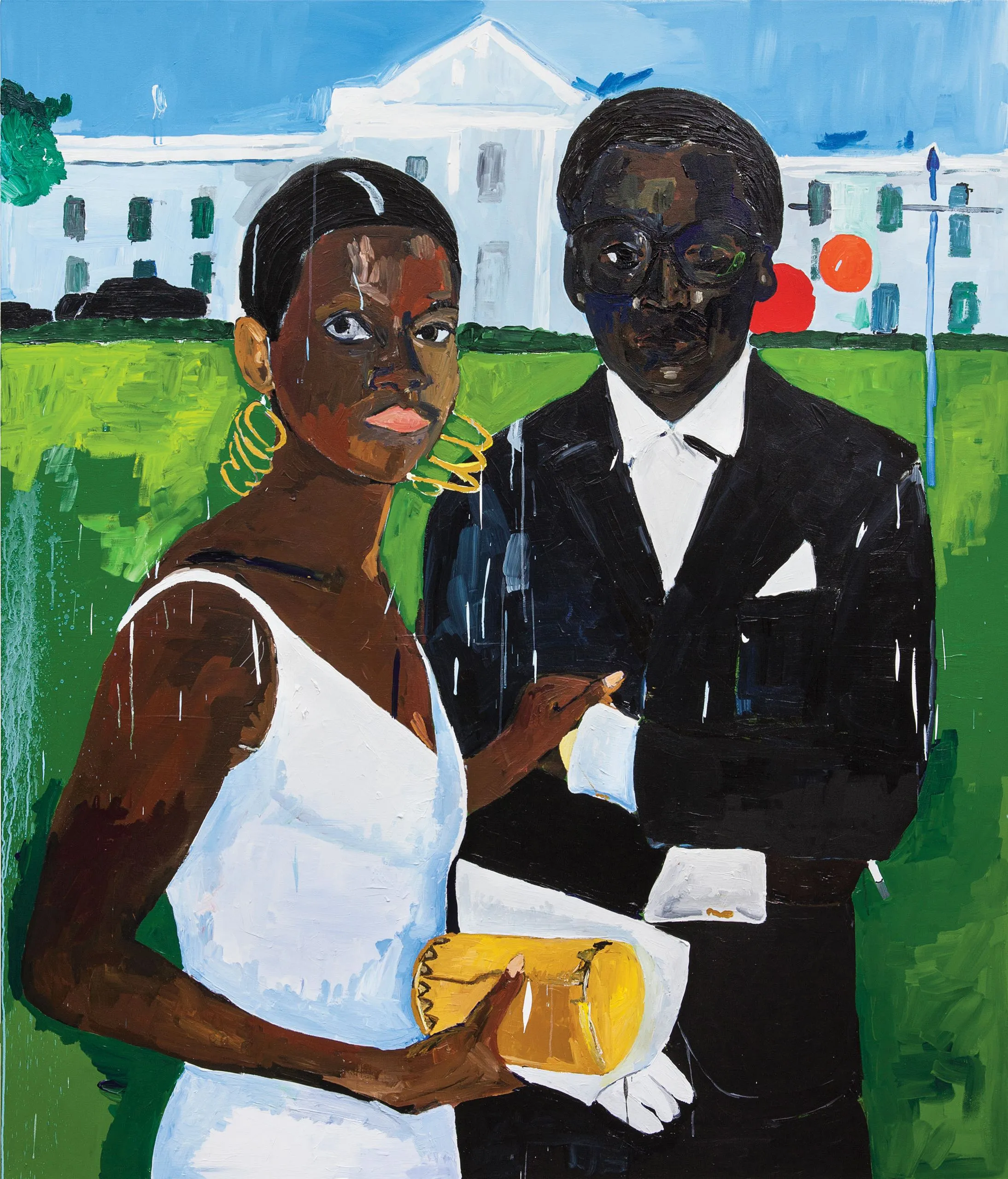
Miles Davis died in 1991. Barack Obama was first elected president in 2008. These two facts are arithmetically incompatible, and yet Henry Taylor's 2017 painting places them in the same room — Davis and Cicely Tyson visiting Obama and Michelle in the White House — with a confidence that does not bother explaining itself. The painting does not pretend that this meeting happened. It imagines that it could have happened, that there is a world in which the greatest jazz musician of the twentieth century and the first Black president of the United States might have sat together and recognized something in each other, and that this imagined meeting is worth painting with the full force of attention and care that you would bring to a painting of something real.
This is a Taylor move: the insistence that imagination and reality exist on the same plane, that the people you know and the people from history deserve the same quality of attention on the same kind of canvas, that the scale and seriousness of a figure in a painting should not depend on their celebrity or historical importance but on what the painter brings to them. A neighbor in Oxnard, California gets the same treatment as Miles Davis. A stranger on the street gets the same treatment as Barack Obama. The hierarchy that the art world usually brings to questions of subject — who is worth painting, who deserves a large canvas, whose face merits careful rendering — is something Taylor ignores with a completeness that looks, from a distance, like naivety but is, on closer inspection, a fully formed position.
The Cicely and Miles painting is tender in the way that only imagined things can be tender. It is not charged with the specific pathos of fact — with the knowledge that this person looked like this on this particular day in this particular place. It is charged instead with desire: this is the meeting that should have happened, the moment of recognition between generations of Black achievement that history did not provide but imagination can. Obama's election made something possible in the cultural imagination that had not been there in quite the same form before — it created a space in which certain kinds of reunion, certain kinds of imagined encounter, became available to the painter. Taylor worked in that space immediately and without ceremony.
Oxnard, the hospital, and learning to see quickly
Taylor was born in 1958 in Oxnard, California, a city on the Ventura County coast that has not typically appeared in the art historical narrative of California modernism. He grew up there, and it stayed with him — the specific people, the specific light, the specific community of a working-class coastal city that is neither Los Angeles nor anything else. Before he was a painter in any recognized sense, he worked as a psychiatric technician at Camarillo State Mental Hospital, the large state psychiatric facility that operated in Ventura County from 1936 until 1997. He was there for years, and the experience was central to the formation of his practice in ways that cannot be overstated.
At Camarillo, Taylor drew and painted the patients around him. This was not an official program or an art therapy initiative — it was something he did, the same way he did other things, because seeing people was what he had always done and having the means to record what he saw was what he had at hand. The conditions of the work were specific and demanding: he was watching people who were in the midst of serious mental illness, people whose relationship to their own faces and bodies might be disrupted in ways that conventional portraiture doesn't prepare you for. He was watching people who were, in various ways, unavailable to the kind of patient, protracted observation that traditional portraiture involves. He learned to capture something essential quickly, before the moment passed, before the specific quality of a person's presence shifted into something else.
This is the most important thing about his training: not CalArts, not the MFA program, not the exposure to art world conversations about what painting is for. The most important training was years of drawing people whose existence the culture had decided to put behind closed doors, people who were not going to be the subjects of portraits in any normal institutional sense, people who would never sit for anyone in a gallery. He looked at them. He drew them. He carried that looking into every canvas he has made since.
"I paint my people. My people are everybody."
— Henry TaylorCalArts, arriving late with more to say
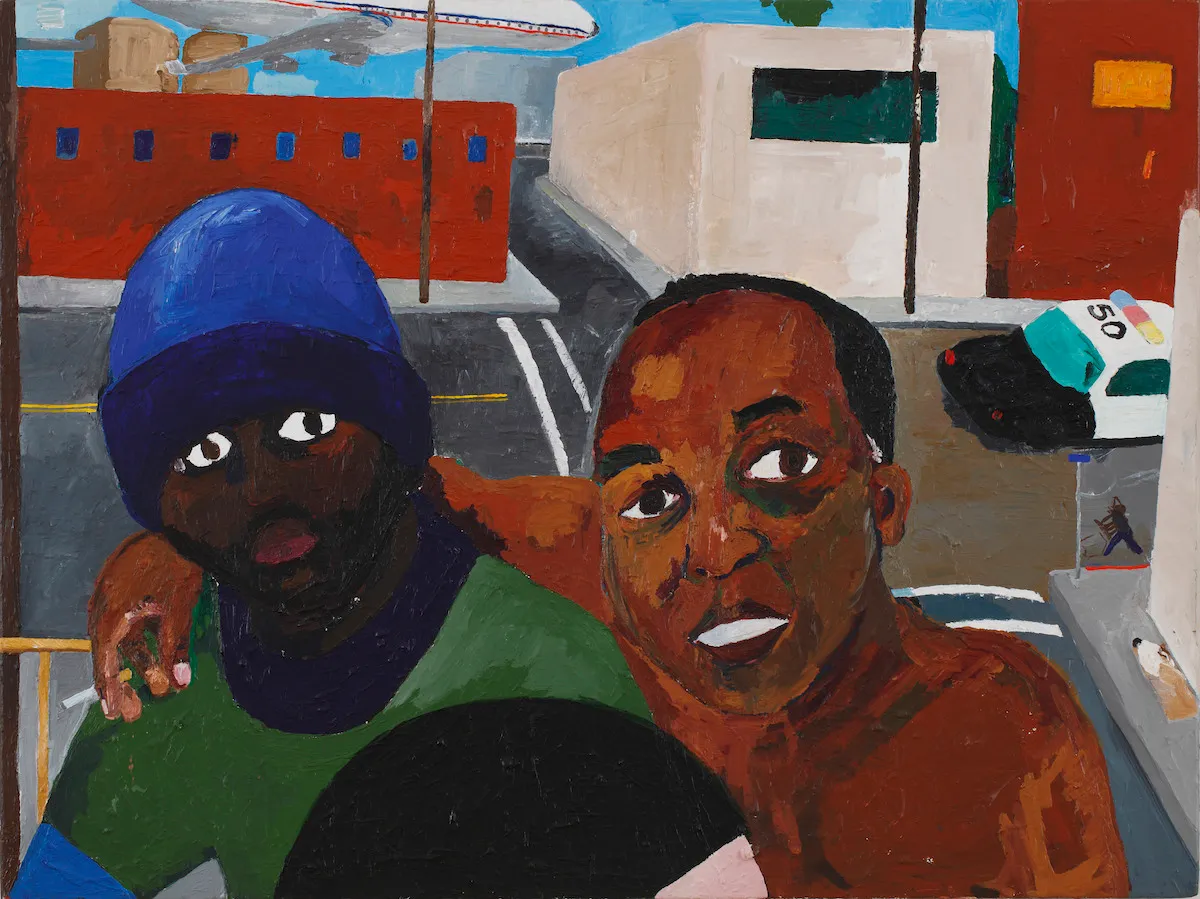
Henry Taylor, Untitled, 2023. Acrylic on wood panel, 36 × 48 in.
Taylor enrolled at the California Institute of the Arts in Valencia relatively late — he was in his thirties when he began his MFA program, which means he arrived with a body of experience that most art school students arrive without. He had been looking at people, seriously and systematically, for years. He had developed a quick, observational mode of mark-making that was entirely his own. He had accumulated the specific kind of visual intelligence that comes from watching people whose inner life is, for one reason or another, unusually legible on their surface. What CalArts gave him was a framework, a set of conversations, exposure to art history and contemporary practice, and access to the community of artists and teachers that a serious school provides. What he brought to CalArts was something that formal training rarely produces on its own.
The late arrival matters because it meant that his development as a painter was not primarily shaped by the art school context — by the conversations about what painting is supposed to do now, by the various theoretical frameworks that MFA programs of the 1990s were deploying, by the anxiety about figuration that ran through American painting for decades after Abstract Expressionism. Taylor was already committed to a practice by the time he arrived. He was not trying to figure out what to paint; he was trying to figure out how to paint what he already knew he wanted to paint, which was the people around him, rendered with the full weight of his attention.
His work since CalArts has been, in the most direct sense, continuous with what he was doing before it. The speed is the same. The subjects are drawn from the same world — his neighborhood, his community, the people he knows and the people he has known. The historical figures — Miles Davis, Emmett Till, the Obamas — appear in the same canvases as people whose names are not in any encyclopedia, painted with the same quality of attention. There is no visible seam between the famous and the unknown in Taylor's work. Both are worth looking at. Both deserve a large canvas and careful paint.
Speed, rawness, and the refusal of polish
Taylor paints fast. Not as fast as Yiadom-Boakye's one-day rule, but fast — with a directness of mark that preserves the energy of the first look, that does not sand the surface down to something smooth and finished and therefore slightly dead. He uses acrylic on canvas, but also on wood panels, found cardboard, whatever is at hand. The material promiscuity is not carelessness; it is part of the practice, the insistence that the painting can happen on any surface, that the support does not need to be prepared and sanctioned before it can receive the work. This is a position about what painting is for — it is not a precious object requiring precious preparation; it is a record of seeing, and seeing doesn't wait for the right materials.
The rawness that results has been consistently misread as the mark of an untrained painter, which is wrong in a way that matters. Taylor is technically skilled. He can render a face with precision, suggest a body in space with economy, convey a mood through color temperature and mark quality. He chooses not to overwork his canvases because overworking them would produce a result that is technically accomplished and emotionally inert — the kind of painting that tells you the painter knew how to paint without telling you anything about the subject. The rawness is a decision. The directness is a technique. The apparent casualness is the result of discipline applied in a direction that conventional training doesn't usually point.
What this means in practice is that his paintings feel inhabited — they carry the energy of the encounter between painter and subject rather than the evidence of a painting session in which the subject has been processed into a final product. When you look at a Taylor figure, you are looking at someone who was seen, quickly and fully, and transferred to the canvas before the seeing could be revised. The revision that most painting involves — the adjustments toward likeness or beauty or compositional resolution — has been replaced by something rawer: the first impact of one person looking hard at another.
"I don't clean my paintings up. When you clean something up too much you clean out what made it worth painting."
— Henry TaylorPainting as an act of community care
Taylor has lived in the same Los Angeles neighborhood for decades. His subjects are, in a very direct sense, the people around him — not selected for visual interest or social significance but simply because they are there, because they are his people in the most literal sense, because painting them is a way of saying that their faces and their lives have the same claim on the painter's attention as any subject in any museum. This is a position that sounds simple and is not. The history of Western painting is full of choices about whose face was worth a large canvas and whose was not, and those choices have consistently tracked power, wealth, race, and status in ways that are now embarrassing to look at directly. Taylor does not reverse these choices; he ignores them, which is more subversive.
He has painted his own family members, his friends, the people he has known for thirty years, the people he passes on the street. He has painted Emmett Till and Trayvon Martin with the same directness with which he paints a neighbor sitting in a chair. The political charge of the historical subjects does not make them more serious in his work than the everyday subjects; it makes them continuous with the everyday, part of the same world of people who deserve a painter's full attention. This is the argument the work makes: that the extraordinary and the ordinary are the same kind of thing, that the headline and the neighbor are equally real, that the measure of a painter's seriousness is not the significance of their subjects but the quality of their attention to whoever they are looking at.
He is represented by Hauser and Wirth, which is one of the largest and most commercially powerful galleries in the contemporary art world, and this institutional positioning has occasionally produced a kind of cognitive dissonance: Taylor's work is about the people the art market has historically ignored, and it is now selling for prices that those people will never see. He is not naive about this. He has talked about it, as directly as he talks about everything, acknowledging the tension without pretending it resolves. The paintings exist in the world now, and the world has decided to value them in the way it values things, which is with money and museum walls. This is not what Taylor made them for, but it is what he has.
What the polish would hide
There is a category of painter who uses technical virtuosity as a form of distance — whose command of the medium is also a way of keeping the subject at arm's length, of transforming the raw fact of a person into a beautiful object that can be admired without being felt. Taylor is the opposite of this. His technical skill is in service of proximity, not distance. The rawness of his marks, the speed of his execution, the willingness to leave the evidence of uncertainty in the paint — these are all ways of staying close to the subject, of not allowing the technical process to intervene between the painter and the person being painted.
This is what he offers that more polished painters cannot: the specific quality of encounter that happens when one person looks at another person without the buffer of craft getting in the way. Not that craft is absent — it is present, disciplined, purposeful. But it is not the point. The point is the person on the canvas, seen clearly and fast and completely, before the distance of refinement could settle in. Standing in front of a Taylor painting of someone you have never met, you feel as if you have met them — not because the likeness is perfect but because the quality of looking is genuine. He looked. You can tell. And the looking has been put on the canvas for you to feel.
He is sixty-eight years old and working at a pace and with a confidence that shows no sign of diminishing. The canvases keep coming — figures from the neighborhood, figures from history, figures imagined or half-imagined, all of them receiving the same fast, direct, fully committed attention that he developed over years of watching people who needed to be seen before they disappeared back into the invisibility that the world had assigned them. He learned to see that way at Camarillo. He has never stopped.