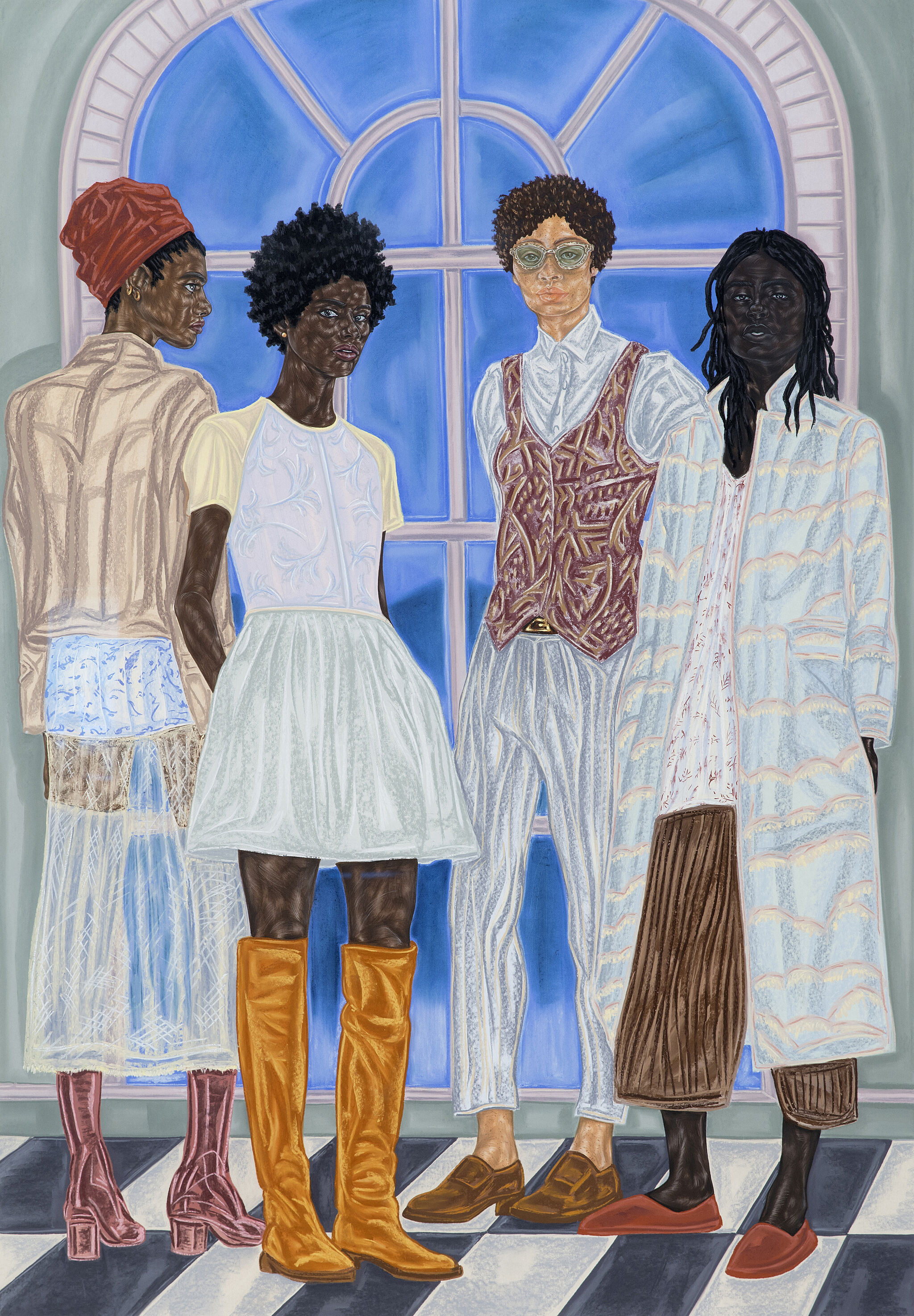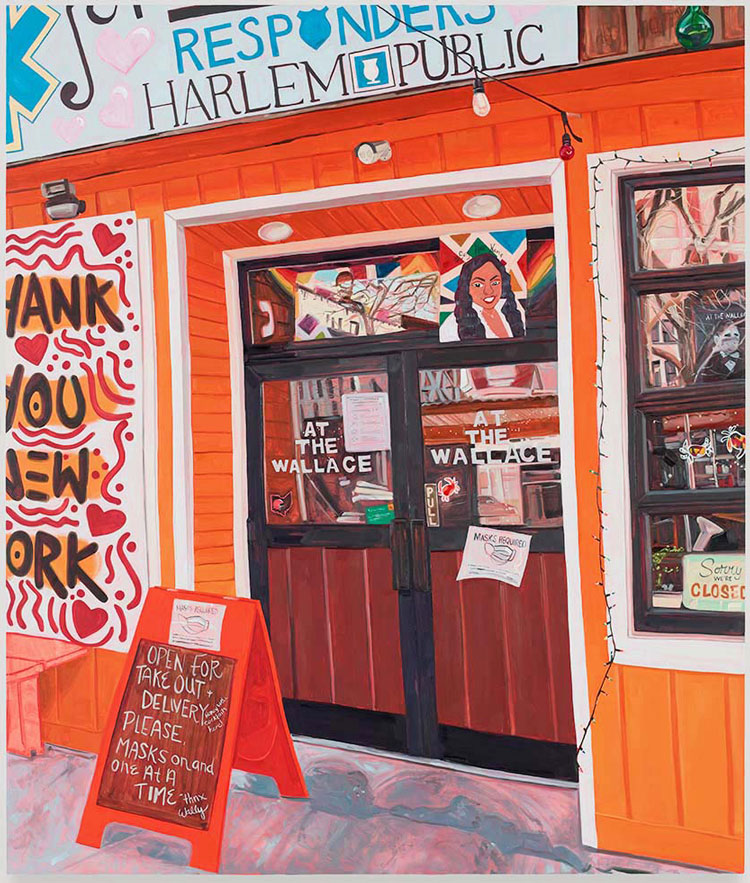
In Harlem Public, the people look back at you. Not all of them — there are enough figures in the painting, enough overlapping presences in the warm interior of the neighborhood bar, that some are in conversation with each other, some are partially turned away, some are caught in the middle of something private. But enough of them are looking directly at you, with the specific quality of gaze that Jordan Casteel gives her subjects — not confrontational, not performative, simply present, fully aware of being seen and not in the least diminished by it — that the effect is one of being looked at by a community rather than looking at one. You are not studying these people. They are regarding you. They have been here before you arrived and they will be here after you leave, and your presence in the space of the painting is entirely ordinary to them, neither a threat nor an occasion. They look back because looking back is what people do when they occupy a space that is theirs.
This is the central formal achievement of Casteel's portraiture: the redistribution of the gaze. Western portrait painting has always involved a power differential — the painter looks at the subject, the viewer looks at the painting, the subject is looked at by both, and this structure of looking tends to position the painted person as an object of attention rather than an agent who has consented to and participated in their own representation. Casteel dismantles this structure by painting her subjects as people who know exactly what is happening and who have agreed to it — more than that, who are collaborating in it, whose gaze back at the viewer carries the full weight of their personhood. You cannot consume these people. They are looking right at you.
Denver, Agnes Scott, Yale, and the road to Harlem
Casteel was born in Denver, Colorado, in 1989 and grew up there during a period when the city was, like many American cities, in the complex process of demographic transformation — neighborhood change, gentrification beginning to reshape the urban geography, the question of who belongs where becoming newly urgent and newly visible. She has spoken about growing up in Denver as an experience of being aware of the city's social organization in ways that her white peers were not necessarily prompted to be. The awareness of how space is organized by race and class, who is comfortable in which neighborhoods, who moves through the city with ease and who does not — these were the preoccupations that would shape her artistic project, though she arrived at the specific form of that project gradually.
She studied at Agnes Scott College, a liberal arts college in Georgia, where she began developing her painterly practice. The move to Yale for her MFA was significant: Yale's graduate painting program is one of the most rigorous in the country, demanding that its students know not only how to paint but why — what their painting is for, what it is saying, what tradition it is in conversation with and what it is refusing. Casteel emerged from Yale with a fully formed set of answers. She knew she wanted to paint people, specifically people from Black communities, with the kind of large-scale sustained attention that had historically been reserved for other subjects. She knew she wanted her subjects to look back. She knew the paintings needed to be large enough that the figures were at least life-size, close enough to be neighbors rather than specimens.
She moved to New York and eventually settled in Harlem, which was not incidental to the work. Harlem is a neighborhood with a specific gravity in Black American cultural history — the Harlem Renaissance, the political organizing, the churches, the barbershops, the restaurants, the community institutions — and Casteel chose it deliberately as the community she would enter, earn trust in, and paint. The paintings are not made by an outsider looking in. They are made by a neighbor — a painter who buys groceries at the same store as her subjects, who sees the bodega owner every day, who has sat with people in their apartments and asked them if they would let her paint them. The intimacy is earned.
"I want the people I paint to feel like they own their space on the canvas. Because they do."
— Jordan CasteelVisible Man and the political urgency of the early work
Casteel's early series "Visible Man" — focused on Black men, painted from life at intimate distance — was made during a period when Black male bodies were, as she has put it, under particular threat: the years of high-profile police killings, of the names that became hashtags, of the news cycle's repeated insistence on Black male vulnerability. Her response was to paint Black men not at the moment of danger but in the moments of ordinariness and ease — at home, relaxed, occupying their space without apology, their bodies present and sovereign in the way that the dominant culture was arguing they were not.
The "Visible Man" paintings are intimate in ways that can feel startling. The figures are close — close enough that you can see the texture of their skin, the specific quality of their relaxation, the way they hold themselves when they are not performing for a public that has decided to regard them as threatening. Casteel was insisting, through formal means, on the private personhood of people who had been publicly defined by their danger: she was making them visible in the most specific, most human, least-threatening sense of the word. The series is not protest art in any conventional sense. It is something more quiet and more persistent: it is the consistent practice of seeing people as they are, rather than as the circumstances around them require them to be seen.
The political urgency of this early project has not diminished in her subsequent work, but it has expanded. The "Visible Man" paintings were driven by a specific historical moment; Casteel's later work — the community portraits, the group scenes, the paintings of Harlem in its full social complexity — has a broader scope. She is no longer painting in response to a particular crisis. She is painting in affirmation of a community, a sustained act of attention that does not require crisis to justify itself. The bodega owner matters not because anything terrible has happened to him but because he is here, every day, and his presence is worth this much sustained attention.
The ethics and practice of community portraiture
Casteel has spoken with considerable thoughtfulness about the responsibility involved in painting people from her community — the difference between documentation and honor, between using people as material for your art and making art that reflects your relationship to them. These are not merely ethical abstractions; they have formal consequences. When you paint someone you know, someone whose life you are adjacent to, someone whose trust you are operating within, the painting carries the weight of that relationship. You cannot treat the figure as purely compositional material. The person's dignity is in the room with you while you're painting.
She describes her process as genuinely collaborative — she works from photographs she has taken of her subjects in their own environments, and she shows the subjects the works in progress, has conversations with them about what they see. This is not standard portraiture practice, and it shows in the paintings: the subjects look like people who have seen the work, who know what is being said about them, and who have agreed to it. The consent is visible in the gaze. These people have not been captured; they have participated. The painting is a record of a relationship, not a record of a person observed without their knowledge.
This approach has been criticized from one direction as sentimentalizing the community — as replacing difficult truth with warmth — and from another direction as insufficient formal innovation. Both criticisms miss what is actually happening in the work. The warmth in Casteel's paintings is not sentimentality. It is the warmth of specific people in specific relationships, rendered with enough precision that you can feel the specific quality of each person's ease or self-possession. And the formal choices are not conventional despite appearing so: the scale, the color, the specific organization of the direct gaze — these are deliberate and thoughtful, in service of an argument about visibility that has real stakes.
"Casteel paints her subjects as people who know exactly what is happening and who have agreed to it — whose gaze back at the viewer carries the full weight of their personhood."
— On Jordan CasteelScale, color, and the formal choices that carry the argument
The scale of Casteel's paintings — the figures often at or above life-size, the canvases large enough that standing in front of them is something like being in the room with the painted people — is the most immediately legible of her formal decisions, and it is also the most directly argumentative. Scale in portraiture has historically correlated with importance: the king, the general, the nobleman painted large; the servant, the laborer, the ordinary person painted small, if painted at all. Casteel reverses this hierarchy without inverting it — she is not painting her subjects large in order to say they are kings. She is painting them large in order to say they are people, which turns out to be large enough.
The color in her paintings deserves equal attention. The palette is warm and specific — deep earth tones, the ochres and siennas and rich browns of skin and wood and textile, the specific greens and warm whites of domestic interiors — and the color decisions are not neutral. Casteel's Harlem glows. The community she paints is warm, not in spite of difficulty but alongside it: the warmth is not a denial of hardship but a record of something that exists simultaneously with hardship and that hardship does not define. The specific colors of her paintings feel like the specific colors of a place remembered with love rather than a place observed with clinical neutrality.
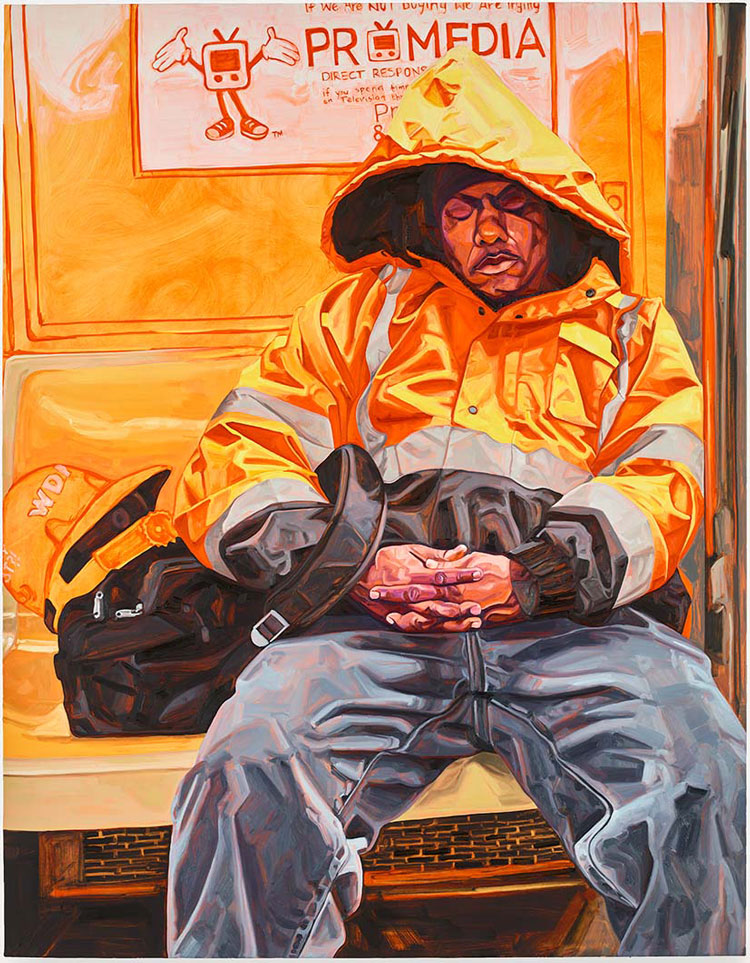
Direct Response (2021) frames the argument in its title: both a formal response (Casteel responding to what she sees before her) and a political one (insisting on direct visibility in a moment when erasure is the default). The painting shows a figure who meets the viewer's gaze with the full weight of his presence — no apology, no performance of accessibility, no diminishment of himself to make the viewer more comfortable. He is simply here. He is simply himself. The directness is the response. The painting says: this is what seeing someone looks like, when you actually do it.
What her portraits do that conventional portraiture cannot
The history of portraiture is largely a history of people painting the people they have access to, and access has always been organized by power. Kings were painted because they could commission painters; the poor were painted when they served as models for allegorical or genre scenes, when someone needed a beggar for a composition. The formal portrait — the work made to honor and memorialize a specific individual — was reserved for people whose individualism was considered worth honoring. This is the tradition Casteel is operating within and against simultaneously, and the tension is productive rather than paralyzing.
She has said that she wants the people she paints to feel like they own their space on the canvas — and that they do, that the ownership is not a gift she is giving them but a fact she is recording. This reframing matters. Conventional portrait rhetoric tends to position the painter as the generous agent who grants the subject visibility, who lifts the subject into the art world's attention through the grace of their skill. Casteel's formulation reverses this: the subjects already own their space. The painting is a record of that ownership, not its source. She is not making these people significant. They were significant. She noticed.
What her portraits do that conventional portraiture cannot is hold this reversal consistently — across every canvas, every face, every gaze returned directly to the viewer — without making it into a program or a thesis. The paintings do not argue for their subjects' importance. They assume it, and the assumption is visible in every formal decision: the scale, the color, the directness of the gaze, the environment given equal weight to the figure, the care with which each person's specific self-possession has been observed and rendered. The New Museum show made this cumulative argument at full scale. Walking through those rooms was an experience of sustained attention to the particular: not a general claim about a community but a series of very specific records of very specific people, each one insisting, in the most direct way available to painting, on the full reality of their presence. You looked at them. They looked back. Neither of you looked away first.