The first thing you notice is that part of the painting has been folded back and tied. A section of the canvas — containing, you understand on closer inspection, a figure — has been rolled outward and secured with cord, obscuring what was painted there and revealing, in its place, the raw back of the canvas: the warp and weft of the linen, the stretcher bar beneath, the structural skeleton of the thing. What remains visible is the other part of the painting, a figure rendered with the full technical vocabulary of 18th-century portraiture — careful light, plausible skin, the particular kind of graceful confidence that Gainsborough and Romney deployed for people who expected to be painted. And then that roll of canvas, cord-bound, exposing its own underside, where a figure used to be.
Standing in front of a Titus Kaphar is one of the stranger physical experiences available to a person in a contemporary gallery, and the strangeness is not a superficial thing — it is the work's argument, made materially. The rolling and folding and cutting are not flourishes added to an otherwise conventional painting. They are the painting's content, the thing it has to say. Kaphar is working in the tradition of historical portraiture — he is technically skilled enough to produce paintings that could almost fool you, briefly, into thinking they were made in another century — and then he is performing surgery on that tradition, exposing what it decided not to paint, cutting away what it foregrounded and leaving visible what it buried. The violence of the gesture is precise. It has been thought through. It costs something to do this to a painting that you have worked to make.
The precision matters. This is not destruction as rejection of painting. It is destruction as a form of historical argument — and the argument only lands if the underlying painting is accomplished enough that you feel the loss of what has been cut or hidden. If the painting were incompetent, the folding would be a way out of the problem of having to be good. Because the painting is genuinely beautiful, the folding is genuinely violent, and the violence opens a space in which you can feel — not just know, but feel — the mechanism by which certain people got left out of official history.
Kalamazoo, Yale, and the uses of technical mastery
Kaphar was born in 1976 in Kalamazoo, Michigan. His early biography is not one that leads obviously toward an MFA from Yale and the particular set of formal obsessions he has developed — but then almost no biography leads obviously toward anything, and Kaphar has been direct about the circuitous path. He has spoken about a difficult adolescence, about encounters with the criminal justice system, about the way certain trajectories can close off before they open. What opened the door, in the version he tells most often, was art — the discovery that painting was a language he could speak, that making things was a form of thinking he had access to that other forms of thinking did not offer him in the same way.
He enrolled at what is now Bay Path University in Massachusetts and then transferred to the University of Connecticut, where he developed the technical foundations that the Yale MFA would later build on. The technical development is, in his account of his own practice, not a background condition but a central one. He needed to learn to paint the way historical painters painted — not to reproduce those paintings but to earn the right to do something with them, to take them seriously enough that what he subsequently did to them would register as something more than provocation. The cutting and folding and tarring are possible because the painting beneath them is made with genuine craft. You have to build something before you can meaningfully dismantle it. That sequence is not optional.
At Yale he came into contact with art history in the systematic way that a serious MFA program provides — the whole sweep of Western painting as a tradition, its techniques and its assumptions, its choices about what to include and what to leave out. He has described the experience of encountering that tradition with the particular alertness of someone who noticed not just what was in the paintings but what was conspicuously absent. The 18th-century portraits of Virginia planters and their families did not include the enslaved people who worked on those plantations. The official portraits of American founders did not acknowledge the forced labor that made their prosperity possible. The paintings were beautiful. The omissions were systematic. He wanted to find a way to make both facts visible at the same time, in the same object.
"I don't think you can understand what's happening now without understanding what happened then. The canvas is a historical document."
— Titus KapharAbsconded: a title taken from an advertisement
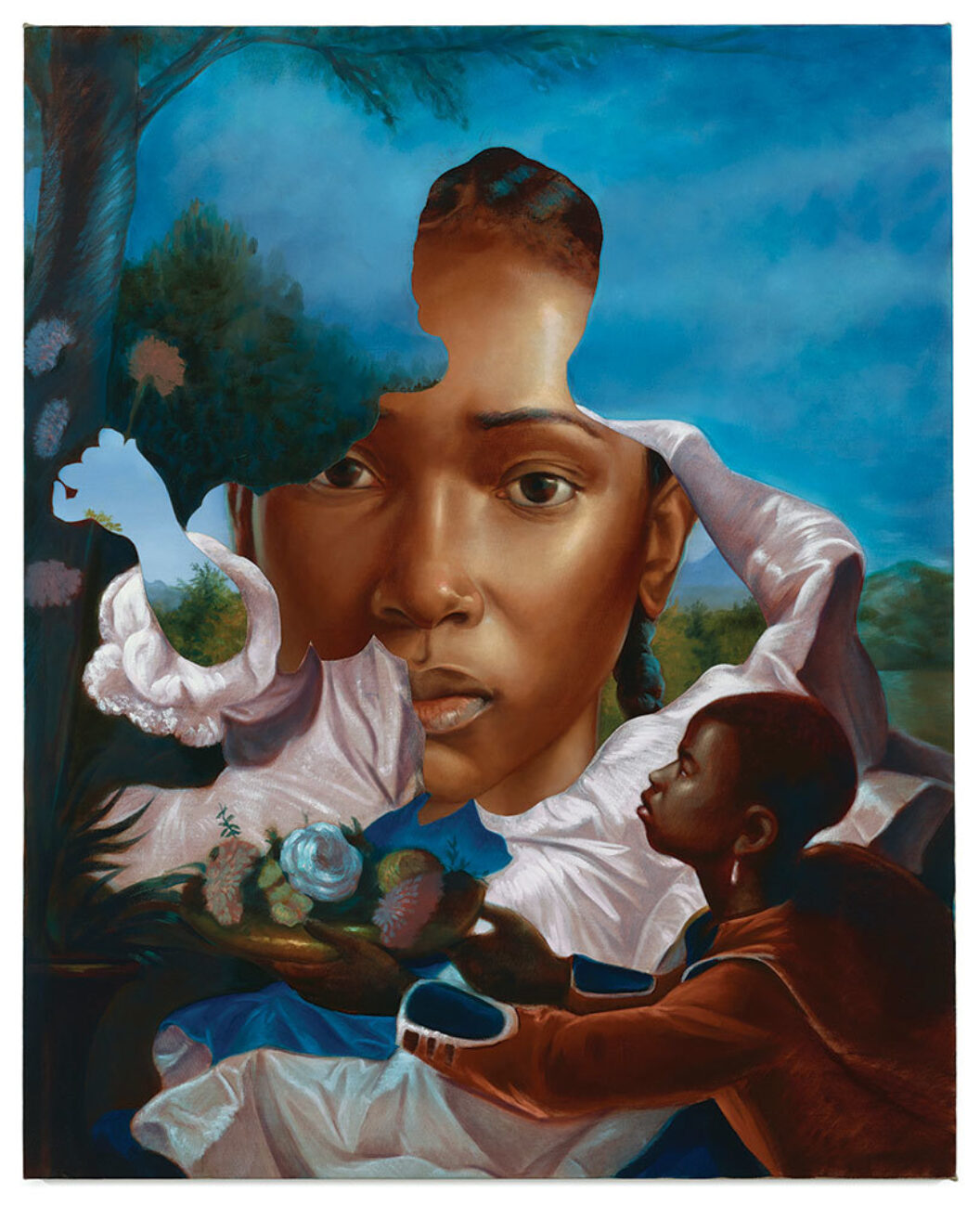
Titus Kaphar, Seeing through Time, 2018. Oil on canvas, 60 × 48 in.
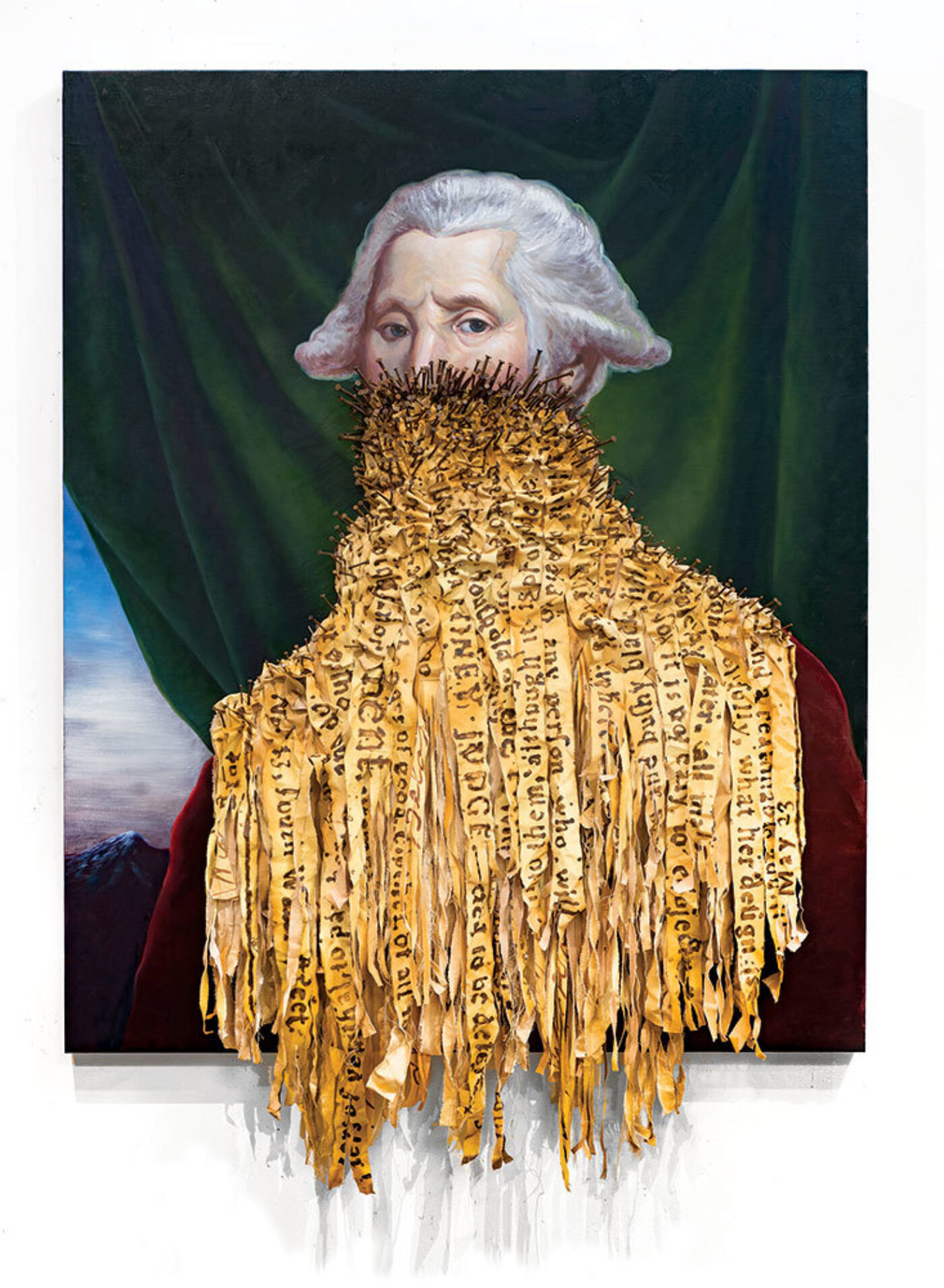
The title Absconded from the Household of the President of the United States is taken from the language of the runaway slave advertisement — the specific, bureaucratic phrasing that newspapers of the 18th and early 19th centuries used when enslaved people fled. George Washington placed such advertisements. The people who had lived in his household, who had cooked his food and dressed his children and maintained the physical conditions of his domestic life, ran when they could. The advertisements described them as property that had absconded, using the language of theft rather than freedom. The title carries all of that — the specificity of the reference, the violence of the language, the particular American history in which the founding mythology and the facts of enslavement are inseparable — into a painting that looks, at first glance, like a standard 18th-century portrait.
The painting itself shows a figure in the visual vocabulary of the period — the clothes, the posture, the lighting all drawn from the tradition of colonial portraiture. And then the rusted nails. Hammered through the surface of the canvas, rust staining the surrounding paint, they are physically part of the painting in a way that its pictorial elements are not. The nails are real objects in the world, not representations of objects; they break the surface, penetrate it, mark it. The rust bleeds. This is not a metaphor about violence, exactly — or not only a metaphor. It is a painting that has been nailed, that carries the mark of that nailing, that presents itself as something that has been acted on rather than simply rendered.
The effect is to make the historical violence legible in the present tense of the object. You are not being asked to think about violence as something that happened in the past, in another kind of painting, to people who are now distant from us. You are standing in front of something that has been nailed through in a gallery today, and the rust is still working, and the canvas is still marked. Time has been collapsed into the object. The painting is both then and now, both the 18th century's choices about who to include and the present moment's obligation to look at those choices clearly.
The personal urgency: raising a Black boy in America
Kaphar has a son. He has spoken about this in the context of his work without making it a simple biographical explanation — it is not that his son inspired specific paintings, but that the experience of raising a Black child in the United States has made the historical dimensions of his practice personally and urgently present in a way that purely intellectual engagement cannot replicate. He has said that the question of what history has done and is doing is not abstract when you are also the parent of someone who will live inside that history. The paintings about the enslaved people left out of official portraiture are not only arguments about art history. They are arguments about now, about the continuities that run between then and now, about what it means to raise a child in a country whose official mythologies were built on elisions of exactly the kind his paintings are trying to reverse.
Seeing Through Time addresses this more directly than some of his other works. It layers historical portraiture with contemporary figures — a Black father and son painted in the style and scale of colonial portraiture, but also visibly continuous with the present moment, present-day rather than historical in their particulars. The painting creates a temporal double exposure: you see the historical tradition and you see through it to a contemporary face. The technique literalizes a metaphor that is central to his practice — the way the past is not behind us but layered beneath the present, visible if you look through the surface of things, insisting on being read alongside whatever is happening now.
NXTHVN and the question of who gets to be seen
In 2019, Kaphar co-founded NXTHVN in New Haven, Connecticut — an arts incubator designed to support emerging artists and arts entrepreneurs, particularly those from communities that have historically been underserved by the institutional art world. The name is a phonetic shorthand for "next haven," and the program's structure is deliberate: studio space, mentorship, professional development, a network of relationships with the institutions and galleries and collectors that a young artist needs access to but often cannot access without the right social geography.
NXTHVN is not a side project to the painting — it is a logical extension of it. If the paintings are about who gets left out of official representation, about the systematic decisions that determine whose face appears in a frame and whose does not, then an institution designed to change the pipeline of who gets to make art and who gets to be seen is practicing the same argument through different means. Kaphar is not naive about the limits of what an arts incubator can do; he is not claiming that NXTHVN will solve the structural problems his paintings anatomize. He is claiming that it is possible to act on those problems rather than only depicting them, and that both kinds of action — the painting and the institution — are necessary.
"The question is not just who gets to be in the painting. It is who gets to be the painter."
— Titus KapharWhat it means to use beauty against itself
There is a philosophical problem at the center of Kaphar's practice that he has not resolved and does not seem to want to resolve: the paintings are beautiful. The technical accomplishment is genuine. The surfaces are seductive in the way that accomplished oil painting tends to be seductive — there is something about the particular way light moves through oil paint on linen that produces a physical pleasure in looking that seems to precede and survive any particular content. And Kaphar's paintings are beautiful in exactly this way, before you have understood what they are doing and after.
This creates a tension that is the work's most productive quality. You are attracted to the paintings, aesthetically, by the very tradition they are critiquing. The beauty of the 18th-century portrait vocabulary — the graceful handling of light, the accomplished rendering of fabric and skin — is precisely the beauty that made those portraits powerful as instruments of representation, as documents of who mattered, as images of the people whose existence was considered worth preserving. By deploying that beauty and then doing violence to it, Kaphar puts you in the position of the tradition: you are drawn in by the aesthetic seduction and then forced to account for what the seduction was serving. You cannot simply enjoy the painting and leave. The nails prevent it. The fold of canvas, revealing the underside, prevents it.
He is still a relatively young painter — fifty years old — with a body of work that has developed in ambitious and unexpected directions and shows no sign of settling into repetition. The formal innovations he has brought to portraiture — the physical alterations of the canvas, the layering of historical and contemporary figures, the use of material like tar and rust that carries its own history of industrial and extractive labor — are inventions that open onto further questions rather than resolving the ones they engage. What can a painting do that no other kind of object can do? Kaphar's answer, so far, is: it can hold the past and the present in the same surface, and make the relationship between them visible, and make you feel the weight of that relationship in your body. He has been doing exactly that, one precisely damaged canvas at a time.


