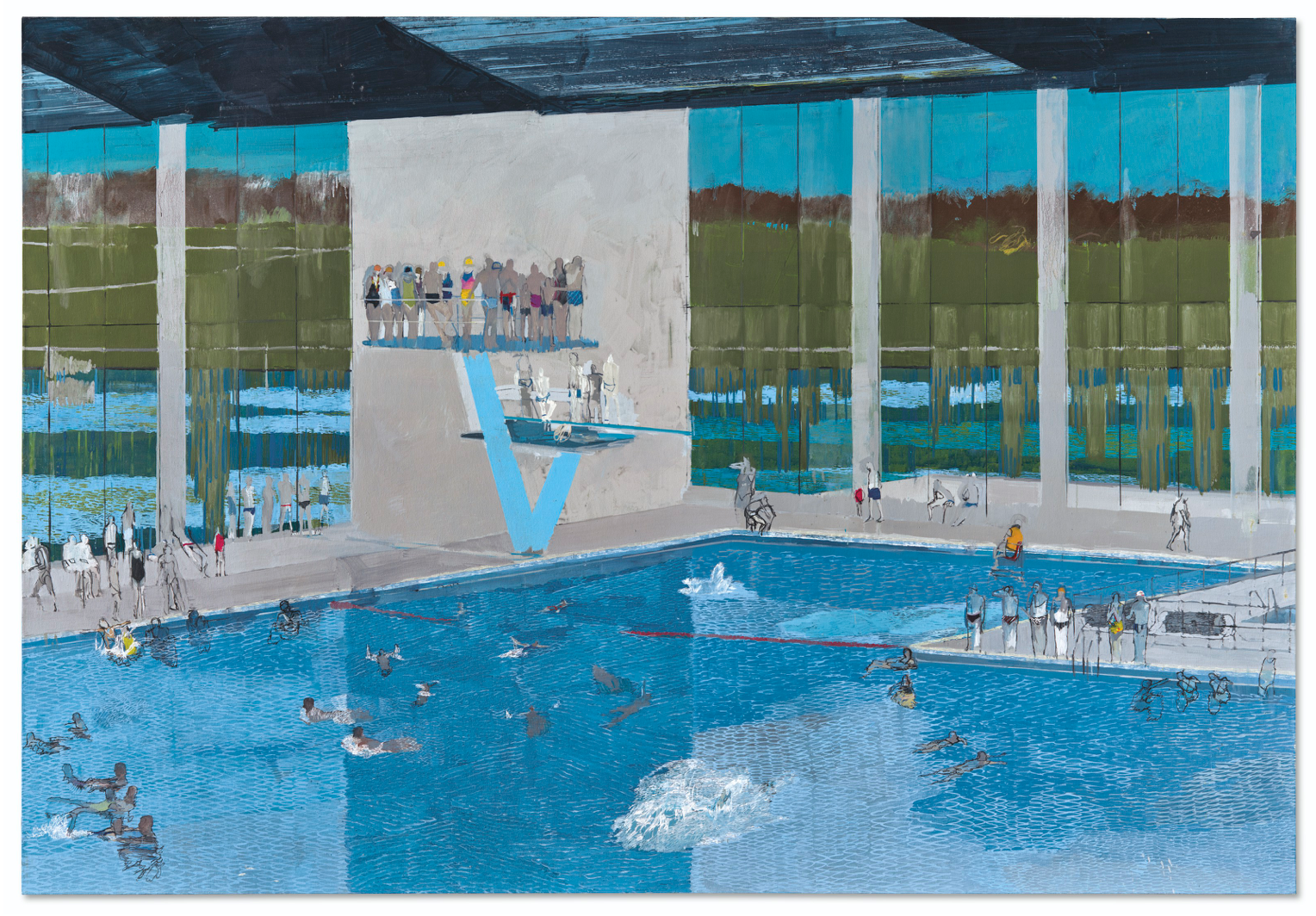
The pool in Audition is shown in late afternoon light — the kind of golden, slightly melancholy light that arrives in the hours before dusk when the heat of the day has peaked and the air is beginning, almost imperceptibly, to cool. The water is still. The tile around the edge of the pool is pale, possibly cream or white, and the reflections of light on the surface of the water make a pattern of wavering lines that Hurvin Anderson has rendered with extraordinary attention, each one slightly different from its neighbor, the whole pattern oscillating between order and random variation in the way that light on water actually does. There is nobody in the pool. There is nobody beside the pool. The loungers, if there are loungers, are empty. The scene is beautiful in a way that the title immediately disturbs: an audition is a test. Someone is being evaluated. The question of who is being evaluated, and what they are being tested for, and by whom, hangs over the empty water like weather about to arrive.
Anderson has been painting swimming pools since the 1990s, and this early, landmark work announces the terms of the project with an efficiency that makes everything that followed feel both inevitable and surprising. The pool is a completely legible subject — everyone knows what a swimming pool is, what it is for, what it means in the context of domestic leisure and aspiration — and it is also a subject so overdetermined by its cultural associations that it requires only the slightest pressure to make it say things far beyond what it appears to be saying. Anderson applies exactly the right amount of pressure: enough to make the pool vibrate with implication, not so much that the implication overwhelms the image. The painting remains a beautiful painting of a beautiful pool. And the beauty is exactly what the question is about.
Birmingham, Jamaica, and what the Windrush generation built
Anderson was born in Birmingham in 1965, of Jamaican heritage. His father came to England as part of the Windrush generation — the large movement of migrants from the British Caribbean to Britain in the late 1940s and 1950s, answering the postwar labor shortage, arriving in a country that had invited them and then proceeded, often, to make their lives difficult. The Windrush story is now well known in Britain in ways it was not for decades: the legal status of many who arrived was never formally documented, and the consequences of that bureaucratic failure — deportations, denials of healthcare and housing, lives upended — became the "Windrush scandal" when it broke publicly in 2018. But for the families of those who came, the texture of the experience — the welcome and the hostility, the belonging and the refusal of belonging — was always present, long before it became a political story.
Anderson grew up in a Birmingham that was in the process of understanding itself as a multicultural city, and the specific kind of double consciousness that produced — being of Britain, being of the Caribbean, being neither fully and both completely — runs through his work in structural ways. He studied at Wimbledon College of Art and then the Royal College of Art, absorbing the traditions of British painting at their most technically accomplished while also keeping his distance from the assumptions those traditions carried about who belongs, who is depicted, whose leisure is considered worth representing. He found the pool as a subject partly by accident and partly because it was the right container for what he needed to investigate: a site of pleasure that is also a site of gatekeeping, a place of relaxation that is simultaneously a place where the question of admission is constantly, if silently, in play.
"A pool is a very specific promise. And the most interesting thing about a promise is what happens when it isn't kept."
— Hurvin AndersonThe history under the water
Anderson's approach to his subject is grounded in specific research that his paintings do not announce but that they absorb. He has studied particular pools — pools in the American South that were formally segregated through the era of Jim Crow, where Black Americans were barred from the same water in which white Americans swam; country club pools in England and America that were never formally segregated but were de facto restricted, where membership requirements and social codes served the same function that explicit law served elsewhere; public pools in Birmingham, in Florida, in the Midwest, each one carrying its own specific history of who was permitted to enter. He is not painting generic pools. He is painting specific sites — sites that have been shaped by decisions about who belongs and who does not — rendered in enough detail to be particular and in enough restraint to be universal.
The American history of segregated swimming is a history that has received surprisingly little attention given how vivid and specific it is. The poolside — the site where bodies are most exposed, most vulnerable, most clearly classified by their physical characteristics — was a particularly charged site of segregation-era anxiety. When the Supreme Court began striking down formal segregation, municipalities across the South responded to the integration of pools by closing them rather than opening them to all. The pools were drained rather than desegregated. This choice — to destroy the amenity rather than share it — is one of the most stark illustrations of the logic of segregation available, and Anderson's empty pools carry this history without depicting it. The pools are empty. The absence of people is doing something.
He has described the pool as a site where the question of belonging is literalized in a way that few other spaces achieve. To enter a pool, you must be permitted. The invitation is either extended or withheld. The water itself — the actual substance you are entering — is the same water; the question is entirely about the decision to include or exclude, a decision made not by the water but by the people who control access to it. Anderson paints the water because the water is innocent of the decisions made about it, and the gap between the water's innocence and the uses to which it has been put is exactly the space his paintings inhabit.
Peter Doig and the painting of water
The series "Peter's Sitter's" — begun around 2009 — involves a long friendship and artistic conversation with the painter Peter Doig, who is himself deeply engaged with water as a subject and a surface. The title structure is idiosyncratic: Anderson positions himself as the sitter in a relationship where Doig is the implicit portraitist, or the pools serve as the mutual subject that both painters return to. Both artists find in water something that painting is uniquely equipped to address: a surface that is both opaque and transparent, that reflects what is above it and reveals, partially, what is below, that is never quite still even when still, that changes constantly under changing light.
The technical achievement of Anderson's water is extraordinary and deserves more sustained attention than it typically receives. The specific blue of chlorinated pool water — a blue that is simultaneously very specific and very particular to that chemical context, recognizable immediately as pool water rather than ocean or river or lake — is one of the most difficult color problems in contemporary painting, and Anderson solves it repeatedly, differently in each work, finding the exact relationship between the blue of the water and the reflection of the sky and the pattern of light on the surface and the hint of the tile pattern visible below. His water is always the right water. It is always water in a specific pool at a specific time of day, not water in general.
Doig's water tends toward the mythic — vast, dark, still lakes that absorb figures and carry the weight of psychological states. Anderson's water tends toward the specific and the historical — pools that are this size, this blue, this light, pools that are attached to this institution or this club or this public facility and therefore to this history. The friendship between the two painters is productive precisely because they are doing different things with the same material, testing what the surface of water can hold in different registers.
"Anderson's empty pools carry history without depicting it. The pools are drained rather than desegregated. The choice — to destroy the amenity rather than share it — is one of the starkest illustrations of exclusion available."
— On Hurvin AndersonBarbershops and the intimacy of community space
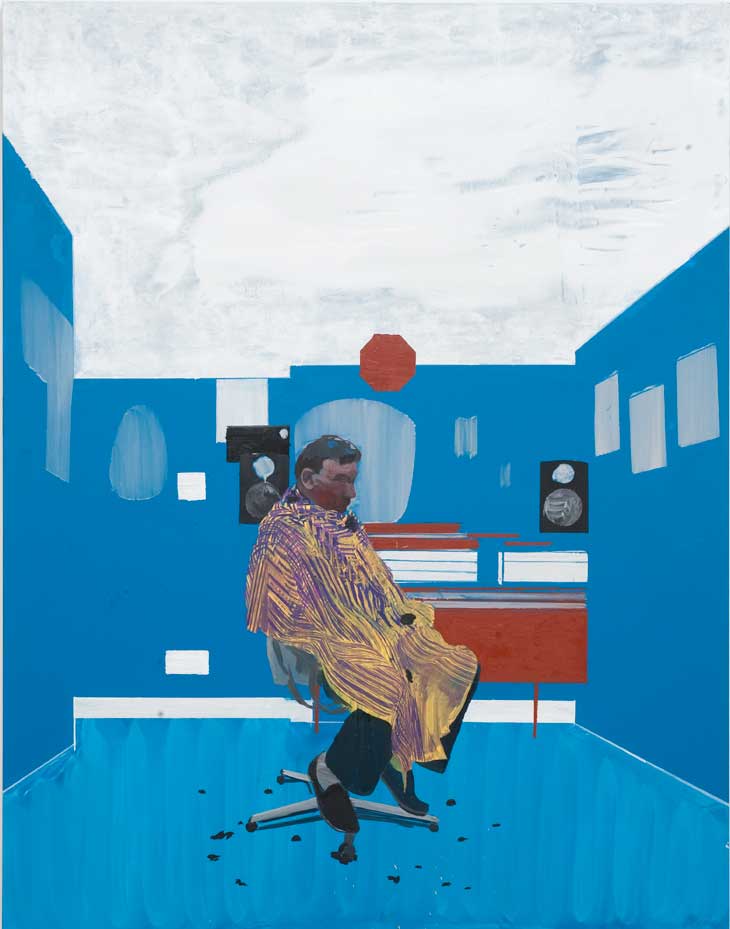
More recently Anderson has extended his investigation to barbershops and hair salons — spaces that represent a very different kind of belonging than the pools, a kind of belonging that is not in question. The barbershop in Black American and Black British life is a space of community care, conversation, humor, and solidarity, a space where being part of the community is not something you need to prove but something that is simply given. It is the opposite, in this sense, of the country club pool: a space of unconditional rather than conditional belonging, a space where admission is not a question.
Anderson paints these spaces with the same technical seriousness he brings to the pools — the same attention to light on surfaces, the same interest in reflection and refraction, mirrors now instead of water doing the reflecting — and the effect is one of homecoming rather than exclusion. The barbershop paintings are quieter than the pools, less charged with historical implication, and this quietness is itself an argument: this is what a space looks like when the question of who belongs has already been settled, when you can simply be present in a room without the ongoing low-level effort of asserting your right to be there.
The two bodies of work speak to each other in ways that make both richer. The pools raise the question of conditional belonging; the barbershops answer it by showing what unconditional belonging looks like, how it organizes a space and the people in it. Together they constitute a sustained investigation of what it means to belong to a place — what physical spaces look like when they include you and what they look like when they don't, what leisure feels like when it is freely available and what it looks like when it is a site of negotiation.
What the pool says that nothing else could
The question of why painting — why this specific medium, applied with patience and skill to a canvas, as opposed to a photograph, a film, a documentary project — is worth answering in Anderson's case, because the answer illuminates what he is doing. A photograph of a swimming pool carries the documentary weight of a specific moment, a specific place, an event that happened. Anderson's paintings are not documents. They are meditations: slowed-down, sustained acts of attention to a subject that painting allows you to inhabit in a way that the camera's instantaneous capture does not.
The time it takes to paint water — to find the exact blue, to render the specific quality of light on the surface, to make the tile pattern visible through the water at the right degree of distortion — is time spent inside the subject. Anderson has spent days or weeks with each pool, looking at it, thinking about it, making decisions about what it holds and what it yields. This sustained attention is itself a kind of argument: these places are worth this much time, this much careful looking. They are worth taking seriously as sites of beauty and as sites of history, as subjects that deserve the full resources of painting applied to them without apology or irony.
The politics of Anderson's pools — the histories of segregation and exclusion, the specific cruelties of the Windrush story, the ongoing question of who belongs where — are stated entirely through formal means. The title Audition does more political work than most activist art manages in a full installation. The empty pool does more work than most documentary photographs. Anderson has discovered, or confirmed, something important: that certain subjects carry so much history that the lightest touch is the strongest. The pool does not need to be argued with. It needs to be painted, accurately, at the right time of day, with the right light, empty of people who are not there and who should be. The absence says everything. The water goes on being beautiful. The painting holds both things at once, indefinitely, without resolving the tension between them. This is what painting can do that nothing else can.


