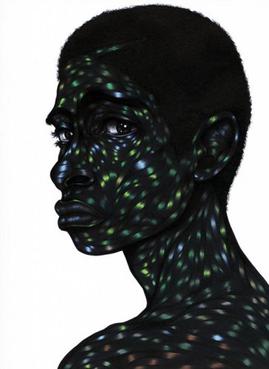
Stand close enough to a Toyin Ojih Odutola portrait — close enough that the subject's face fills your field of vision — and the face disappears. What you see instead is surface: thousands of individual marks laid down in charcoal and pastel and pencil, each one discrete, each one a tiny event of pressure and direction, the accumulation of them forming something that, from the right distance, reads unmistakably as skin. It is not a representation of skin, exactly. It is more like a landscape that has been organized, by means of extraordinary patience, into the appearance of skin. The terrain is real. The geology is audible, if you look long enough. Step back three feet and a person assembles herself out of the marks, fully present, commanding, looking back at you with the specific gravity that only comes from being rendered at such cost.
This dual experience — the marks close up, the face from a distance — is not incidental to Odutola's project. It is the project, stated in formal terms before a word of the work's narrative context has been absorbed. The person you are looking at was built, deliberately, from constituent parts that do not themselves resemble a person. The face is an emergent property of ten thousand decisions, none of which, in isolation, is the face. This is what Odutola does with the tradition of portraiture: she makes visible the labor that portraiture usually conceals, and in doing so she asks a question about what a face is and what it means to render one. Is a portrait a record of a person? Or is it a construction of a person — something made, assembled, imposed on a surface through the expenditure of enormous energy?
Nigeria, Alabama, and the navigation between
Odutola was born in 1986 in Ile-Ife, in Osun State, Nigeria — a city known as the cradle of Yoruba civilization, the place where, according to tradition, Oduduwa descended from the heavens on a chain to create the earth. She grew up in Huntsville, Alabama, where her family relocated when she was a child. Huntsville is a particular place: a small city that became significant through its connection to NASA and the space program, home to Marshall Space Flight Center, a place of technical ambition in the middle of the American South. For a Nigerian girl arriving in the late 1980s, it was also a place where the question of race — of what her body meant in the landscape she had been placed in — was immediate and legible.
She has spoken with considerable specificity about what it meant to grow up Nigerian in Alabama: navigating simultaneously the expectations of a Nigerian family (education, achievement, the particular gravity of immigrant striving) and the expectations of the American South, where Blackness carried its own set of histories and assumptions that her Yoruba identity did not simply translate. She was, in a structural sense, between worlds — between Yoruba and American, between African and African-American, between cultures that each had strong ideas about what she should be and neither of which quite matched what she was. This condition of navigating multiple sets of expectations without fully inhabiting any of them became, in her work, a subject without ever becoming a complaint. The figures she makes do not illustrate this experience. They embody it in their very construction: assembled from constituent parts, legible as one thing from a distance, complex and irreducible up close.
She studied at the University of California, Santa Barbara, where she began developing the technical approach — the density of marks, the attention to surface — that would define her mature work. The early pieces used ballpoint pen and marker: extraordinarily labor-intensive, the individual lines almost invisible but overwhelming in aggregate. She worked small, the scale of the paper and the scale of the mark in a tension that forced the density of attention that would remain a constant even as the format grew larger and the materials shifted toward charcoal and pastel.
"Portraiture is world-building. Every face implies a history, a society, a set of forces that made this person possible."
— Toyin Ojih OdutolaThe early work: pen, ink, and the architecture of a mark
Lonely Chambers (T.O.), made in 2011, belongs to the body of work Odutola produced with ballpoint pen and marker during her years of establishing the method. The T.O. in the title suggests autobiography — these are her initials — but the figure is displaced into something fictional, a person who shares a relationship with the artist but is not the artist, a portrait that is both self and not-self. This displacement, present from the beginning, would become one of the defining features of her practice: the use of the first person not as confession but as a structural position, a way of being inside the work without being identical to it.
The ballpoint-pen works are astonishing in a way that photographs do not fully capture. The line is extremely fine — the width of a ballpoint tip — and the marks accumulate in densities that, up close, read almost as texture, as if the surface of the paper has been physically altered by the pressure of the drawing. Which it has, in a way: hundreds of passes of pen over the same area change the paper's surface character, leaving a trace that is partly visual and partly haptic. The skin of the figures in these works has this quality of having been worked until it becomes something other than paper — a kind of secondary surface generated by the accumulation of marks, a drawing of skin that is itself a kind of skin.
What Odutola understood early, and what made the pen-and-ink method so productive for her, is that the labor of mark-making is not merely technical preparation for a finished image. The labor is the content. When you look at a work that has taken this long to make, at this density of individual decisions, you are aware of time — of the hours and days that the surface accumulates. This awareness changes your relationship to the figure you are looking at. A portrait of a person rendered in an afternoon feels different from a portrait that has taken weeks of sustained attention. The second portrait is made heavier by its own making, weighted by the time spent on it. And this weight — this record of extended attention — reads as a kind of care, a kind of devotion, that conventional portraiture rarely achieves.
Representatives of State: portraiture as world-building
By the mid-2010s, Odutola had shifted her primary materials to charcoal, pastel, and pencil, working at larger scale, and had begun developing the practice of creating elaborate fictional narratives for her subjects. The 2016 work Representatives of State — large charcoal and pastel drawings showing figures who appear to inhabit a specific invented world — marked a decisive move in this direction. The people in these works are not portraits of actual individuals. They are portraits of invented individuals who exist within a coherent fictional society, one that has its own hierarchies and histories and relationships. The figures carry themselves with the specific weight of people who belong somewhere, who have social positions and backstories and relationships to each other that the viewer can sense without being told.
This move toward fictional narrative was not a retreat from portraiture. It was an extension of what Odutola understood portraiture to be. If a portrait represents a person, and a person is inseparable from the society that made them possible, then to portray a person is already to imply a world. Her innovation was to make that implication explicit — to build the world deliberately, to give it specific rules and aesthetics and social arrangements, and then to populate it with figures whose faces carry the traces of that world's history. Every face implies a history, as she has put it. She decided to make that history visible.
The effect, in the large charcoal works, is uncanny in the best sense: the figures feel real, feel known, feel like people you should recognize, even as you understand that they are invented. This is partly because Odutola renders them with the same density of attention she brought to the pen-and-ink works — the surfaces are built up to the same extraordinary depth, each face a landscape of marks that has required weeks of sustained work. But it is also because the figures have the specificity of real people: the particular way one holds her head, the exact quality of attention in another's gaze, the specific social relationship between two figures sharing a frame. These are not generic types. They are individuals who happen not to exist.
A Countervailing Theory: the portrait as chapter
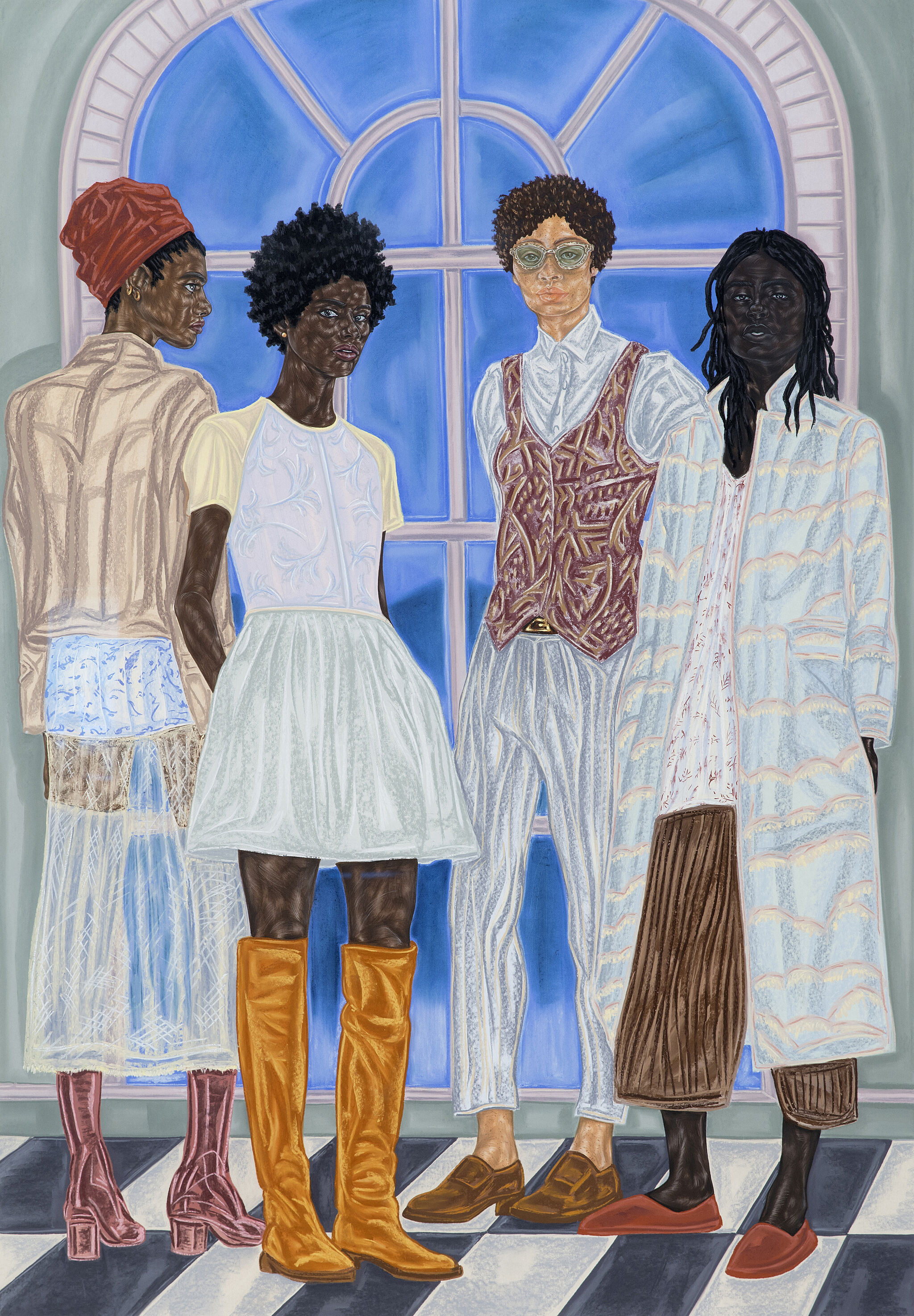
The major exhibition A Countervailing Theory, presented at Jack Shainman Gallery, took the world-building project to its full scale. The show presented a complete fictional narrative — two noble families, their relationships, their social arrangements, their visual codes of dress and posture and proximity — as a set of large charcoal and pastel works that had to be experienced sequentially, as chapters in a story. No single work in the exhibition was fully legible without the context of the others. The portraits required each other. You needed to see one figure in relation to another to understand what the first face was carrying, what it was holding back, what it was declaring.
This is an unusual demand to make of portrait drawings, which conventionally function as autonomous objects — each one self-contained, each one capable of communicating independently. Odutola refused this autonomy deliberately. Her figures live in relation to each other, and to remove them from those relationships is to misread them. The exhibition format — the specific sequence of works, the story they told when experienced in order — was as much a part of the work as any individual drawing. She was making an argument about what portraiture can do when it stops pretending that the individual face is the whole story: it can render a society, a system of relationships, a world with its own internal logic. A novel told in charcoal and pastel.
The fictional families in A Countervailing Theory are Black. Their world — the one Odutola has built for them — is one in which Blackness is not the context of struggle but the context of privilege, of wealth, of social complexity. This is an unusual thing to portray, and it was clearly intentional. By placing her invented figures in a world of aristocracy and leisure and social negotiation — a world usually associated, in Western visual art, with whiteness — Odutola was not making an argument about aspiration or escape. She was making an argument about portraiture's historical relationship to power: about who has historically been considered worthy of the kind of sustained, serious, labor-intensive attention she brings to every face.
"The skin of her subjects is rendered as topography — dense, textured, almost architectural. It is not a representation of skin; it is a landscape built from marks that accumulate into the appearance of skin."
— On Toyin Ojih OdutolaSkin as landscape
One of the things that distinguishes Odutola from other portrait artists working in her generation is her treatment of skin — which is to say, her refusal to treat skin as a surface to be represented and her insistence on treating it as a terrain to be built. The distinction matters. When you represent a surface, you describe what it looks like. When you build a terrain, you create an experience of it — its texture, its depth, its history of having been formed by forces that operated over time. Odutola's faces are not descriptions of what dark skin looks like in a particular light. They are landscapes that happen to be organized into the features of a face.
This is why the work reads differently close up and at distance — why the geological reality of the marks is visible only when you approach, and the face assembles only when you step back. Odutola is doing something that resembles what a topographic map does: recording a terrain at a level of detail that exceeds what the eye perceives from any practical distance, making visible the structure beneath the surface appearance. Her faces have this quality of revealed structure — the marks record something about the nature of the skin that a photograph, however high-resolution, would not capture, because a photograph represents the surface and Odutola builds it.
The implications for race and representation are significant and have been much discussed, though Odutola's own comments on the subject are typically more precise than the critical conversation around her. She is not simply "celebrating" dark skin, not illustrating its beauty in ways that would merely invert the historical hierarchies of Western portraiture. She is doing something technically specific: she is refusing the single light source that defines most Western portrait tradition (where skin is illuminated from one direction and read as a single tonal field) and replacing it with an approach that distributes light across the surface, making every part of the face equally legible, equally present, equally demanding of attention. The whole face matters. Every part of the terrain has been visited.
What she adds to drawing
The question of where Odutola sits in the history of drawing — and portraiture, and narrative art — is one that critics have circled without fully landing. She is clearly in conversation with the tradition of the Old Master drawing, with the idea that charcoal and pencil on paper can carry the full weight of a sustained artistic intelligence. She is also in conversation with the tradition of the illustrated novel, with the way narrative image-making can generate a world that prose alone cannot. And she is in conversation with the tradition of Black portraiture — with the specific history of who has been rendered, by whom, at what level of care and attention — that runs from the formal portraits of nineteenth-century free Black Americans through Kehinde Wiley and beyond.
What she adds to all of these traditions simultaneously is the insistence on the face as a made thing, built from individual decisions rather than captured from life. Her subjects do not exist. But the portraits of them are among the most specific, most attentive, most labor-intensive records of a face that contemporary art has produced. This is the paradox at the center of her practice: the more fictional the subject, the more real the portrait. By inventing her figures rather than copying them from life or photographs, she is free to make every decision about them — free to build the world they inhabit, the history their faces carry, the relationship between one face and another. The portrait becomes purely what it always pretended to be: not a record of something that was there, but a construction of something that now exists because it was made.
This is what Odutola has given portraiture: the honest version of itself. Every portrait is an invention. Every face on canvas or paper is built, not found. She has simply removed the pretense — the model, the life source, the claim to correspondence with reality — and replaced it with the more demanding and more honest claim that she has made these people, entirely, out of marks. Ten thousand marks, accumulated over weeks of sustained attention, assembled into a face that looks back at you with the gravity of someone who has always been here. The intimacy of that face is entirely real. The person behind it is entirely hers.