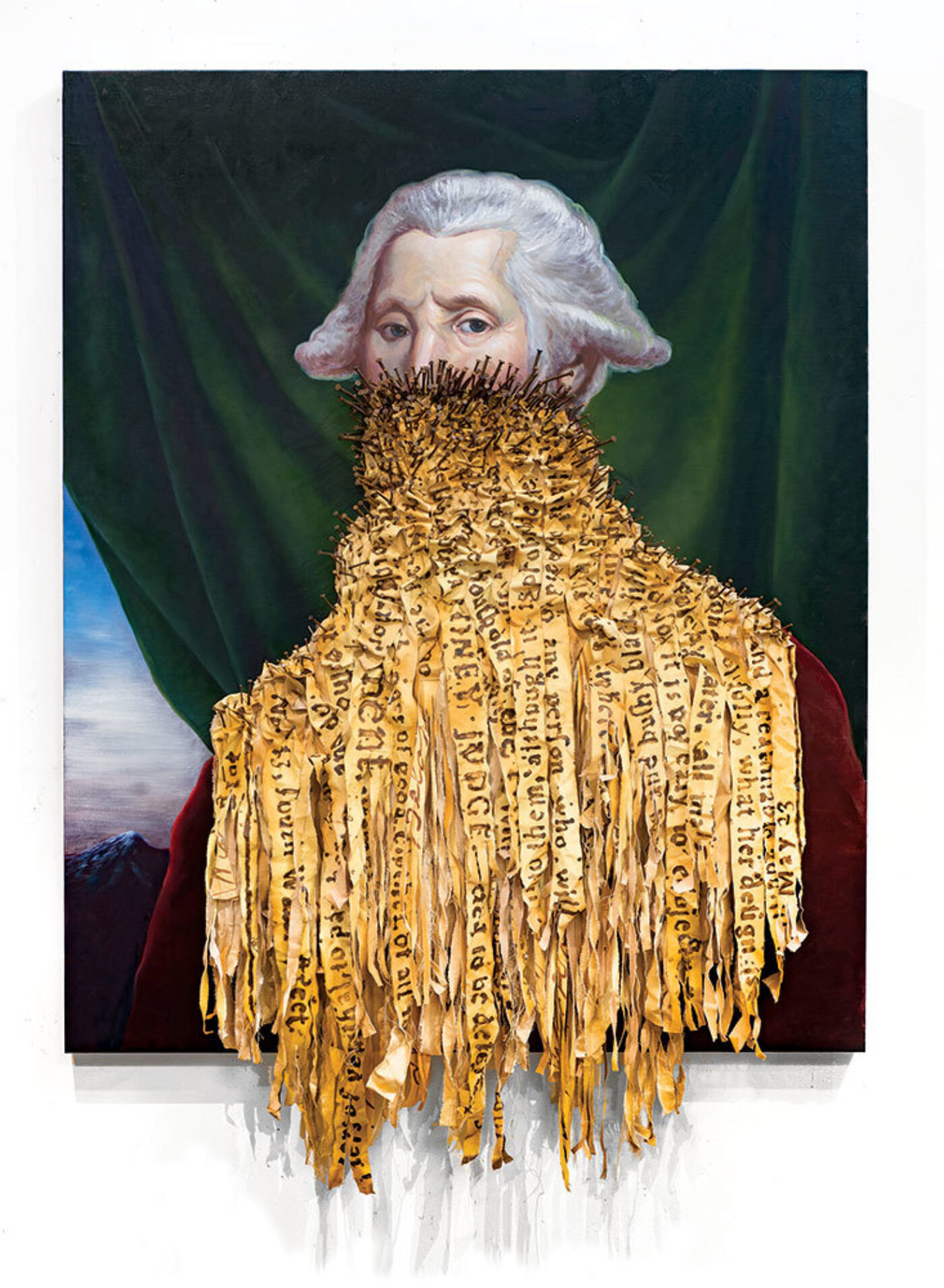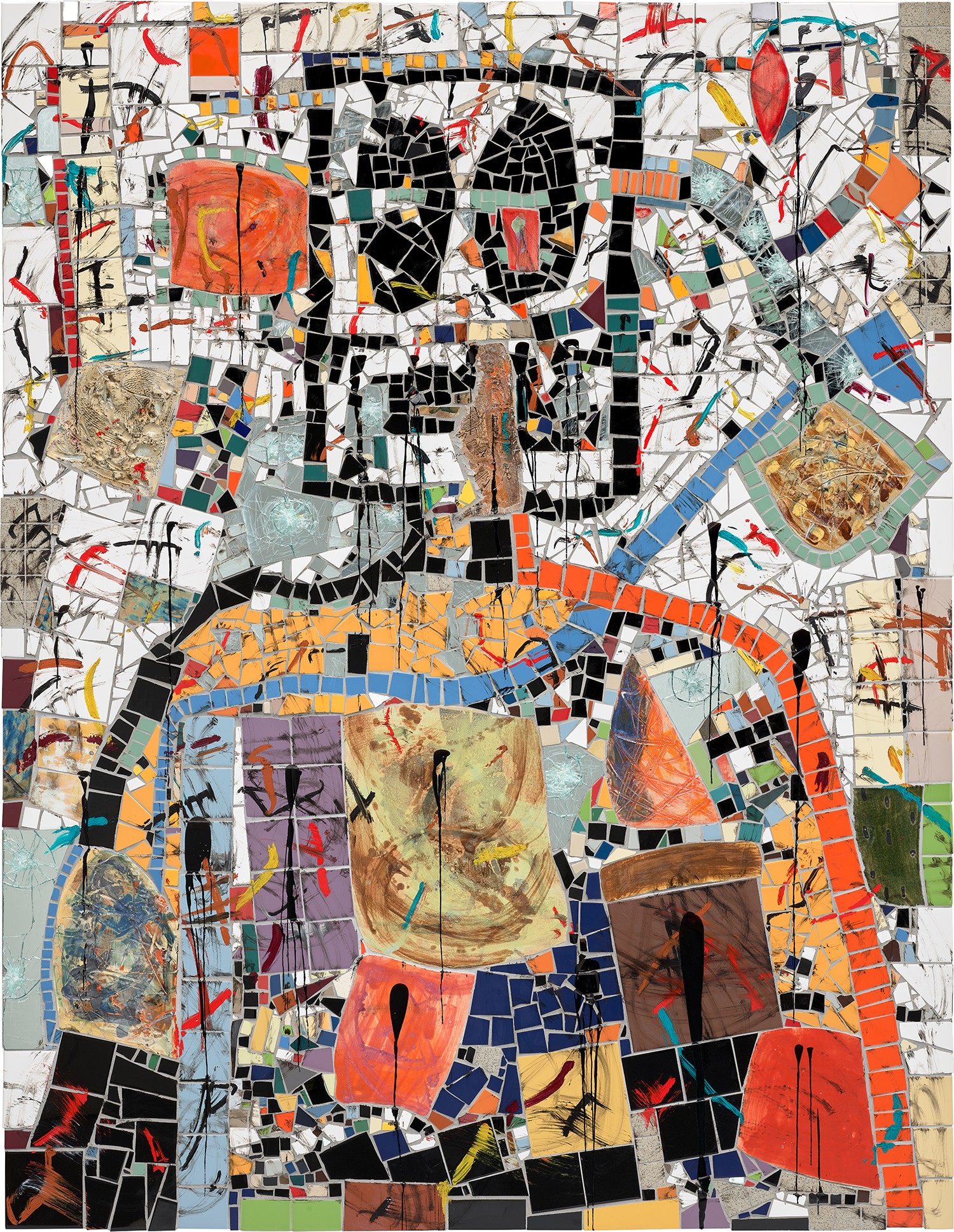
You walk into a large Rashid Johnson installation and the first thing that happens is you see yourself. The mirror tiles — small, irregular, grouted into the steel grid that forms the structure — return your image to you in fragments, a dozen or a hundred small versions of your face appearing and disappearing as you move. Then you notice the books: stacked or arranged on shelves built into the structure, their spines reading Amiri Baraka, James Baldwin, Sun Ra's collected writings, Toni Morrison, a library of Black intellectual and creative life organized into a wall. Then the plants — tropical, living, growing — their tendrils reaching out of the structure into the air of the gallery. Then the shea butter, dense and waxy, worked into the surfaces. Then the black soap. Then, sometimes, the faces scratched into tiles: distorted, anxious, barely human, the marks carved through the surface into something that is trying to be a face and cannot quite hold together.
The cumulative effect of all this — the mirrors, the books, the plants, the soap, the anxiety — is not quite like any other experience in contemporary art. Johnson's large works function like environments, like rooms that have been organized around a set of specific materials and the histories those materials carry. You are inside a library that is also a cosmology that is also a self-portrait that is also a record of a culture's survival. You cannot stand outside the work and look at it. It has already included you — you are in the mirrors, you are surrounded by the plants, you are part of the installation in a way that Johnson has clearly planned and that you cannot prevent. The anxiety the work names is not abstract. You feel it.
Chicago and the materials of the everyday
Johnson was born in Chicago in 1977 and grew up there during a period — the late 1970s through the 1980s — when the city was experiencing the full weight of what deindustrialization and disinvestment do to a place and its people. He studied at Columbia College Chicago and later at the School of the Art Institute of Chicago, which placed him inside two overlapping traditions: the first a documentary, socially engaged practice with roots in photography and journalism; the second a conceptually rigorous fine-arts tradition that took the history of abstraction and material culture seriously. Johnson absorbed both and synthesized them into something that doesn't belong entirely to either.
The materials he uses are specific and deliberate, and their specificity is the argument. Shea butter is a product used in the care of Black hair and skin — it appears in Black households across the African diaspora, from West Africa to Chicago's South Side. Black soap, also called African black soap, is a traditional West African cleansing product that entered the American market through Black beauty supply networks and became a common domestic object in many Black American homes. These are not exotic materials, not materials chosen for their visual interest. They are materials that Johnson handled as a child, that were present in the ordinary texture of his daily life, that carry the specific weight of the everyday without having been consecrated as significant by any prior art-historical designation.
This is the intervention: to take materials that are invisible to the art world — invisible because they are not marble or bronze or oil paint, invisible because they are associated with a domestic culture that the art world has not historically attended to — and to place them at the center of ambitious, large-scale work. The shea butter is not a metaphor for Blackness. It is a material with specific physical properties (waxy, dense, aromatic, slow to change) and specific cultural histories (West African trade networks, the diaspora's transportation of practices across the Atlantic, the Black beauty economy in America) that Johnson works with directly. The material is the content. You cannot separate the message from the substance.
"I'm interested in the materials that carry memory — the things we handle every day without noticing what they hold."
— Rashid JohnsonThe Anxious Men and what giving anxiety form accomplishes
The "Anxious Men" series — faces scratched or drawn into the tile-and-soap surfaces of Johnson's large works — began as an almost accidental discovery. Johnson was working into the wax and soap surfaces of his tile pieces, making marks, and the marks began to resolve into faces. Not representational portraits — nothing close to that — but distorted, barely-legible human features, the eyes wrong, the proportions compressed or stretched, the whole thing radiating a quality of distress that is hard to name precisely and impossible to miss. He recognized what was happening and pursued it, made the anxious face into a recurring figure, let it become a kind of signature and a kind of argument simultaneously.
The question of what it accomplishes to give anxiety form is one that Johnson has circled in interviews without quite settling. Art has always been a way of making inner states visible — of externalizing what the body holds — but Johnson's anxious faces are unusual in that they are not individualized, not portraits of a specific person's specific anxiety. They are almost generic: the human face at the limit of its composure, the features threatening to come apart under pressure. This is anxiety as a social condition, not a private one. The face in the tile is not Johnson's face, or not only his face. It is a face that the conditions of Black American life have produced, repeatedly, across many decades and many bodies. The "Anxious Men" are not self-portraits. They are portraits of a condition.
Making that condition visible — giving it a face, however distorted, however barely holding together — is an act with real consequences. There is a long tradition in Black American art of making the invisible visible, of insisting on the legibility of experiences that the dominant culture has refused to acknowledge. Johnson's anxious faces participate in this tradition while refusing its most straightforward strategies. He is not painting a scene of injustice or making a documentary image. He is scratching a barely-human face into a surface made of soap and wax and tile, and letting the face's failure to cohere speak for itself. The anxiety does not need to be explained. You can see it in the marks.
The Shelves as architecture of a life
The "Shelves" works are among Johnson's most immediately striking: steel structures — sometimes freestanding, sometimes wall-mounted — holding books, plants, shea butter, personal objects, sometimes small video screens or ceramic pieces. They function simultaneously as library, altar, display case, and self-portrait. The organization of the shelves is deliberate but not rigid; the works have a quality of arranged rather than designed, as if someone has been accumulating objects over time and has placed them here in a configuration that makes sense to them, that reflects a set of priorities and affinities, without having been planned from the beginning as an aesthetic system.
The books are load-bearing in every sense. Johnson fills his shelves with works by Black writers — Baldwin and Baraka are constants — but also with texts on philosophy, cosmology, jazz, politics, African history, and the specific intellectual traditions that have shaped Black American thought. A shelf of books is always already a kind of autobiography: it records the mind that read them, the curiosities that were pursued, the conversations that were joined. Johnson's shelves make this autobiographical dimension explicit and then expand it: the books are surrounded by the shea butter and the plants, the materials of the body alongside the materials of the intellect, the physical daily life alongside the intellectual one. The shelf is a complete portrait of a life organized around a set of specific materials and a set of specific ideas.
The plants deserve particular attention. Johnson has described his use of living plants in the shelves and installations as a way of introducing time into the work — of making something that changes as it lives, that requires care, that has a relationship to the conditions of its environment. A bronze sculpture does not need watering. A plant does. The living material in Johnson's work introduces an element of dependency, of ongoing attention, of care as a necessary condition of the work's existence, that challenges the assumption of the art object as a completed thing. The plant is part of the work only as long as it is alive. Its aliveness is part of the work's meaning.
"His 'Anxious Men' series gives a social condition a face — the human form at the limit of its composure, threatening to come apart under pressure that has no single source."
— On Rashid JohnsonThe Bruise Paintings and what the move to paint means
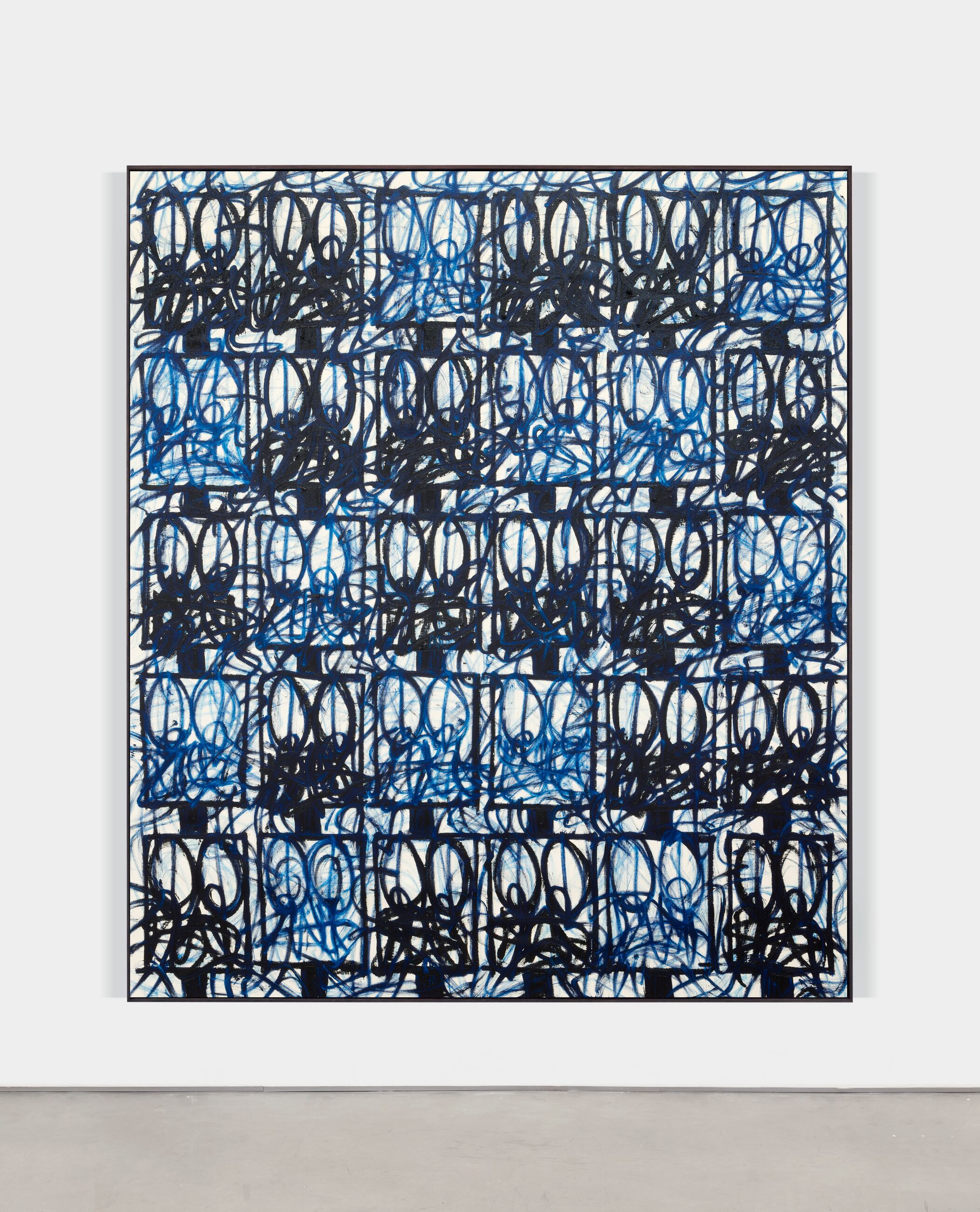
The "Bruise Painting" series, begun in 2023, marks a significant development in Johnson's practice: a move toward oil paint on linen, toward something rawer and more direct than the carefully composed material structures of his tile and shelf works. The paintings are large, their surfaces worked through repeated application — built up, worked into, the pigment accumulating in ways that echo the building of surfaces in his material works but feel more immediate, more bodily, more directly connected to the physicality of making. The title names the condition: these are surfaces that have been subjected to repeated force, that show the evidence of that force in their coloration and texture. A bruise is both a wound and a document of how the wound was received.
The move to paint has been read as a return — Johnson working his way back toward the dominant medium of Western art history, claiming a place in that tradition that his material-based work had complicated or complicated the terms of. But this reading misses something. The "Bruise Paintings" are not paintings that have put aside the concerns of the material works. They are paintings that have absorbed those concerns and expressed them through a different medium. The surfaces are built up with the same attention to accumulation, the same interest in the history that materials carry, the same awareness of what it means to apply force repeatedly to a surface over time. Paint, applied at this scale and with this urgency, is not a neutral medium. It is a material that carries the weight of its application, that records the decisions made during the making, that shows you the bruises of its own production.
Sun Ra and the cosmological ambition
Johnson cites Sun Ra — the bandleader, philosopher, and cosmic mythologist who built an entire alternative cosmology as a response to the conditions of Black life in America — as a primary influence, and the citation is illuminating in ways that go beyond the obvious (Black artist citing Black musician, both engaged with themes of identity and survival). What Sun Ra did was build a world: a complete alternative reality, with its own history, its own mythology, its own aesthetic codes, its own account of where Black people came from and where they might go. He claimed to be from Saturn. He wore elaborate costumes that combined ancient Egyptian iconography with science fiction. He led a large ensemble — the Arkestra — through compositions that moved between swing, free jazz, electronic music, and something that had no established name. He did all of this as a way of refusing to accept the terms that the actual world had set for Black existence.
Johnson shares this impulse. His practice is not, at root, a practice of documentation or critique, though it contains both. It is a practice of world-building — of assembling, from the materials at hand, an alternative cosmology that is both a record of what the existing world contains and an argument for what it could be organized differently into. The books on his shelves are not just records of Black intellectual history; they are the foundation documents of an alternate world, one in which those ideas and those writers are central rather than marginal. The shea butter and the black soap are not just materials of daily life; they are the elemental substances of this world, its most basic building blocks, the equivalent of marble and bronze in the hierarchies that Johnson is rewriting.
This cosmological ambition — the desire to make, from existing materials, a complete alternative to the world as it presents itself — is what makes Johnson's practice genuinely ambitious in the largest sense. He is not commenting on the existing order. He is building another one, piece by piece, shelf by shelf, tile by tile, painting by painting, from whatever is at hand. The anxiety in the works is real — the faces scratched into the tiles are not performing distress, they are made of it. But the beauty is equally real, and it is the beauty of a world that has been deliberately made, assembled with enormous care and intelligence from materials that were not supposed to count. They count now. Johnson made sure of it.